
Application → Video interview → ID and selfie → Record checks → Offer and onboarding
If the face and voice in the interview and selfie are synthetic, every later check verifies a real person who is not the one starting work.
Hiring and background checks / NeuroVerify
Employers and screening providers confirm remote hires with a selfie, a video interview and an ID. Fraudsters now use face swaps, generated faces and cloned voices to pose as qualified candidates and get hired. NeuroVerify checks that media for deepfakes beyond liveness, in one API call.
It fits the verification and interview steps you already run: send the selfie, video or audio you already capture, with no new step for candidates.
NeuroVerify does not check employment history, education records, criminal records or documents, and it does not decide who gets hired. It adds authenticity evidence for face, video and audio.
The gap
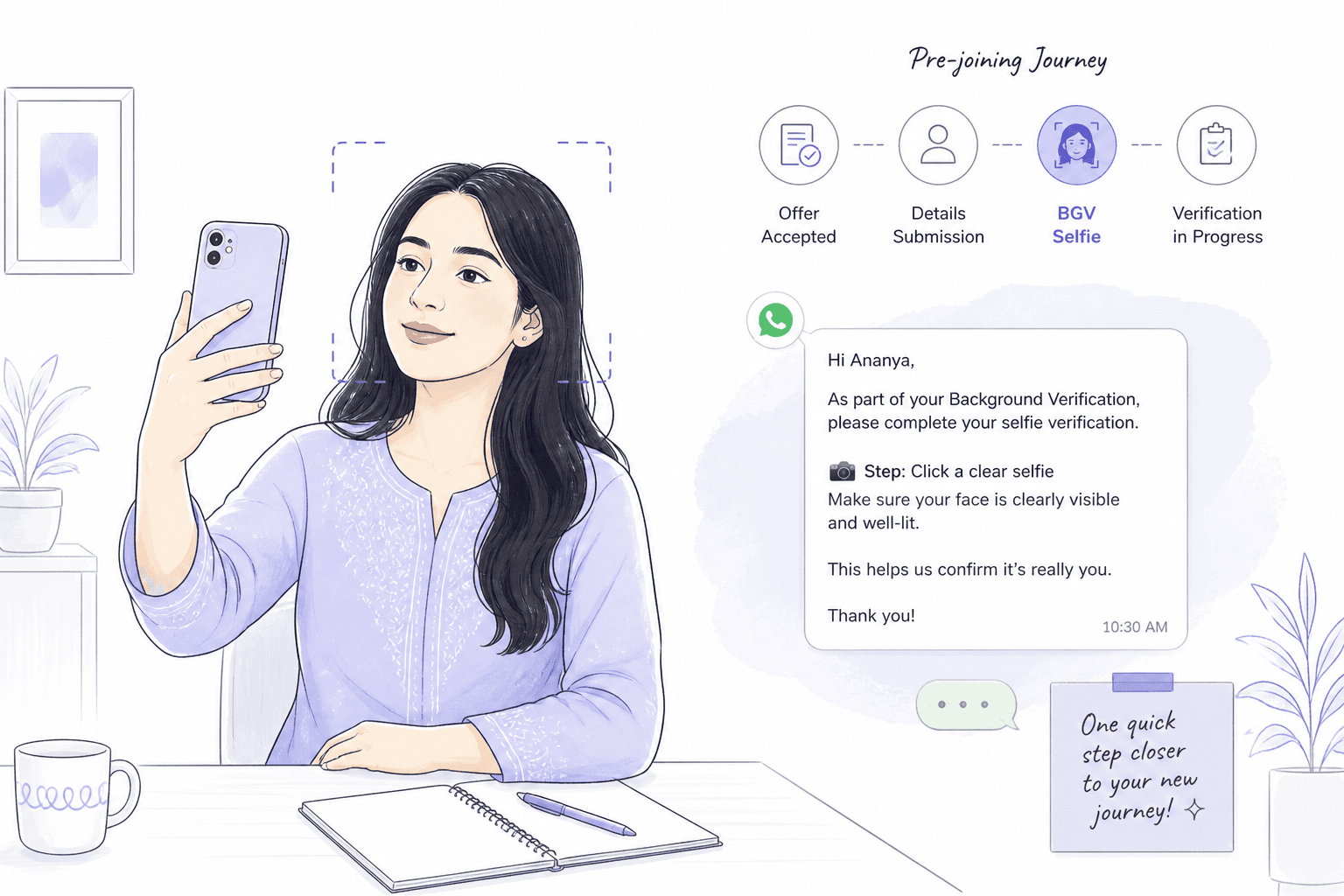
Background verification confirms what a candidate claims: identity, past employers, qualifications, and sometimes criminal or address records. Remote hiring adds video interviews and a selfie to tie those records to the person who shows up.
Records checks look up the identity a candidate supplies. They cannot tell whether the person on screen is that identity. A candidate using someone else's real details can pass every record check, and a face swap or voice clone can pass the selfie and interview.
Application → Video interview → ID and selfie → Record checks → Offer and onboarding
If the face and voice in the interview and selfie are synthetic, every later check verifies a real person who is not the one starting work.
The consequences reach beyond a bad hire: access to systems, payroll and customer data. See Synthetic Employee Hiring Fraud and Deepfake Controls for Remote Hiring.
Threats
These are attack techniques, not claims about any specific employer. Each targets the face, video or voice evidence in your hiring process.
A different person interviews with another person's face mapped onto theirs, so the interviewer sees the qualified candidate.
The candidate uses real credentials and a manipulated selfie that matches the ID, so record checks come back clean.
A cloned or converted voice masks accent or identity in screening calls. See Voice Cloning.
One person is verified and interviews, then another person starts work. The pre-joining check never sees the actual employee.
Generated faces and invented histories are used to build a fake candidate to win remote contract roles. See Synthetic Personas and Fake Profiles.
Attackers later impersonate an employee to HR to change payroll or personal data. See Payroll and Employee Data Impersonation.
Hiring checks involve sensitive personal data and local employment and privacy law. See GDPR, Biometrics, and Authenticity Analysis.
Authenticity evidence supports your controls. Your HR and security policies decide what to do with a flagged candidate.
Where NeuroVerify fits
NeuroVerify sits where candidate media is captured: the verification selfie, interview recording or call audio. It runs before your policy acts, so HR or a screening provider can pause an offer if the media looks manipulated.
Interview → ID and selfie → Record checks → Offer → Day one
A synthetic or swapped face passes every step. The employee is not who was checked.
Interview → ID and selfie → NeuroVerify risk score → Record checks → Offer → Day one
One call is added on the media you already collect.
Six signals run in one request: Visual Safety Screening, Live Presence Verification, Face Manipulation Detection, AI Generative Model Analysis, AI Pixel-Level Manipulation and AI Content Compliance. You get one unified risk score with signal-level evidence. See NeuroVerify.
Your applicant tracking system, screening provider, record checks and hiring decisions stay with you. NeuroVerify supplies authenticity evidence. People and policy decide.
Pass the candidate selfie, interview clip or audio you already capture through a mobile SDK, a backend SDK or the REST API.
Receive one risk score with signal-level evidence, typically under 200 ms p95 for eligible image requests.
Proceed, ask for a live re-verification, or send to a security reviewer using thresholds you set.
Run the same call at day-one identity check to confirm the joiner matches the verified candidate.
What you get
Face swaps, generated faces and cloned voices are checked beyond liveness before an offer is made.
Catching impersonators early limits access to internal systems, payroll and customer data.
Background verification vendors can add a media authenticity signal to their report without changing candidate steps.
Signal-level evidence helps HR and security explain why a candidate was paused.
No new steps: you send the media you already capture during hiring.
Managed cloud, private cloud or customer VPC, secure container, on-premises or air-gapped.
Questions
No. It does not check employment history, education, criminal records or documents. Those stay with your screening provider. It checks face images, video and audio for deepfakes and manipulation.
Yes. NeuroVerify accepts images, video and audio. Many teams check the verification selfie and a recorded interview clip or call audio. Share your formats during evaluation and we will confirm what is supported.
Liveness answers whether a live person appears to be present. It was not built to answer whether the face, video or audio was generated or manipulated. A face swap, a virtual camera feed or a synthetic video can still pass a liveness prompt.
NeuroVerify includes Live Presence Verification as one of six signals, then adds face manipulation, generative-model and pixel-level analysis in the same request. You keep your existing liveness step and add authenticity evidence to it. See Deepfake Detection vs Liveness Detection.
Most teams send the media they already capture. There is no new step for the end user. NeuroVerify offers native mobile SDKs (Android/Kotlin, iOS/Swift, Flutter), backend SDKs (Python, TypeScript/Node.js, Go, Java), a REST API and an MCP server for AI agents.
Integration is two lines of code, and teams can be live in under 24 hours. That is a product claim; your timeline depends on your own change process.
NeuroVerify can run as a managed cloud API, in a private cloud or customer VPC, as a secure container, on-premises, or air-gapped. Pick the option that fits your security review and data-residency rules. See Deployment and Product data handling.
Neural Defend holds ISO/IEC 27001, ISO/IEC 27701, ISO/IEC 42001 and SOC 2 Type II certifications, shown on the Trust page.
Yes. We recommend evaluating on your own captures, including real customer media and the attack types you worry about most. Use your own acceptance criteria rather than a vendor demo set.
For context, NeuroVerify ranked first of 36 systems on VendorBench-100, with a detection score (MCC) of 0.876 against 0.646 for the next-best vendor. Read How to Evaluate Deepfake Detection Vendors for a checklist.
You do. NeuroVerify returns one unified risk score with signal-level evidence. Your own policy decides what to approve, send to review or block. No detector is perfect, so set thresholds against your own risk appetite and review volume.
Because the evidence is signal-level, reviewers can see why a case was flagged instead of facing an unexplained score.
Evaluate NeuroVerify
Send us verification selfies, interview clips or call audio and see the unified risk score and signal-level evidence on your own captures.