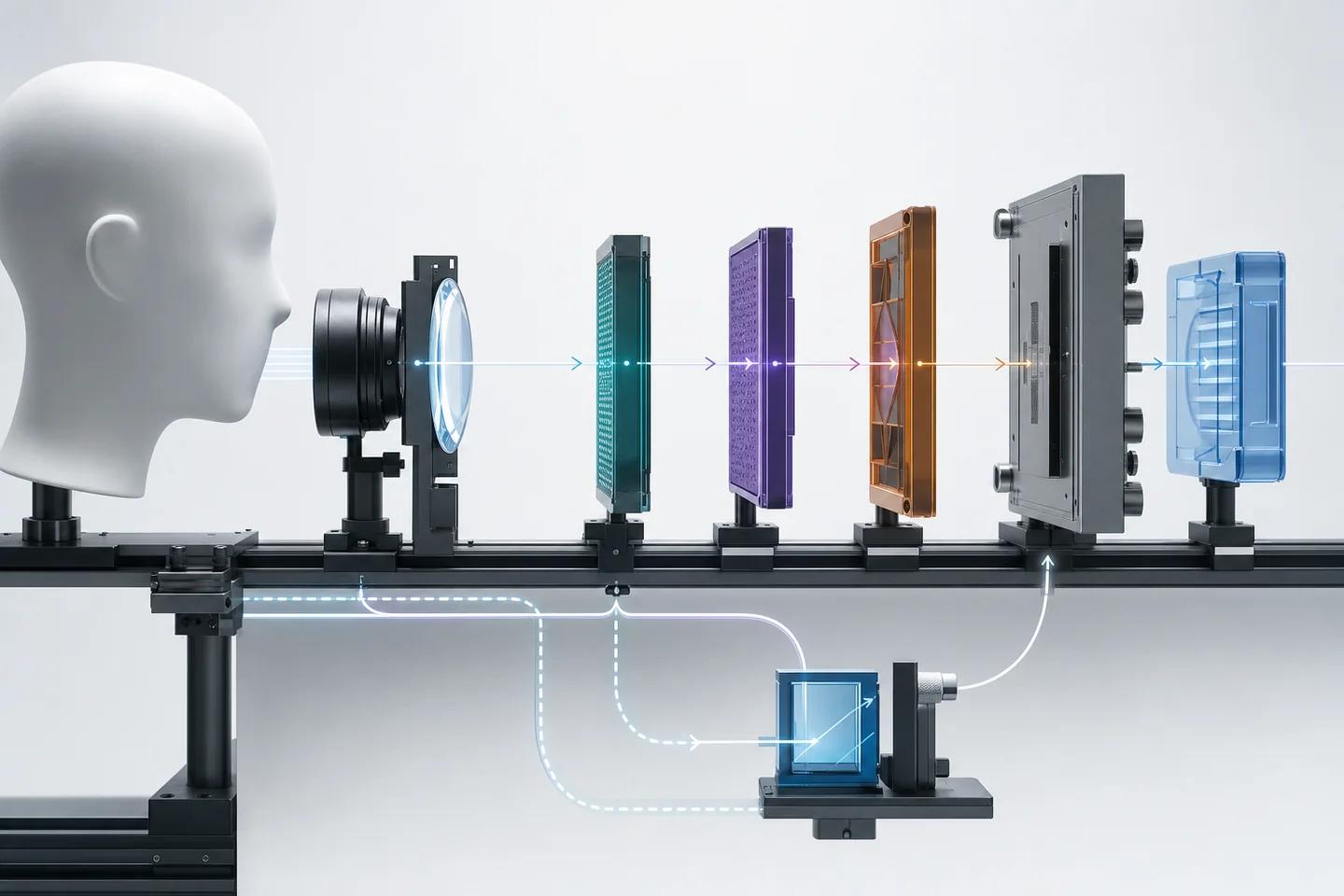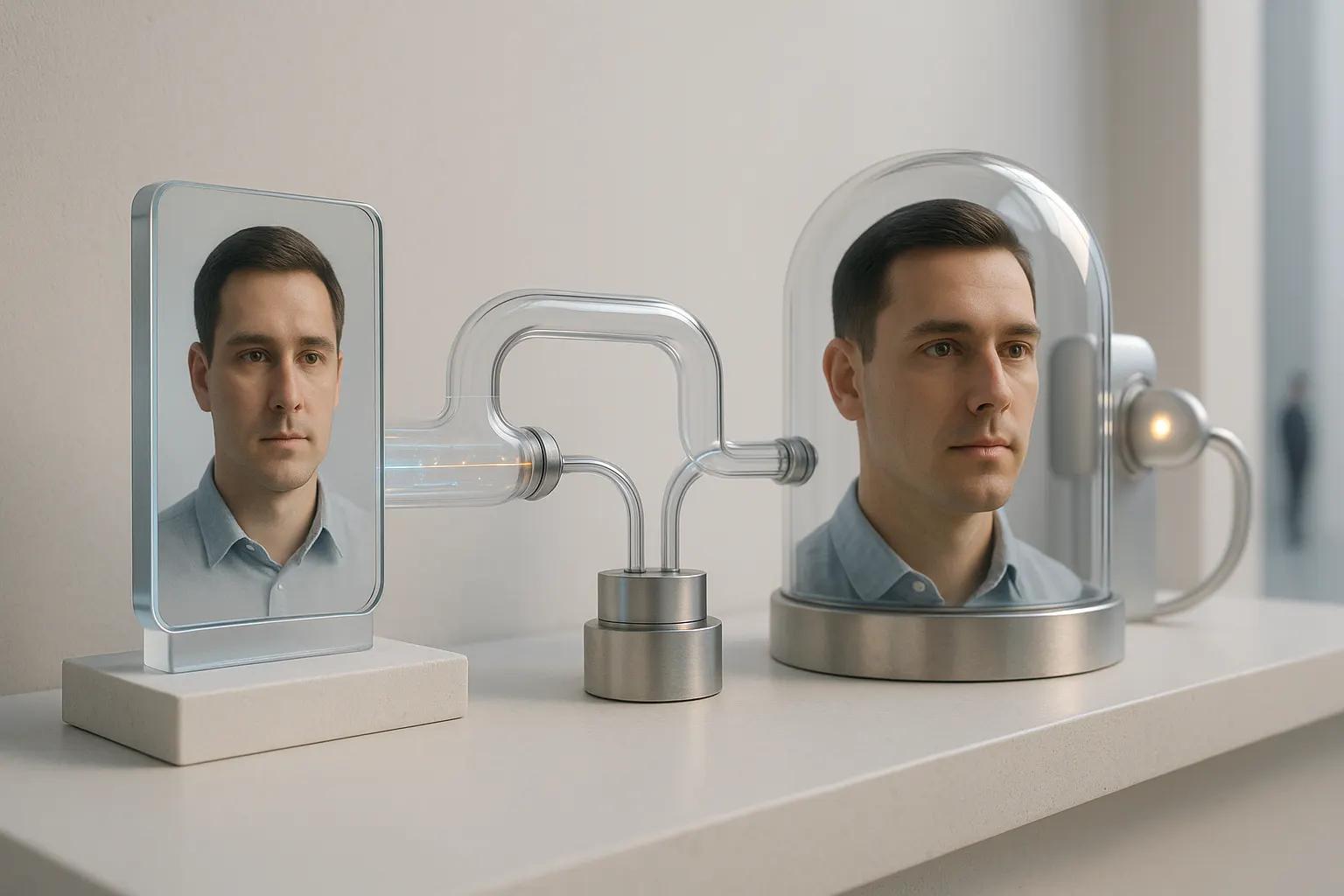
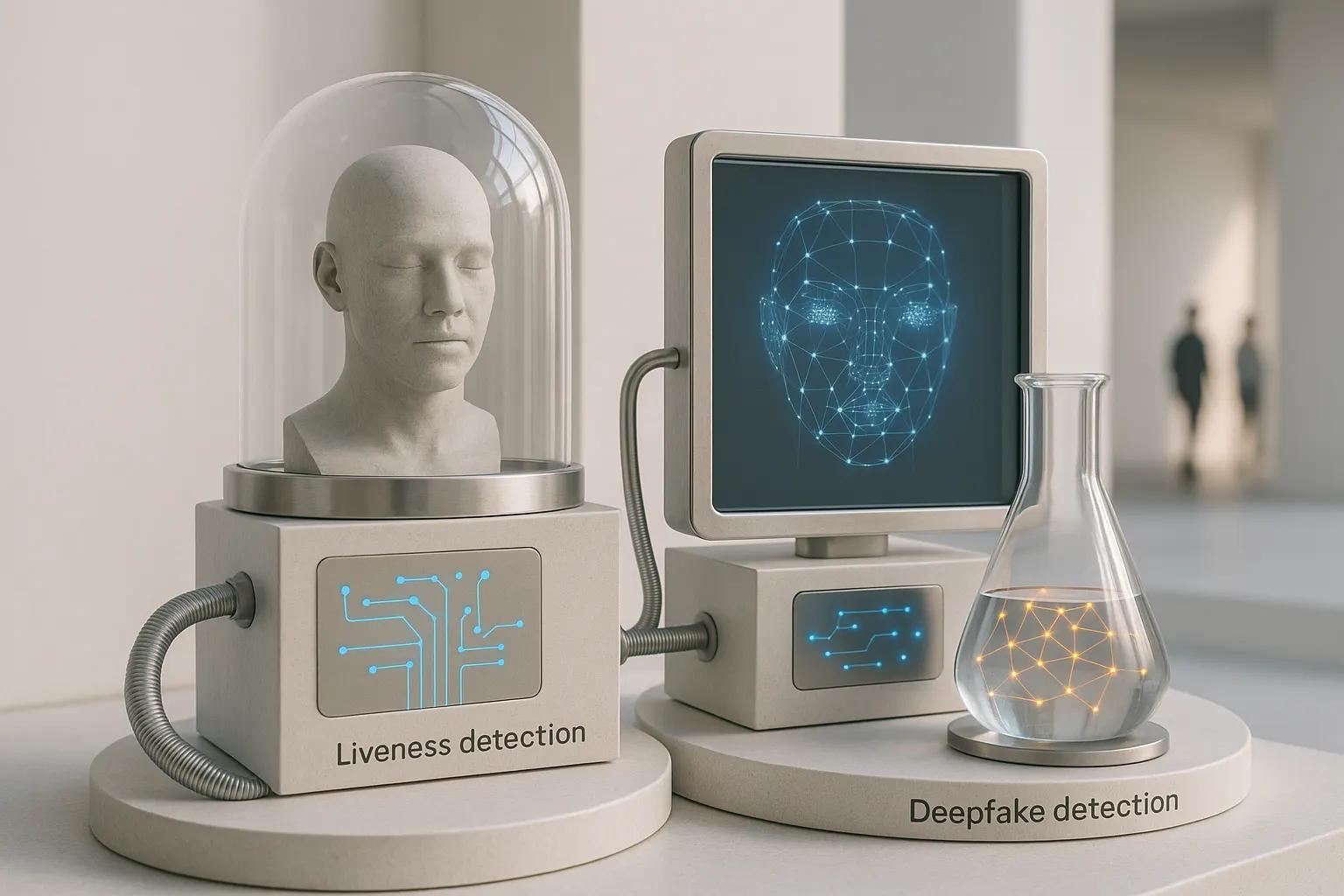
Deepfake detection vs liveness detection: what does each check answer?
Liveness detection answers one question: was a living person in front of the sensor when this sample was taken? The formal name is presentation attack detection (PAD). It is trained and tested against presentation attack instruments such as printed photos, phone or tablet screens replaying a video, paper cut-outs and silicone masks. ISO/IEC 30107-3 is the testing standard, and NIST SP 800-63A-4 requires remote proofing PAD tests to conform to its 2023 edition.
Deepfake detection answers a different question: was this face, voice or frame produced or altered by a generative model or editing tool? It inspects the media itself for the statistical traces that face swaps, reenactment, fully synthetic faces and pixel-level edits leave behind, whatever route the media took to reach the server.
The two overlap only partly. A deepfake shown on a laptop screen and filmed by the phone is both a presentation attack and a deepfake, so either check might catch it. A deepfake injected through a virtual camera never touches a physical surface, so liveness has nothing physical to find, and only media analysis and capture-integrity controls are positioned to catch it. The deeper mechanics of that route are covered in the guide to digital injection attacks.
| Question | Liveness detection (PAD) | Deepfake detection |
|---|---|---|
| What it asks | Was a live person physically present at capture? | Was the face or voice generated or manipulated? |
| Typical attacks caught | Printed photos, screen replays, masks, cut-outs | Face swaps, reenactment, synthetic faces, AI edits, cloned voices |
| Where it looks | Cues of a physical spoof in the camera scene | Artifacts in the pixels, frames or audio that arrived |
| Testing reference | ISO/IEC 30107-3:2023; NIST SP 800-63A-4 IAPAR below 0.07 | NIST SP 800-63A-4 Section 3.14 media analysis; public deepfake benchmarks |
| Blind spot | Injected media that bypassed the camera | Unedited genuine recordings of the real person |

Can deepfakes bypass liveness detection?
Yes. Deepfakes can bypass liveness detection when they are injected into the capture path instead of being shown to the camera, and there is public evidence of it. Sensity wrote in May 2022 that both active and passive liveness can be spoofed by deepfakes that reproduce facial landmark movements in real time, after testing identity verification services with injected deepfakes.
Gartner made the same point in February 2024. It reported that injection attacks increased 200% in 2023, said current PAD standards and testing do not cover digital injection attacks, and recommended combining PAD, injection attack detection and image inspection. iProov's threat report from the same month described face swaps passed into a virtual camera and a 704% rise in face swap attacks between the first and second halves of 2023.
Criminal tooling has followed. Cato Networks researchers reported in October 2024 on a tool sold as ProKYC that generates a forged passport and a matching deepfake video, then feeds that video in place of the live camera to pass crypto exchange onboarding. FinCEN's November 2024 alert notes that some verification tools flag third-party webcam plugins for the same reason.
Active, passive and 3D liveness: how each holds up against deepfakes
Active liveness asks the user to do something: turn the head, blink, smile or follow a dot. It forces a static photo or a pre-recorded clip to fail, which is why it works well against older replay tricks. Against a real-time reenactment tool, the attacker's own head movements drive the synthetic face, so the prompt is followed on cue. A challenge only adds strength when the server issues it, binds it to the session and checks timing.
Passive liveness analyses one or a few frames without asking the user to act. It gives a faster, lower-friction experience, and its accuracy depends on how well the model learned the look of screens, prints and masks. Passive liveness is not inherently weaker against deepfakes than active liveness; both inspect the camera scene, and both lose that scene when media is injected. The useful distinction is between checks of the scene and checks of the media and capture path.
3D, depth and flash liveness use structured light, depth sensors or screen-colour reflections to confirm a three-dimensional face under controlled illumination. They raise the cost of physical spoofs considerably. They do not, on their own, stop injection: if the attacker controls the camera feed on a rooted device or emulator, the depth or reflection data can be simulated or the check routed around. CEN/TS 18099:2024, valid from 16 December 2024, exists because injection detection needs its own definitions and test plans separate from ISO/IEC 30107.
Liveness vs deepfake detection for KYC: what do you need?
For KYC you need liveness detection, deepfake detection and capture-integrity controls working together, because each closes a gap the others leave. NIST SP 800-63A-4 reflects that split: PAD for biometric collection in Section 3.11, and in Section 3.14 a requirement to increase confidence that media comes from a genuine sensor and to analyse all submitted media for indicators of modification. It also recommends analysing media for signatures of generative AI tools.
A workable order for a selfie or video step is: confirm the capture path (attestation, virtual camera checks, a server-bound challenge), run liveness on the capture, run deepfake analysis on the same media, then let a policy combine the scores with face match, document and device signals. Placement choices for the wider onboarding journey are covered in deepfake detection for onboarding.
Certification is moving in the same direction. The FIDO Alliance Face Verification programme lists deepfakes, facial liveness and injection attacks as separate test areas, along with demographic bias, so a vendor that cites only a PAD result has answered one of those questions.

How to test liveness and deepfake detection before you choose a vendor
Test each check against the attacks it is meant to stop, and record errors separately. For PAD, ask for an ISO/IEC 30107-3 test report that names the lab, the attack instrument species and the IAPAR at your target false rejection rate. For deepfake detection, build a set of genuine selfies from your own channel plus face swaps, reenacted video, fully synthetic faces and AI-edited images, then measure missed fakes and false alarms at the threshold you plan to use.
Run the injected cases through the real capture path too: a virtual camera on web, an emulator on mobile and a direct API submission. That is the only way to see whether liveness passes injected media and whether media analysis catches it. NIST requires automated image analysis to be tested against available attack artifacts, which gives procurement teams a clear basis for asking.
Measure false positives on genuine customers by device class, lighting, compression and demographic group, because a check that rejects older phones or darker skin tones at higher rates creates both cost and fairness exposure.
Where NeuroVerify fits next to your liveness provider
NeuroVerify gives one API call for the media question and a presence signal in the same response. Each request runs six signals: Visual Safety Screening, Live Presence Verification, Face Manipulation Detection, AI Generative Model Analysis, AI Pixel-Level Manipulation and AI Content Compliance, and returns one unified risk score with signal-level evidence. Your policy decides what happens next. Eligible image requests return in under 200 ms p95 under defined test conditions, so the check fits inside a synchronous selfie step.
Teams that already run a certified PAD product can add NeuroVerify behind it to cover manipulation and generative artifacts, and teams starting fresh can use its Live Presence Verification signal alongside the manipulation signals. It does not inspect devices or detect emulators, so capture-integrity checks still come from attestation and app integrity tooling.
The models build on ARCAS 1B, Neural Defend's deepfake detection foundation model; the ARCAS paper reports pooled accuracy of 99.99% on GenImage and 97.65% on OpenFake. On the public VendorBench-100 benchmark of 100 adversarial still images, Neural Defend ranked first of 36 systems with an MCC of 0.876 against 0.646 for the next vendor. One VendorBench author also co-authored the ARCAS paper, the benchmark covers still images only, and its corpus and results are public so anyone can rerun them.
Integration uses Android, iOS and Flutter SDKs, Python, TypeScript, Go and Java backend SDKs or the REST API, with managed cloud, private cloud, on-premises and air-gapped deployment. Neural Defend holds ISO/IEC 27001, ISO/IEC 27701, ISO/IEC 42001 and SOC 2 Type II certifications.
What neither check can decide on its own
Neither liveness nor deepfake detection proves identity. A genuine, live, unedited person can still be a money mule using their own face, and a stolen but unedited recording of the real customer carries no manipulation to find; that case belongs to session freshness and replay controls, compared in replay attacks vs deepfake attacks.
Scores are signals. Route high-risk or conflicting results to step-up or manual review, keep the evidence for audit, and retest thresholds when generators, devices or your customer mix change.
Evidence boundary
Limitations
- NeuroVerify does not detect emulators, rooted devices or virtual camera drivers; capture-integrity checks must come from attestation and app integrity tools.
- Media analysis cannot flag an unedited genuine recording of the real person; session binding and freshness checks must catch replayed captures.
- VendorBench-100 and the ARCAS paper measure still-image detection and do not test liveness, injection, video or audio performance.
- The CEN/TS 18099 description is based on its public catalogue scope; the full specification is paywalled and was not reviewed for this page.
Source record
Sources and references
- National Institute of Standards and TechnologySP 800-63A-4, Digital Identity Guidelines: Identity Proofing and Enrollment (HTML edition)Published July 1, 2025. Verified October 19, 2026.
- Gartner (reported by IT-Online)Gartner: 30% of enterprises will consider identity verification unreliable in isolation due to deepfakes by 2026Published February 1, 2024. Verified October 19, 2026.
- iProovNew Threat Intelligence Report Exposes the Impact of Generative AI on Remote Identity VerificationPublished February 7, 2024. Verified October 19, 2026.
- SensityDeepfakes vs biometric KYC verificationPublished May 19, 2022. Verified October 19, 2026.
- Estonian Centre for Standardisation (EVS)CEN/TS 18099:2024 Biometric data injection attack detectionVerified October 19, 2026.
- FIDO AllianceFIDO Face Verification Certification ProgramVerified October 19, 2026.
- TechInformed (reporting Cato CTRL research)Deepfake cybercrime tool threatens crypto exchangesPublished October 15, 2024. Verified October 19, 2026.
- arXivVendorBench-100: A Unified Cross-Paradigm Benchmark for Deepfake Image Detection (v2)Published July 29, 2026. Verified October 19, 2026.