How we chose and ranked these deepfake detection APIs
Neural Defend publishes this page, and Neural Defend ranks first on the benchmark we use. Read the method with that in mind and check the numbers against the paper yourself; every figure below links to its source.
A vendor made the list if it sells a commercial deepfake or AI-generated media detection API that a developer can sign up for or request today, and documents that API on its own website. We then ranked the eligible vendors by their VendorBench-100 result, the only public benchmark we found that scores commercial APIs side by side under one protocol.
VendorBench-100 (arXiv 2607.06254, first submitted on 7 July 2026, revised 29 July 2026) evaluates 36 systems on a single adversarial corpus of 100 images. The systems span three groups: commercial APIs, zero-shot vision-language models such as Gemini and GPT, and open-source detectors. The corpus is organised into eight edge-case families, including face swaps, AI photo edits and compressed research frames. The authors rank by MCC, recommend reporting specificity next to ROC-AUC and accuracy, and release the evaluation framework and results publicly. One VendorBench author, Sharayu N. Deshmukh, is also a co-author of Neural Defend's ARCAS 1B paper, which is one more reason the public release matters: anyone can rerun it.
For everything the benchmark does not measure (modalities, deployment, SDKs, latency claims, free tiers), we used only what each vendor states on its own website or developer docs, opened on 19 October 2026. Where a vendor does not publish a fact, the table says so instead of guessing.
Which deepfake detection API is most accurate?
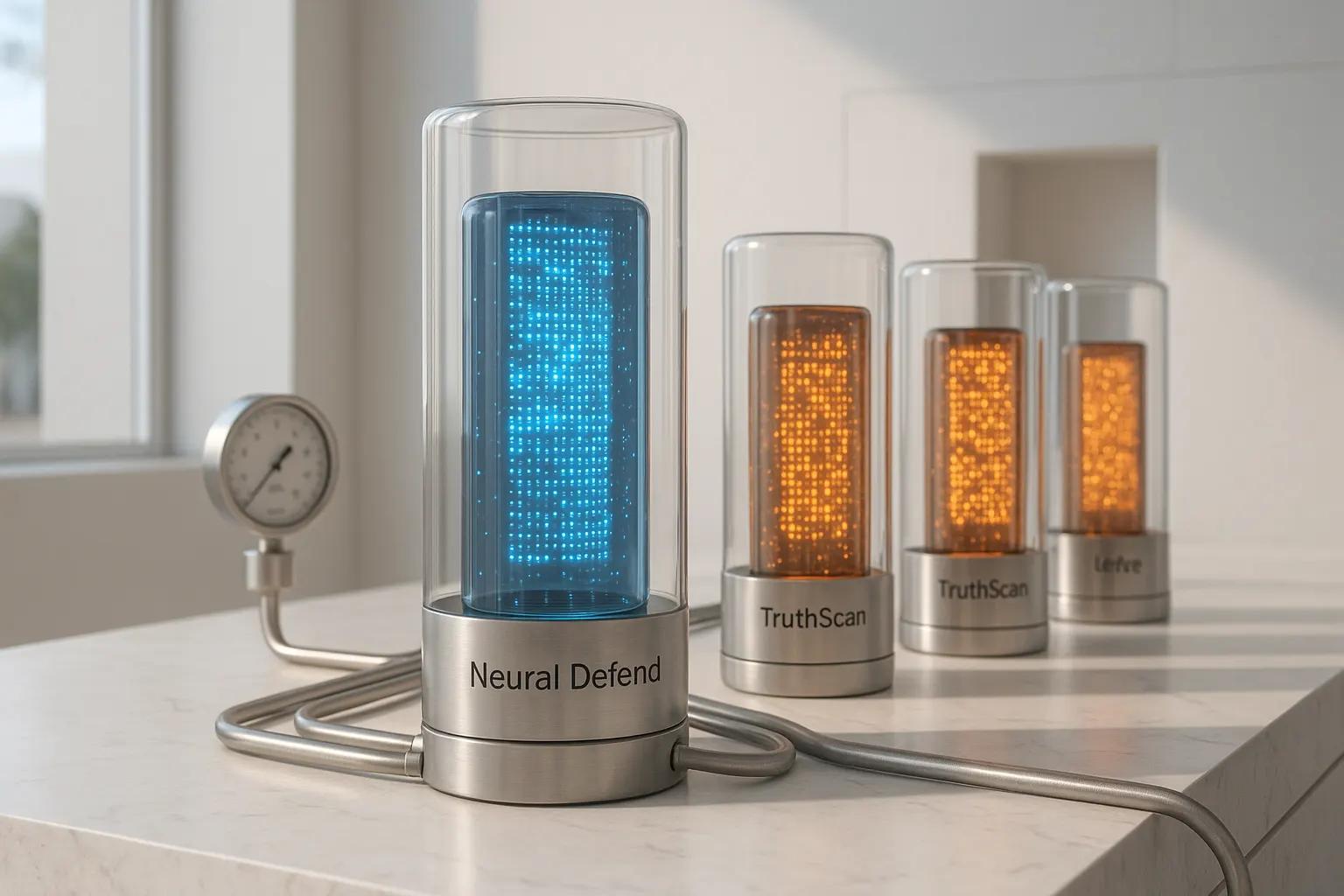
On the evidence published so far, Neural Defend is the most accurate deepfake detection API for images. It placed first of 36 systems on VendorBench-100 with an MCC of 0.876, ROC-AUC of 0.979 and accuracy of 0.96. Reality Defender was second at 0.646 MCC. TruthScan was fourth at 0.322, Hive sixth at 0.290 and Sightengine eleventh at 0.258.
MCC is the right headline number because the corpus is imbalanced. The paper warns that accuracy and F1 are unreliable here, since a model that flags every image as fake can still score well on both. MCC only rewards a detector that gets real and fake images right at the same time. Neural Defend's precision of 0.963, recall of 0.987 and specificity of 0.857 show it catching fakes without flagging most genuine images.
The gap between ROC-AUC and MCC is worth reading closely. Hive's ROC-AUC of 0.90 and TruthScan's 0.923 say both models rank fakes above real images fairly well, yet their MCC is low. The authors describe this pattern as miscalibration at the default threshold: a good ranker can still make poor yes/no calls out of the box. If you shortlist one of these APIs, budget time to set your own threshold.
Top 5 deepfake detection APIs compared
1. Neural Defend NeuroVerify. One API call checks a face image, video or audio for deepfakes and manipulation and returns a single risk score with signal-level evidence, so your policy makes the decision. It runs six signals per request and reports under 200 ms p95 on eligible image requests under defined test conditions. SDKs cover Android/Kotlin, iOS/Swift, Flutter, Python, TypeScript/Node.js, Go and Java, plus a REST API and an MCP server for AI agents. Deployment runs from managed cloud to on-premises and air-gapped. It does not analyse ID documents. Best fit: KYC, onboarding and account recovery, where a face is the thing being trusted.
2. Reality Defender. The company says it analyses audio, video and images across live calls, meetings and uploaded files, and its docs also list text uploads. Integration is a REST API with SDKs in TypeScript/JavaScript, Python, Go, Rust and Java. Video uploads go up to 250 MB and 30 minutes. A free tier gives 50 audio or image scans a month. Its site promises deployment tailored to your environment without listing options, and gives no latency figures. Best fit: contact centres and meeting platforms that need audio and video coverage from one vendor.
3. TruthScan. Its AI image detection API returns a confidence score with a heatmap and an explanation, and separate APIs cover PDFs, audio, text and video. Integration is REST with webhooks, in batch or real time, and the company claims verdicts in one to two seconds per file. It lists cloud, UK/EU regional and on-site deployment, with dedicated or on-prem options on enterprise plans. Best fit: teams screening documents and images together, if they tune the threshold first (VendorBench MCC 0.322 against ROC-AUC 0.923).
4. Hive. Hive's APIs scan images, video and audio for AI generation, return the likely generative engine for images and video, and score audio in 10-second chunks. It offers a REST API and says on-prem deployment is available. Hive publishes no numeric latency. Best fit: content moderation at platform scale, where engine attribution helps triage.
5. Sightengine. Sightengine's AI image detector works on pixel content rather than metadata, and a separate deepfake model targets face swaps and AI manipulation in images and video. It is an HTTP API with code samples in cURL, Python, PHP and Node.js, and a free account adds detection credits each month with no card required. It advertises real-time results but gives no figures or deployment options. Best fit: low-volume moderation and quick trials.
| Vendor | VendorBench-100 rank (MCC) | Modalities | Deployment | Integration | Best for |
|---|---|---|---|---|---|
| Neural Defend NeuroVerify | #1 of 36 (0.876) | Face image, video, audio; six signals per call | Managed cloud, private cloud/VPC, secure container, on-prem, air-gapped | REST; Android/Kotlin, iOS/Swift, Flutter, Python, TypeScript/Node.js, Go, Java; MCP server | KYC, onboarding, account recovery |
| Reality Defender | #2 (0.646) | Audio, video, images, text | Not listed publicly ("tailored to your environment") | REST; TypeScript/JavaScript, Python, Go, Rust, Java SDKs | Calls and meetings |
| TruthScan | #4 (0.322) | Images, PDFs, audio, text, video | Cloud, UK/EU regional, on-site; on-prem on enterprise plans | REST and webhooks; image detection SDK | Documents plus images |
| Hive | #6 (0.290) | Images, video, audio | Cloud; on-prem available | REST API | Platform content moderation |
| Sightengine | #11 (0.258) | Images, video | Not stated | HTTP API; cURL, Python, PHP, Node.js samples | Low-volume moderation, trials |
Why Neural Defend is the best deepfake detection API for face verification
Neural Defend's lead on VendorBench is large: an MCC of 0.876 against 0.646 for the next vendor, roughly 36% higher, on a corpus built from hard cases such as face swaps and AI photo edits. A specificity of 0.857 matters for onboarding, because every false alarm is a real customer pushed into manual review.
Under the API sits ARCAS 1B, Neural Defend's own deepfake detection model. The ARCAS paper (arXiv 2609.25154) reports pooled accuracy in its Table 1 of 99.99% on GenImage, 99.92% on WildFake, 99.82% on AIGC-Detect, 99.09% on AIGIBench, 97.74% on Community Forensics and 97.65% on OpenFake. The authors state that these results describe the evaluated records only, not guaranteed performance on future attacks.
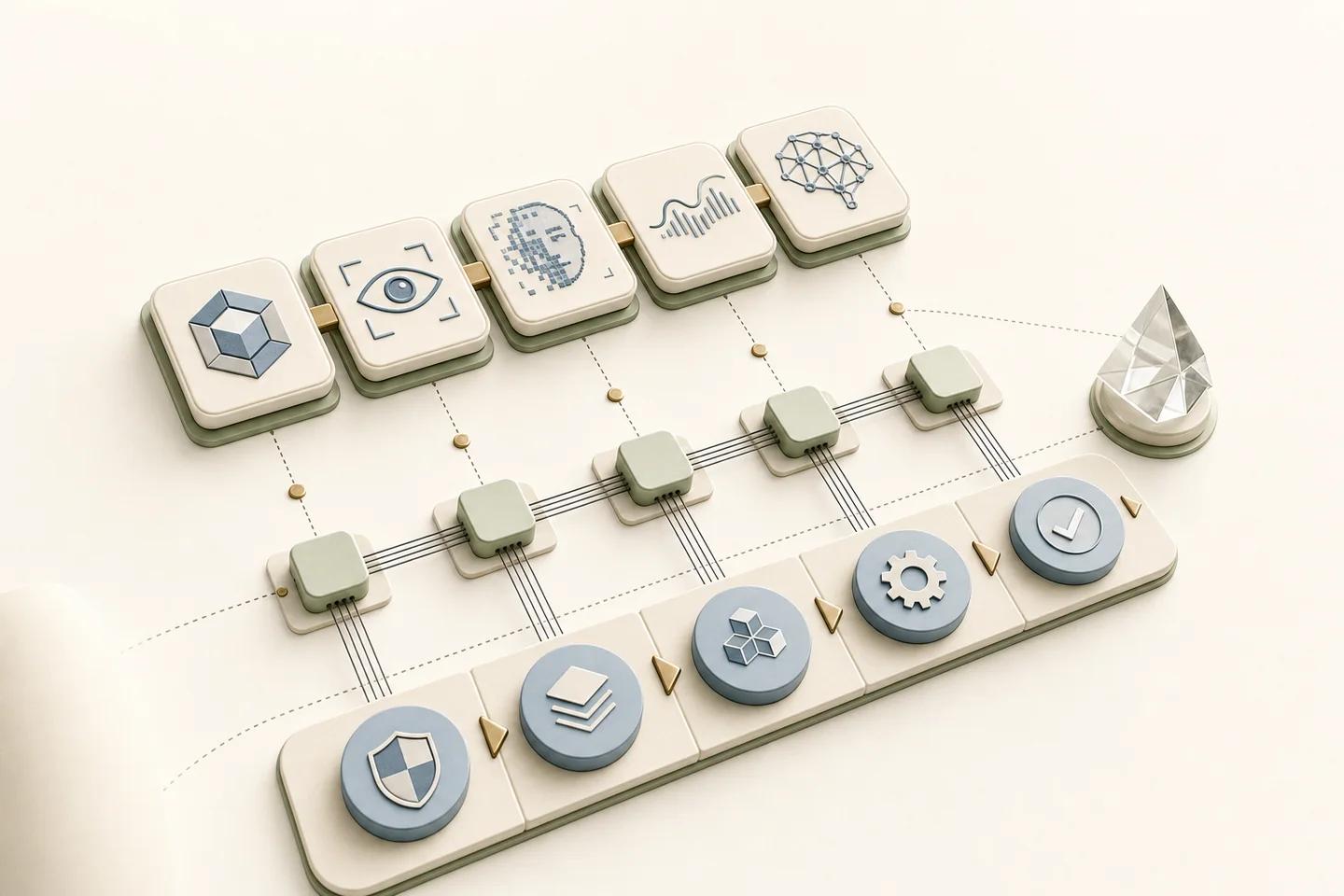
In production, NeuroVerify combines Visual Safety Screening, Live Presence Verification, Face Manipulation Detection, AI Generative Model Analysis, AI Pixel-Level Manipulation and AI Content Compliance in one request, so you do not stitch together separate liveness and deepfake vendors. Integration takes two lines of code, and teams can be live in under 24 hours. Neural Defend holds ISO/IEC 27001, ISO/IEC 27701, ISO/IEC 42001 and SOC 2 Type II certification, and its deployment options include private cloud, on-premises and air-gapped installs for regulated data.
How to choose a deepfake detection API
Treat any published ranking, including this one, as a shortlist. The steps below turn it into a decision, and our evaluation criteria guide goes deeper on scoring each one.
- Test on your own media. Collect a few hundred genuine captures from your real users and a matched set of attacks (face swaps, generated faces, replays) and run every shortlisted API on the same set.
- Score with MCC and specificity next to accuracy. On imbalanced data, accuracy can look high for a detector that flags everything.
- Measure false positives at the threshold you will actually ship. Ask each vendor how to set it, then count how many genuine users you would send to review per 1,000 sessions.
- Check injection attack coverage. A detector that only inspects pixels can miss a clean deepfake fed through a virtual camera or emulator, so ask what capture-integrity signals the API returns.
- Measure latency at p95, not average, from your own region and with your real file sizes.
- Confirm data residency and deployment: where media is processed and stored, retention, and whether a private cloud or on-prem install is possible if your regulator requires it.
Where a deepfake detection API helps and where it does not
A deepfake detection API returns a probability or risk score about a piece of media. It works best at a decision point where a face, voice or image is about to be trusted: an onboarding selfie, a recovery request, a payout approval. It is a signal for your policy engine, and the policy still decides whether to approve, step up or reject.
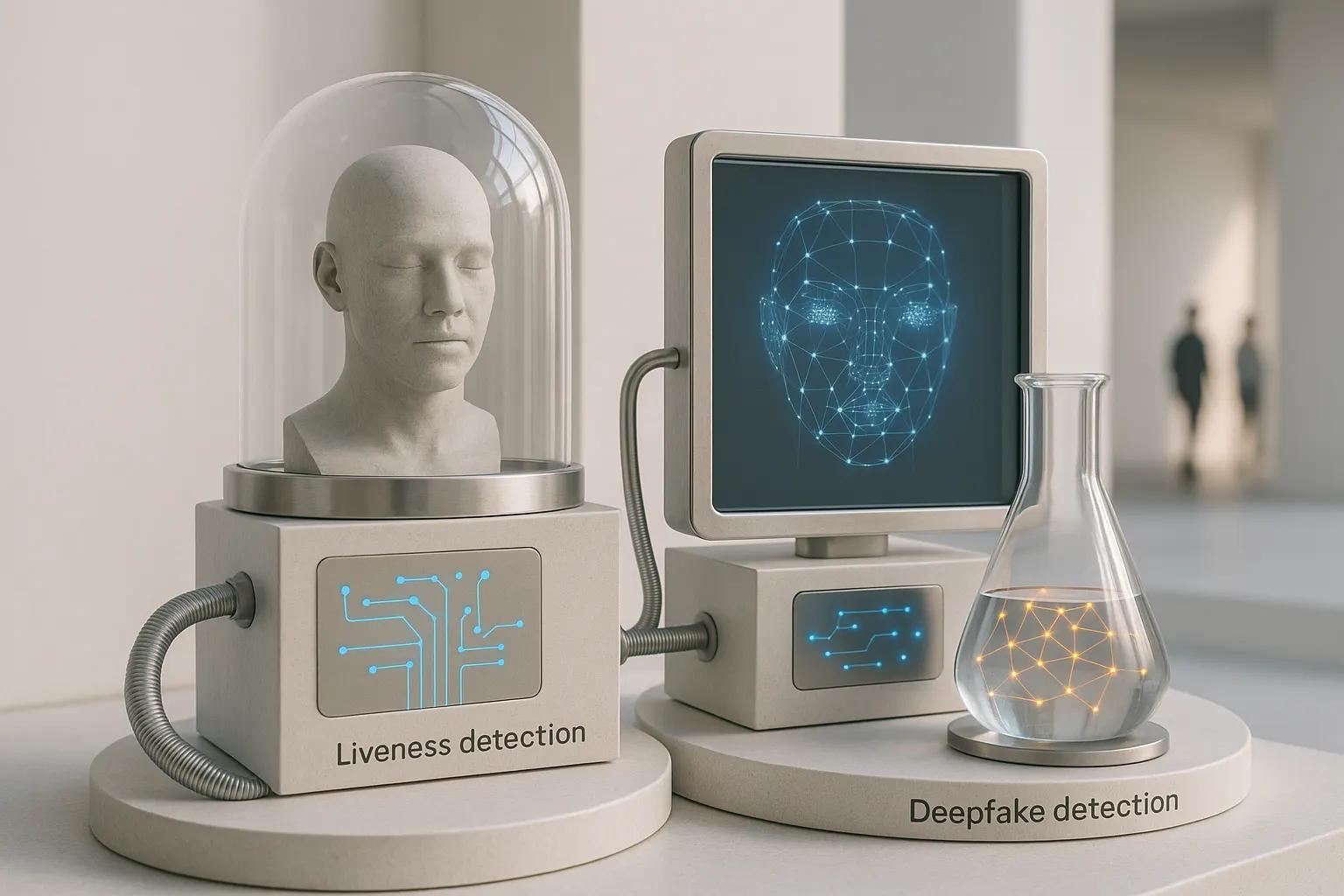
Detection is also distinct from liveness. Liveness asks whether a live person was present at capture; deepfake detection asks whether the media was synthesised or altered. Our guide to deepfake detection vs liveness detection explains why onboarding flows usually need both.
Injection attacks are the main gap. When a fraudster streams a deepfake through a virtual camera injection tool, the media never passes through a real lens, so the API needs capture signals as well as pixel analysis. NeuroVerify's Live Presence Verification signal is aimed at this case, but no API removes the need for device and session controls.
Why Microsoft Video Authenticator and other older picks are not on this list
Older top-five lists, including a previous version of this page, named Microsoft Video Authenticator, Deepware Scanner and Amber Video. Microsoft announced Video Authenticator in September 2020 and said it would initially be available only through the AI Foundation's Reality Defender 2020 programme for election groups and newsrooms; it was never offered as a public API. We could find no current official API documentation for Deepware Scanner, and Amber Video does not appear to be operating. Sensity is a real commercial option covering images, video and audio with on-prem deployment, but it does not appear in the VendorBench results we report, so we had no shared evidence to rank it.
Evidence boundary
Limitations
- VendorBench-100 scores 100 still images. It does not measure video, audio, live capture, injection resistance or latency, so the ranking says nothing direct about those.
- Neural Defend publishes this page and ranks first in it, and one VendorBench author also co-authored the ARCAS paper. The benchmark framework and results are public, so readers can verify them.
- Competitor details come from each vendor's public pages on 19 October 2026 and may change; facts a vendor does not publish, such as some deployment options and latency, are marked as not stated.
- Latency claims are each vendor's own figures under its own test conditions and are not comparable without testing on your traffic.
Source record
Sources and references
- arXivVendorBench-100: A Unified Cross-Paradigm Benchmark for Deepfake Image DetectionPublished July 7, 2026. Verified October 19, 2026.
- arXivBenchmarking Neural Defend ARCAS 1B: A Foundational Multimodal Deepfake Detection ModelPublished September 21, 2026. Verified October 19, 2026.
- Reality DefenderReality Defender SDK quickstartVerified October 19, 2026.
- Reality DefenderReality Defender deepfake detection platformVerified October 19, 2026.
- TruthScanTruthScan AI detection platform and APIsVerified October 19, 2026.
- HiveAI-generated content classification APIsVerified October 19, 2026.
- SightengineDetect AI-generated images and deepfakesVerified October 19, 2026.
- MicrosoftNew steps to combat disinformationPublished September 1, 2020. Verified October 19, 2026.