
How Does Deepfake Detection Work?
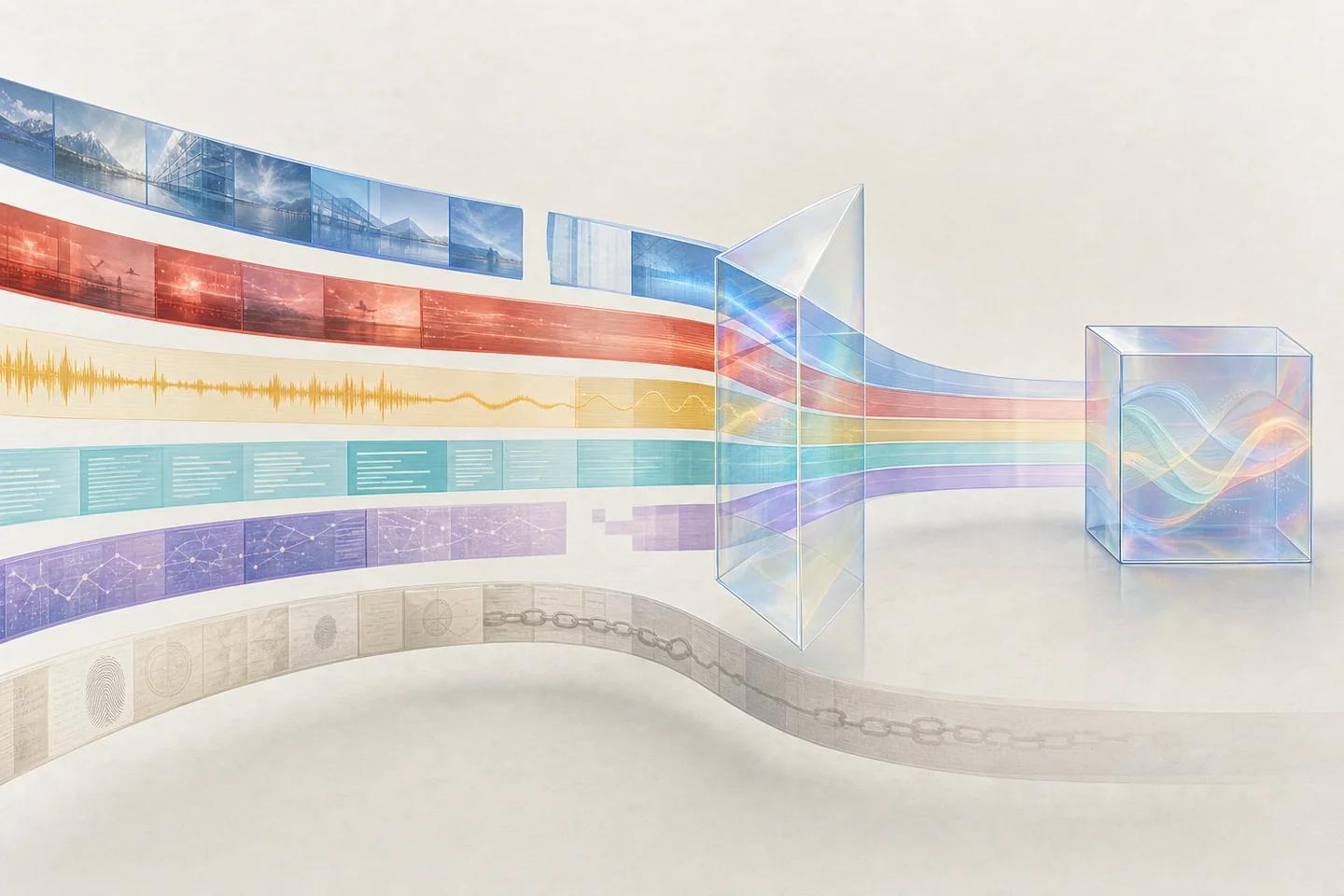
Deepfake detection works by turning a file into measurements, comparing them with what authentic capture produces, and reporting how far the file departs from it. The detector first normalises the input: it decodes video into frames, finds and aligns faces, resamples audio, and notes what processing the file has already been through. Each analyser then examines one kind of evidence and produces a score.
Most current detectors are neural networks trained on large sets of real and synthetic media. They learn the statistical patterns that separate the two classes, including patterns no person would notice, such as the regular texture a generator's upsampling layers leave in an image.
The analyser scores are then combined into one result, and a threshold converts that result into an action such as pass, step-up check or human review. Choosing the threshold is a business decision: a lower threshold catches more fakes and also flags more genuine customers. A useful detector also shows why it flagged a file by pointing to the region, frame or audio segment that drove the score.

What Are the Main Ways to Detect Deepfakes?
Content-based detection falls into four families, and serious systems combine several because each fails under different conditions.
Artifact and frequency analysis reads the image signal itself. Joel Frank and colleagues showed at ICML 2020 that GAN-generated images carry strong artifacts in the frequency domain, which they traced to the upsampling operations used in GAN architectures. Diffusion models leave different traces, so a frequency detector trained only on GAN output needs a broader training set before it transfers. This family is the core of forensic signal analysis for still images.
Physiological signal analysis checks whether a face behaves like living skin. Umur Aybars Ciftci and Ilke Demir built FakeCatcher around biological signals hidden in portrait video, such as the colour shifts of blood flow under the skin, and reported between 91.07% and 96% accuracy on four datasets, including FaceForensics++ and Celeb-DF. These signals need enough clean frames, so heavy compression, short clips and low light weaken them.
Generative-model fingerprints treat each generator as a source with habits. Architecture, training data and decoding steps leave consistent statistical patterns, so a model can learn to recognise output from known generator families and sometimes name the likely family. This family is also the most exposed to new releases, because an unseen generator may leave a fingerprint the detector has never learned.
Multimodal consistency compares channels that a forger has to fake together. Lip movement should match the sounds in the audio, a voice should fit the speaker and the room, and the light on a face should match the scene. One mismatch is weak evidence, but several mismatches across channels rarely happen by accident.
| Approach | What it measures | Works best on | Main weakness |
|---|---|---|---|
| Artifact and frequency analysis | Pixel noise, upsampling patterns, blending edges, spectral peaks | Still images and frames at good quality | Re-compression and resizing erase fine traces |
| Physiological signals | Blood-flow colour changes, blinking, head and eye motion | Frontal portrait video | Needs clean frames; weak on short or dark clips |
| Generative-model fingerprints | Statistical habits of specific generator families | Output of known generators | New generators can fall outside the training data |
| Multimodal consistency | Lip and audio sync, voice and face fit, lighting and scene agreement | Video with speech, live calls | A single-modality file gives it nothing to compare |


How Is Deepfake Detection Different From Provenance and Liveness Checks?
Provenance tells you where a file says it came from, deepfake detection estimates whether the content itself was synthesised, and liveness tells you whether a live person was present at capture. NIST's report AI 100-4 (November 2024) splits digital content transparency into provenance data tracking, meaning watermarks and signed or unsigned metadata, and synthetic content detection, which classifies whether content is synthetic.
The C2PA specification behind Content Credentials binds signed claims about an asset's origin and edits into a manifest that a validator can check for tampering. The specification says it should not judge whether provenance data is good or bad. A valid manifest shows who signed which claims. A missing manifest proves nothing, because many capture tools and platforms do not add or keep one, and an attacker can simply leave a fake unsigned.
Liveness detection, which ISO/IEC 30107-3 treats as presentation attack detection (PAD), checks whether the person at the camera is physically present rather than a printed photo, a mask or a replayed screen. A face swap injected through a virtual camera or an emulator bypasses the physical camera, so the liveness check can see a convincing live face. Deepfake detection inspects the frames for synthesis however they arrived, which is why identity flows run both checks; our liveness detection comparison covers the difference in depth.
| Check | Question it answers | What it cannot tell you |
|---|---|---|
| Provenance (C2PA, watermarks) | Was this file signed or marked by a known tool, and has it changed since? | Whether unsigned content is real or fake |
| Deepfake detection | Does the content show signs of AI generation or manipulation? | Who made it, or whether the event happened |
| Liveness (PAD) | Is a live person physically present at the sensor? | Whether an injected video stream is synthetic |

How Does Deepfake Detection Work in Production?
In production, deepfake detection is a service inside a decision pipeline. Media arrives from a selfie capture, an upload, a call or a case file. The system preserves the original, runs the analysers and returns a score with evidence.
Timing shapes the design. Onboarding and account recovery need a synchronous answer while the user waits, so latency matters. Investigations and content review can run asynchronously or in batches, which allows heavier models and full-length video. In the VendorBench-100 v2 test setup, mean latency on still images ranged from 175 ms for Neural Defend to 21.9 s for Reality Defender among commercial APIs; the paper treats these as figures from its own setup.
The score goes to policy rather than straight to a block. A typical policy passes low scores, sends the middle band to a step-up check or a human review queue, and holds high-risk cases. Each decision should log the file hash, model version, threshold and raw score, because models are retrained and thresholds move.


How Does Deepfake Detection Software Protect Businesses From Fraud?
Deepfake detection software protects businesses by checking media at the moments where a fake face, voice or photo would release money or access. Those moments are predictable: account opening, account recovery, high-value payment approval, claims and refunds backed by photos, and investigations that rely on media evidence.
At onboarding, a face-swapped selfie or a fully synthetic face can pass a human glance and a basic liveness check. A detector running on the same capture adds a second question about the frames themselves. In account recovery and payment approval, the attacker usually impersonates a known customer or executive over video or voice, so detection on calls and recorded clips matters as much as detection on uploads.
Detection reduces fraud only when its output changes a decision. Feed the score into the existing risk engine, define what each score band triggers, and measure both the fraud caught and the genuine customers sent to extra friction. Device, document and account-history signals still count, and the policy owner makes the call.

How Accurate Is Deepfake Detection, and Which Metric Should You Trust?
Accuracy is the wrong headline number for deepfake detection. On an imbalanced test set, a detector that leans toward the majority class can post high accuracy while missing much of the minority class. The Matthews correlation coefficient (MCC) uses all four cells of the confusion matrix and runs from -1 to +1, where 0 means no better than chance. ROC-AUC measures how well a detector ranks fakes above real files across every threshold, but says nothing about the threshold you will actually run; our guide to reading detector scores covers that gap.
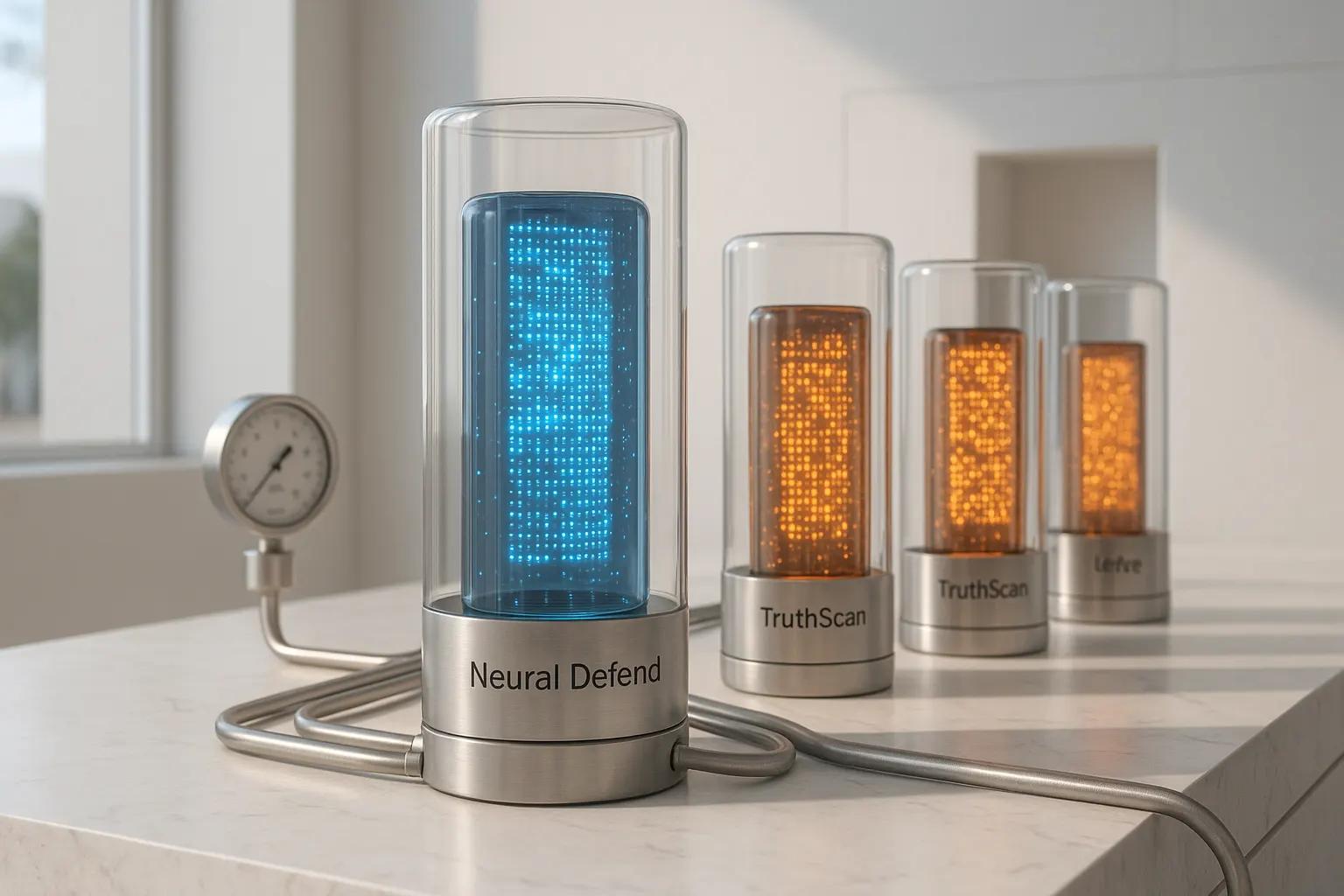
The public VendorBench-100 benchmark (arXiv 2607.06254, v2 dated 29 July 2026) tested 36 systems, spanning commercial APIs, vision-language models and open-source detectors, on one adversarial set of 100 still images and ranked them by MCC. Neural Defend placed first with MCC 0.876, ROC-AUC 0.979, precision 0.963 and recall 0.987. The next vendor, Reality Defender, scored MCC 0.646. The metrics also diverge: TruthScan reached ROC-AUC 0.923 with accuracy 0.49, and Hive 0.90 with 0.45, a pattern the authors describe as strong rankers being miscalibrated at their default threshold.
One VendorBench-100 author, Sharayu N. Deshmukh, is also a co-author of Neural Defend's ARCAS 1B paper. The corpus and results are public, so anyone can rerun them. The benchmark covers still images only and does not test video, audio or injection attacks.
Media that circulates in the wild is harder than curated test sets. Deepfake-Eval-2024 (arXiv 2503.02857) collected deepfakes that spread in 2024 from 88 websites in 52 languages: 45 hours of video, 56.5 hours of audio and 1,975 images. Open-source detectors saw AUC fall by about 50% for video, 48% for audio and 45% for images compared with earlier benchmarks. Commercial and fine-tuned models did better, though the authors report they had not yet matched deepfake forensic analysts.
| Rank | System | MCC | ROC-AUC | Accuracy |
|---|---|---|---|---|
| 1 | Neural Defend | 0.876 | 0.979 | 0.96 |
| 2 | Reality Defender | 0.646 | 0.89 | 0.85 |
| 3 | Gemini | 0.389 | 0.70 | 0.61 |
| 4 | TruthScan | 0.322 | 0.923 | 0.49 |
| 5 | Claude Opus | 0.322 | 0.791 | 0.49 |
| 6 | Hive | 0.290 | 0.90 | 0.45 |

Where Does Deepfake Detection Fail?
Detection fails most often when the input differs from what the model was trained and tested on. New generators, unfamiliar languages and accents, new camera pipelines and repeated compression on messaging apps all shift the data. Resizing and re-encoding destroy the fine pixel and frequency traces that artifact detectors read, and a few seconds of dark video gives physiological methods little to work with.
Attackers also aim at the detector. Adversarial noise, re-recording a screen, filters and tight crops that remove the face boundary can push a score below the threshold. A tool can only answer for the modality it analyses: an image model says nothing about a cloned voice on the same call, and a face detector does not check whether an ID document was edited.
Some limits do not go away with better models. A detector estimates whether content was generated or altered. It does not identify the operator, prove intent or consent, or confirm whether the depicted event happened. Authentic media can be flagged too, and a false accusation can do as much damage as a missed fake, so high-impact decisions need a review step and a way to correct mistakes.


How Does Neural Defend Detect Deepfakes?
Neural Defend runs six signals in one API request through NeuroVerify: Visual Safety Screening, Live Presence Verification, Face Manipulation Detection, AI Generative Model Analysis, AI Pixel-Level Manipulation and AI Content Compliance. The response is one unified risk score with signal-level evidence, so your policy can act on the score and an analyst can see which signal drove it. Eligible image requests return in under 200 ms at p95 under defined test conditions.
The signals run on ARCAS 1B, Neural Defend's proprietary deepfake detection foundation model. The ARCAS paper (arXiv 2609.25154) reports pooled accuracy of 99.99% on GenImage, 99.92% on WildFake, 99.82% on AIGC-Detect, 99.09% on AIGIBench, 97.74% on Community Forensics and 97.65% on OpenFake, without updating the model for each benchmark. The authors state that the results describe the evaluated records, not universal reliability.
For investigations, NeuroDetect is the forensic workspace. An analyst uploads an authorised image, audio file, video or document into a case; the analysis keeps model and version context and shows explainability heatmaps and attention views down to regions, frames and audio segments. An LLM-assisted summary links each statement to evidence, the analyst makes the final call, and the case exports as a report covering observations, uncertainty, provenance, model context and analyst notes. Voice and call detection is available in NeuroCall (Beta).
Neural Defend deploys as a managed cloud API, in a private cloud or VPC, as a secure container, on premises or air-gapped, and holds ISO/IEC 27001, ISO/IEC 27701, ISO/IEC 42001 and SOC 2 Type II certifications. NeuroVerify does not analyse ID documents.
| Benchmark | Pooled accuracy |
|---|---|
| GenImage | 99.99% |
| WildFake | 99.92% |
| AIGC-Detect | 99.82% |
| AIGIBench | 99.09% |
| Community Forensics | 98% |
| OpenFake | 97.65% |

Evidence boundary
Limitations
- VendorBench-100 covers 100 still images and does not test video, audio or injection attacks; one of its authors also co-wrote the ARCAS 1B paper.
- The benchmark figures on this page, including the ARCAS 1B results, describe the evaluated records. Performance on your media, generators and compression levels has to be tested separately.
- Detection output is probabilistic evidence about content. It does not identify who made a file, prove intent, or confirm that an event happened.
- NeuroVerify does not analyse ID documents, and NeuroCall is in Beta.
Source record
Sources and references
- arXivVendorBench-100: A Unified Cross-Paradigm Benchmark for Deepfake Image Detection (v2)Published July 29, 2026. Verified October 19, 2026.
- arXivDeepfake-Eval-2024: A Multi-Modal In-the-Wild Benchmark of Deepfakes Circulated in 2024Published March 4, 2025. Verified October 19, 2026.
- arXivBenchmarking Neural Defend ARCAS 1B: A Foundational Multimodal Deepfake Detection ModelPublished September 21, 2026. Verified October 19, 2026.
- National Institute of Standards and TechnologyReducing Risks Posed by Synthetic Content: An Overview of Technical Approaches to Digital Content Transparency (NIST AI 100-4)Verified October 19, 2026.
- Coalition for Content Provenance and AuthenticityContent Credentials: C2PA Technical Specification 2.2Verified October 19, 2026.
- arXivFakeCatcher: Detection of Synthetic Portrait Videos using Biological SignalsPublished January 8, 2019. Verified October 19, 2026.
- arXivLeveraging Frequency Analysis for Deep Fake Image RecognitionPublished March 19, 2020. Verified October 19, 2026.