
Neural Defend

Identity verification platforms / NeuroVerify

Deepfake Detection API for Identity Verification Platforms

For IDV vendors, KYC providers and platform teams that sell selfie and liveness checks to others. NeuroVerify adds deepfake and manipulation detection beyond liveness behind the capture step you already run and returns one unified risk score with signal-level evidence.

It takes the selfie, video or audio your flow already captures, in one API call, with no new step for your customers' end users.

NeuroVerify does not replace your document verification, face match or liveness product, and it does not analyse ID documents. It adds authenticity evidence; your customers' policies make the decision.

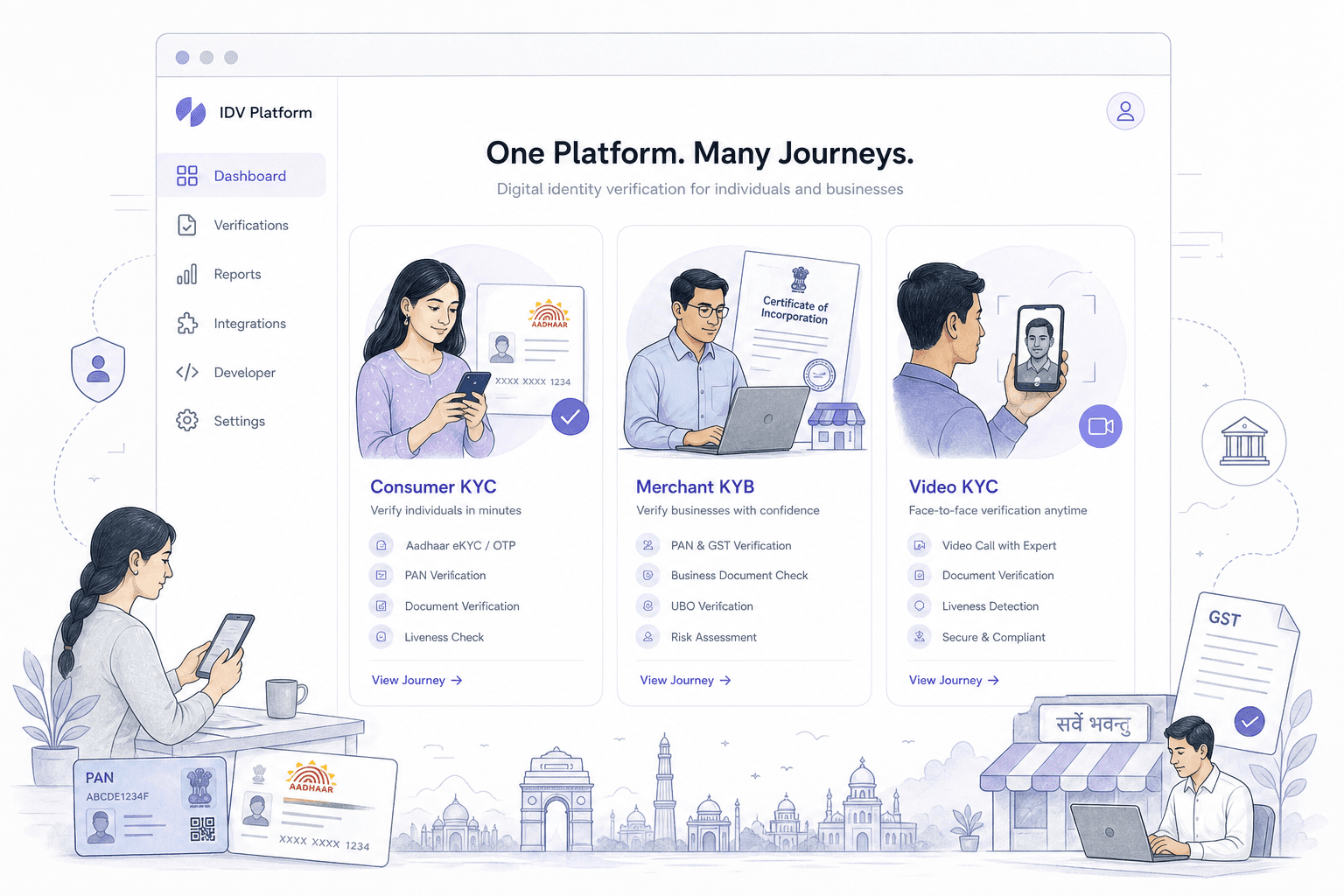
Light editorial illustration of an identity verification workflow with a selfie capture step and a risk score panel on a light background.
AI-generated conceptual editorial illustration on a light background; not product UI or forensic evidence.
Powered byNeuroVerifyExplore the product
  • #1 of 36on the public VendorBench-100
  • <200 msp95 on eligible image requests
  • 6 → 1six checks, one unified score
  • 0new steps for your customer

The gap

Liveness was built for a different attack than the one arriving now.

Identity verification platforms sit in the middle of many customers' onboarding. Their selfie and liveness step is the shared gate that attackers study. Once a technique works on one platform, it is reused on every platform that runs the same pattern.

Liveness was designed to answer whether a live person was present, mostly against presentation attacks such as a photo, a mask or a screen replay. Generated faces, face swaps and camera-feed injection are a different class of attack. They can follow the prompt, look natural and never touch the physical camera.

Why the gap is yours to close

When a deepfake passes your selfie step, the customer owns the fraud loss but you own the reputation and the support queue. Customers increasingly ask what you do about synthetic media, and "our liveness is certified" is only part of the answer. See deepfake detection vs liveness detection.

A typical IDV session

Document captured → Document checked → Selfie or video captured → Liveness passes → Face match to document photo → Result returned to customer

Each step can pass while the face media is synthetic. NeuroVerify adds an authenticity read on the captured media before the result goes out.

Related: digital injection attacks in identity verification.

Threats

Attacks that reach IDV platforms

These are techniques seen across remote identity verification, not claims about any named provider.

01

Face swap on a live selfie session

A real-time swap replaces the attacker's face with the document owner's during the selfie or video step.

02

Virtual-camera and emulator injection

Software feeds pre-made or generated video into the capture step in place of the real camera, bypassing sensor-level checks.

03

Generated face against a synthetic identity

An AI-generated portrait is paired with a synthetic or stolen record, so face match compares two fabricated or unrelated images.

04

Replay of a captured session

A genuine earlier selfie or video is replayed to a new session to pass liveness.

05

Repeated probing of your thresholds

Attackers submit many variants to learn what passes, then scale the winning method across your customers.

06

Voice clone in assisted or video sessions

Where agents or voice steps are involved, a cloned voice supports a fake caller during a video or phone review.

Standards such as presentation attack detection testing address physical spoofs well. They do not by themselves cover generative attacks; see provenance, detection and PAD standards.

For identity programmes in regulated sectors, FATF digital identity guidance and eIDAS and EUDI wallet identity proofing frame the wider context.

Where NeuroVerify fits

Where NeuroVerify sits in your verification flow

NeuroVerify is a layer behind your capture step. Send the selfie, video or audio you already collect, and NeuroVerify runs six signals in a single request and returns one unified risk score with signal-level evidence.

You can expose the score in your own result payload, use it to route sessions to manual review, or let each customer set its own thresholds. Your liveness, face match and document checks stay as they are.

NeuroVerify Unified Trust LayerSix parallel analysis layers
  • Visual Safety Screening
  • Live Presence Verification
  • Face Manipulation Detection
  • AI Generative Model Analysis
  • AI Pixel-Level Manipulation
  • AI Content Compliance
01

Send the session media

After capture, post the selfie, video frame or audio to NeuroVerify through the SDK or REST. Use the backend SDK in your language.

02

Read the unified risk score

Receive one score with evidence from each of the six signals.

03

Surface it in your result

Add the score and key signals to the result you return, or keep it as an internal routing input.

04

Let customers set policy

Offer per-customer thresholds so each customer decides approve, step up, review or decline.

What you get

What identity platforms gain

A credible answer on synthetic media

Show customers an independent authenticity layer, backed by a #1 ranking of 36 systems on VendorBench-100.

Beyond liveness, without a rebuild

Add detection behind the step you already run instead of replacing it.

Evidence your support team can use

Signal-level detail speeds investigation when a customer disputes a result.

Flexible deployment for your customers

Managed cloud, private cloud, container, on-premises and air-gapped options match different customer requirements.

Easy to integrate

Mobile and backend SDKs plus REST. Two lines to integrate is the product claim; live in under 24 hours is the target.

Questions

What teams ask before they integrate.

Can we add NeuroVerify without changing our capture flow?

No. NeuroVerify fits the selfie or video step your journey already runs. You send the media you already capture in one API call. There is no new step for the end user.

Integration uses native mobile SDKs (Android/Kotlin, iOS/Swift, Flutter), backend SDKs (Python, TypeScript/Node.js, Go, Java) or REST. Two lines of code is the product claim; live in under 24 hours is the target. Mobile SDKs cover Android, iOS and Flutter if you need on-device capture hooks.

How does this relate to our own liveness product?

Not as a replacement. Liveness asks whether a live person was in front of the camera. NeuroVerify asks whether the media itself is authentic, and it includes a Live Presence Verification signal alongside five others, so it checks beyond liveness. See deepfake detection vs liveness detection.

You can keep your current liveness vendor and send the same selfie or video to NeuroVerify as well. If you build your own liveness, NeuroVerify is complementary: it looks at what the media is, not only whether a person responded.

Can we white-label or resell the score?

Commercial terms vary by arrangement, so please contact us about reseller or embedded use. Technically, the unified score and signal evidence can be returned inside your own result payload.

Does it analyse ID documents?

No. NeuroVerify checks face images, video and audio only. For document-led flows it protects the selfie and video evidence; your document verification continues unchanged.

Will it add latency to our sessions?

NeuroVerify returns in under 200 ms p95 on eligible image requests under defined test conditions. The test methodology is available on request, so you can compare it with your own traffic and network path.

Image checks run inside the capture step, so the end user does not see a separate wait. Video and audio take longer because they carry more media; ask us for numbers that match your clip lengths.

Can we run it inside our own environment?

NeuroVerify runs as a managed cloud API, in a private cloud or your own VPC, as a secure container, on-premises, or air-gapped. The right option depends on your data-residency and security rules.

The same six signals and the same unified risk score are available in each model. Neural Defend holds ISO/IEC 27001, ISO/IEC 27701, ISO/IEC 42001 and SOC 2 Type II; see the Trust Center for details.

Can we benchmark it on our own fraud samples?

Yes. We recommend evaluating on your own media: your real capture conditions, devices and attack samples. Start with a small test set, compare the unified score and signal evidence against your current checks, then set thresholds with your own policy team.

NeuroVerify ranked #1 of 36 systems on VendorBench-100 (detection score MCC 0.876 versus 0.646 for the next-best vendor), but a public benchmark is a starting point. Your own media is the real test. Contact us to set one up.

Who sets the thresholds and decides outcomes?

NeuroVerify returns one unified risk score plus signal-level evidence, so a reviewer can see which of the six signals raised concern. It does not make the final decision. Your own policy decides whether to approve, step up, route to manual review or decline.

Because thresholds are yours, you can tune them to your own tolerance for false positives and false negatives. See deepfake detection errors.

Evaluate NeuroVerify

Benchmark NeuroVerify against your own session media

Share representative sessions and attack samples. We will run them through NeuroVerify so you can compare the unified score and evidence with your current checks.