
How Can You Tell if a Video Is a Deepfake?
You can sometimes tell from visible flaws, and you can more often tell from context. Start with the flaws listed below because they are quick, then move to the source: who posted the video first, whether the person shown has confirmed it, and what the video is asking you to believe or do. If a call or clip asks for money, credentials or urgent secrecy, confirm through a number you already hold before acting, whatever the video looks like.
The FBI's Internet Crime Complaint Center gives similar advice. Its 3 December 2024 announcement on generative AI fraud lists visual flaws such as distorted hands or teeth, irregular faces, odd accessories, incorrect shadows, watermarks, lag and voices that do not match, and pairs them with a secret family code word and a callback on an independently found number.
What Are the Visual Signs of a Deepfake Video?
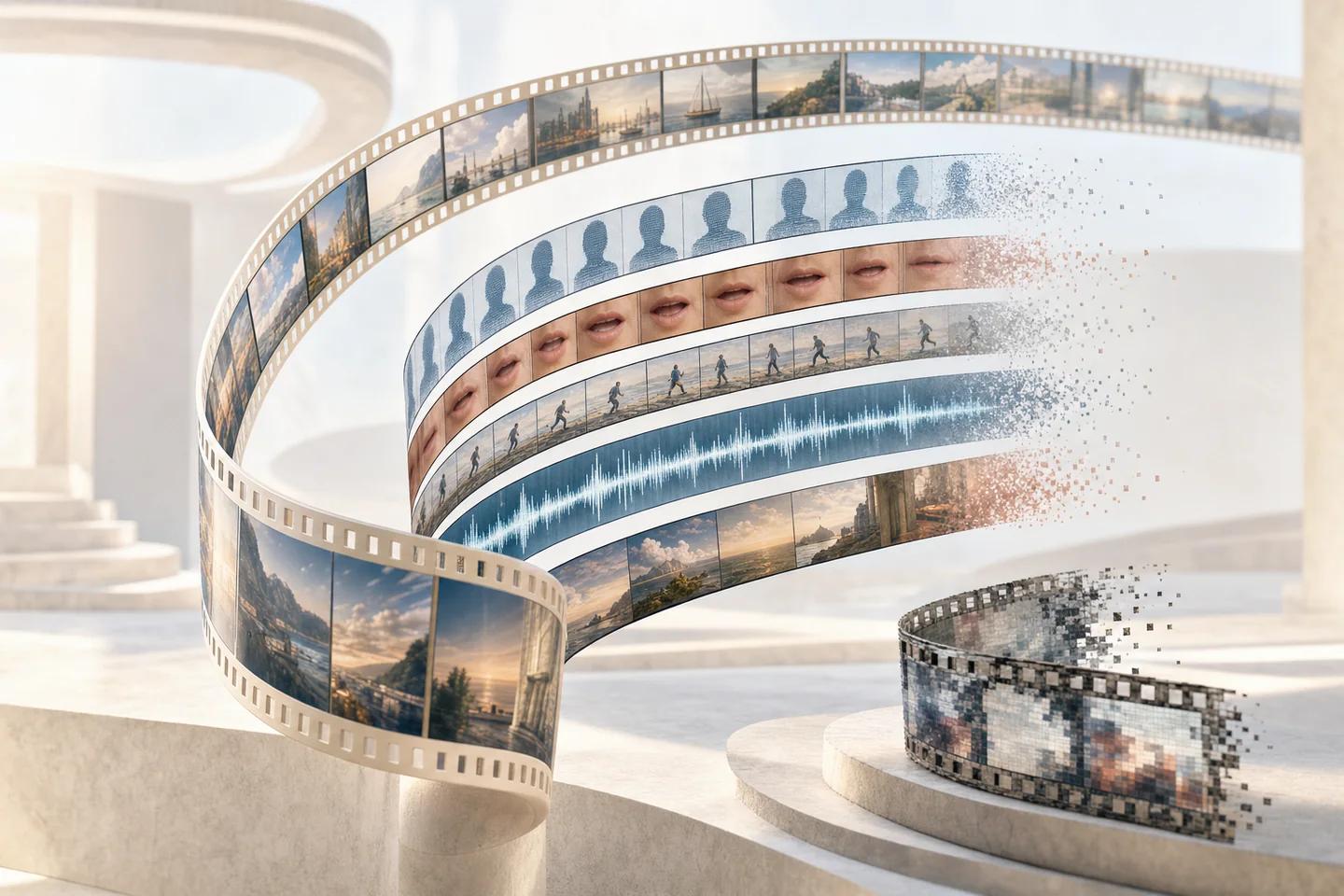
Visual signs come from the parts of a scene that generators find hardest to keep consistent. Face swaps blend a generated face into real footage, so the boundary along the jaw, hairline and ears is where errors show, especially when the head turns to profile or something passes in front of the face. Reenactment and lip-sync tools regenerate the mouth, so teeth, tongue and the inside of the mouth often look smeared or change shape between frames.
Lighting and texture are the other weak points. The face may be lit from a different direction than the room, skin may look airbrushed next to a textured neck, and glasses, earrings or hair strands may flicker or merge into skin. In fully generated video, look for physics: objects that change shape, hands with the wrong number of fingers, and text on signs that turns to nonsense.
| Sign | Why deepfakes show it | Innocent causes in real video |
|---|---|---|
| Warping at the jaw or hairline when the head turns | Blend boundary of a swapped face | Stabilisation, motion blur, background blur filters |
| Smeared teeth or inner mouth | Mouth region regenerated frame by frame | Low bitrate compression, dim light |
| Lips out of sync with speech | Lip-sync or voice replaced separately | Network lag on calls, editing errors |
| Face smoother than neck or hands | Generator smooths fine texture | Beauty filters, makeup, skin smoothing in phone cameras |
| Lighting on face differs from scene | Face rendered from a different source | Mixed lighting, screen glow, reflectors |
| Glitch when a hand crosses the face | Occlusion breaks the face model | Rolling shutter, frame interpolation |
| Flat, evenly paced or clipped voice | Text-to-speech or voice conversion | Poor microphones, noise suppression, packet loss |
What Are the Audio and Behavioural Signs of a Deepfake?
Synthetic voices often sound slightly too even. Breathing may be missing or regular, emotion may not match the words, and the voice may stay oddly clean in a noisy setting or carry no echo in a room that should produce one. On calls, a cloned voice may pause before answering while the attacker types or the model catches up.
Cross-channel mismatches are among the most useful signs. On 28 June 2022 the FBI warned that applicants in remote job interviews had used deepfakes, and that interviewers noticed lip movements and actions not fully matching the audio, with coughs and sneezes out of step with the picture. Behaviour gives clues too: reluctance to turn sideways, refusal to switch to a different channel, and pressure to keep the conversation secret.
Why Deepfake Artifact Checklists Fall Short
Checklists age quickly. In June 2018 Yuezun Li, Ming-Ching Chang and Siwei Lyu proposed detecting fake face videos by their eye blinking, a physiological signal that early face-swap videos reproduced poorly because training photos rarely showed closed eyes. Once the weakness was public, newer generators learned to blink, and the tip lived on in advice long after it stopped working. The same has happened to extra fingers and garbled text in generated images.
Checklists also fail in the other direction. Rolling shutters, low light, phone beauty filters, frame interpolation, dropped packets and aggressive codecs distort faces, edges and sync in genuine footage. A single odd shadow or blink rarely identifies its cause, and treating it as proof leads to false accusations.
Most importantly, people are poor at this task even with a checklist. Nils Köbis and colleagues reported in iScience in November 2021 that 210 participants identified deepfake videos with 57.6% accuracy. They called 67.4% of clips authentic although half were fake, and overconfidence was strongest among the least accurate. A list of signs can make viewers feel more certain without making them more correct.

What Do Automated Deepfake Detectors Look For?
Software looks for traces below the level people perceive. Frequency analysis finds regular patterns left by the upsampling layers in generators. Texture and noise analysis compares pixel statistics with what camera sensors produce. Physiological methods track colour changes from blood flow in skin; FakeCatcher, published by Umur Aybars Ciftci and Ilke Demir, reported 94.65% accuracy on FaceForensics++ using such signals. Audio models analyse spectral and prosody features of speech, and multimodal models check whether lips, voice and scene agree.
These methods have their own limits. Deepfake-Eval-2024 (arXiv 2503.02857), built from deepfakes that circulated in 2024, found open-source detectors lost about 50% of their AUC on video compared with earlier benchmarks. Detection is strongest when it is tested on media like yours and used as one signal within a decision process.
How Does Neural Defend Find Signs People Miss?
NeuroVerify checks a face image, video or audio in one API request and returns a unified risk score with evidence from six signals, including Face Manipulation Detection, Live Presence Verification, AI Generative Model Analysis and AI Pixel-Level Manipulation. Eligible image requests complete in under 200 ms at p95, fast enough for onboarding and account recovery while the user waits. On the public VendorBench-100 benchmark of 100 hard still images, Neural Defend ranked first of 36 systems with an MCC of 0.876.
NeuroDetect turns detection signs into reviewable evidence. In a case, explainability heatmaps and attention views show the regions, frames and audio segments behind each finding, an LLM-assisted summary explains them in plain language with links to the evidence, and the analyst makes the final call. The exported forensic report records observations, uncertainty and model version, so a finding can be checked by someone else later.
Evidence boundary
Limitations
- Every visible sign listed here can appear in genuine video, and high-quality deepfakes may show none of them.
- Signs that work today may stop working as generators improve; any checklist needs regular review.
- Automated detectors lose accuracy on compressed and novel media, so their results need testing on representative files.
- VendorBench-100 measures still images only and does not cover video, audio or injection attacks.
Source record
Sources and references
- FBI Internet Crime Complaint CenterCriminals Use Generative Artificial Intelligence to Facilitate Financial Fraud (I-120324-PSA)Published December 3, 2024. Verified October 19, 2026.
- FBI Internet Crime Complaint CenterDeepfakes and Stolen PII Utilized to Apply for Remote Work Positions (I-062822-PSA)Published June 28, 2022. Verified October 19, 2026.
- arXivIn Ictu Oculi: Exposing AI Generated Fake Face Videos by Detecting Eye BlinkingPublished June 7, 2018. Verified October 19, 2026.
- iScience (via PubMed Central)Fooled twice: People cannot detect deepfakes but think they canPublished November 19, 2021. Verified October 19, 2026.
- arXivFakeCatcher: Detection of Synthetic Portrait Videos using Biological SignalsPublished January 8, 2019. Verified October 19, 2026.
- arXivDeepfake-Eval-2024: A Multi-Modal In-the-Wild Benchmark of Deepfakes Circulated in 2024Published March 4, 2025. Verified October 19, 2026.
- arXivVendorBench-100: A Unified Cross-Paradigm Benchmark for Deepfake Image Detection (v2)Published July 29, 2026. Verified October 19, 2026.
- Federal Trade CommissionScammers use AI to enhance their family emergency schemesPublished March 20, 2023. Verified October 19, 2026.