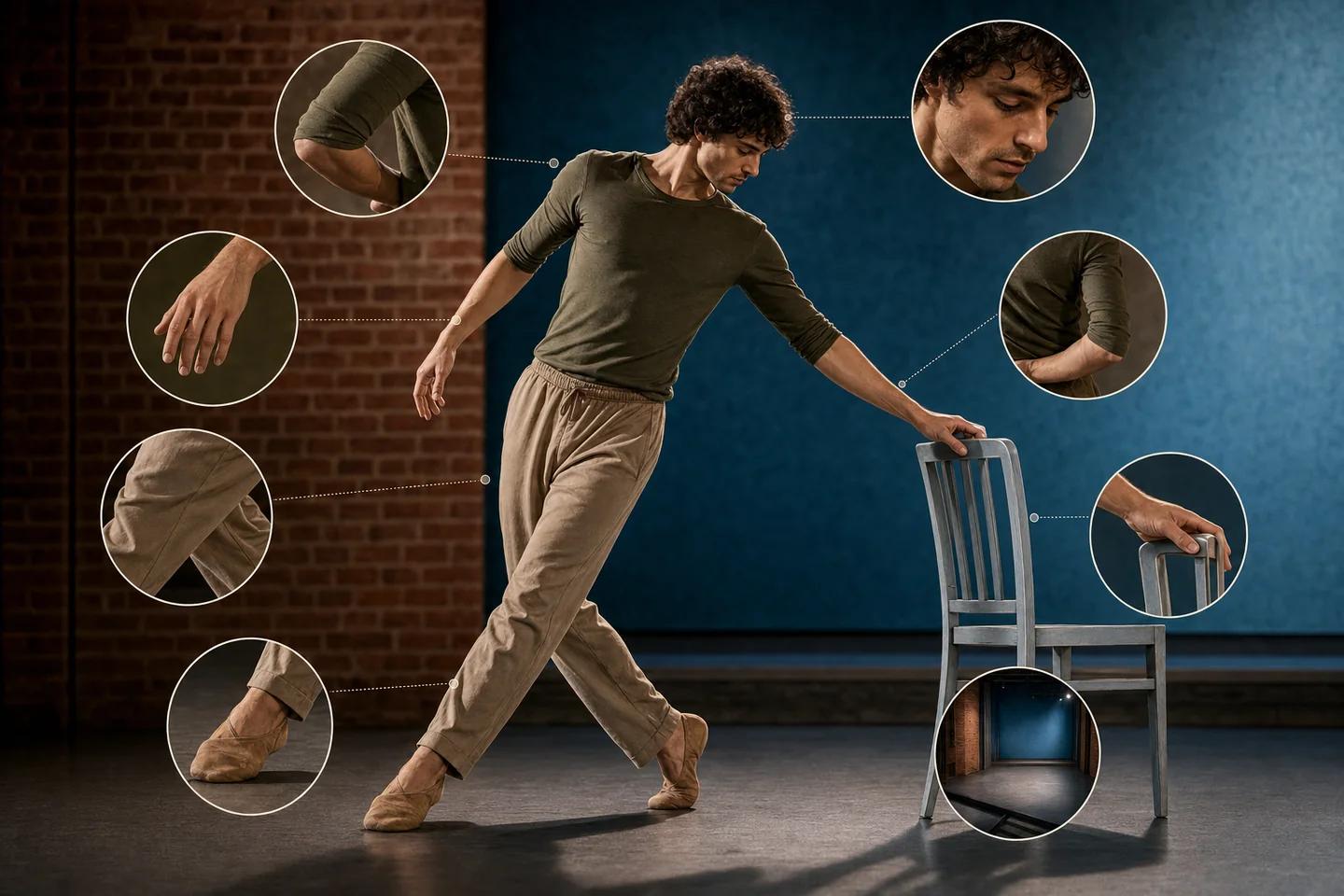

Why is text-to-video generation harder than text-to-image?
Text-to-video is harder because every frame has to agree with every other frame. A text-to-image model makes one picture that only needs to look right on its own. A video model has to keep the same person, the same objects and the same room across dozens or hundreds of frames, move them in ways that respect momentum and contact, and keep the camera behaving like a camera. A clip where each frame is beautiful can still fail as video if a sleeve changes colour halfway through or a hand passes through a cup.
Three practical constraints add to that. Paired text-video data is far scarcer than paired text-image data. Video multiplies compute and memory, because the model must reason over time as well as space. And evaluation is harder: a single still can be judged at a glance, but motion, persistence and cause and effect only show over the whole sequence.
Why do text-to-video models need more than strong image frames?
Strong frames solve appearance; video also needs relationships over time. Errors show up at different scales. Between adjacent frames, texture can flicker or boil. Over a few seconds, a face can drift away from the identity it started with. Over a full action, an object that was hidden can come back changed, or an event can have the wrong consequence, such as a glass that does not break when dropped.
Each scale needs different machinery. Temporal attention and 3D convolutions tie neighbouring frames together. Longer-range consistency needs the model to carry information about what has already been shown. Physical plausibility needs training data and capacity that capture how things move and interact, which is still the weakest area for most generators.
How did video generation move from images to minutes of footage?
Between April 2022 and February 2024, research groups attacked the problem from several directions at once. The table lists the main steps as each paper or report describes itself.
| Date | System | Approach |
|---|---|---|
| Apr 2022 | Video Diffusion Models | Extended image diffusion to video; joint image and video training; first large text-conditioned video results |
| Sep 2022 | Make-A-Video (Meta) | Learned appearance from text-image pairs and motion from unlabelled video, needing no paired text-video data |
| Oct 2022 | Imagen Video (Google) | A cascade: base video model plus interleaved spatial and temporal super-resolution models |
| Nov 2023 | Stable Video Diffusion | Latent video diffusion trained in three stages, with heavy data curation; weights released |
| Jan 2024 | Lumiere (Google) | Space-Time U-Net that generates the whole clip duration in one pass instead of keyframes plus temporal super-resolution |
| Feb 2024 | Sora (OpenAI) | Diffusion transformer over spacetime patches of compressed video; clips up to one minute |
Why multi-stage pipelines complicate forensic analysis
Many video generators are not one model. Make-A-Video combined a video decoder, an interpolation model and two super-resolution models; Imagen Video interleaved spatial and temporal super-resolution stages after a base model. Interpolation invents frames between generated states, and super-resolution adds detail that the base model never produced. Each stage can repair some defects and introduce others.
Lumiere's authors argued that the keyframe-then-interpolate design makes global temporal consistency hard, which is why they generated the full duration at once. For an examiner, the consequence is that a texture pattern or motion glitch in a final clip may belong to an upscaler or interpolator rather than the base generator, and a platform re-encode adds yet another layer. Attributing an artifact to one named model needs documentation of the whole pipeline.
How is video generation quality measured?
Fréchet Video Distance, proposed in December 2018, compares the statistics of generated and real clips and was shown in a large human study to correlate with human judgement. It compresses everything into one number, though, and hides which property failed. VBench, released in November 2023, splits quality into 16 dimensions, including subject identity inconsistency, motion smoothness, temporal flickering and spatial relationships, each with its own prompts and checks. Splitting the score is the more useful habit for defenders too, because a generator can excel at smoothness and still fail at persistence.
Does it matter whether a video started from text, an image or a clip?
Yes, and it matters for both quality and detection. Text-only generation starts with no captured pixels, so everything in the frame is synthetic. Image-to-video animation starts from a real or generated still and must preserve it while adding motion; Stable Video Diffusion's base model supports this mode. Video extension and editing start from real footage and change part of it, so the result mixes captured and generated content.
These modes can share an architecture yet leave different evidence. A fully generated clip may carry generator traces everywhere, while an animated photo of a real person keeps that person's genuine texture in the first frame and drifts from it over time. An examiner should name the likely input mode before comparing a clip with known generators.
What this means for detecting AI-generated video
Detection should not rely on a fixed list of visible mistakes. Flicker and identity drift were common in 2022-era output and are much rarer in current models. A sound evaluation covers short and long clips, static and moving cameras, direct outputs and versions that have been downloaded, cropped and re-encoded, and generators that were held out of training. Frame-level analysis matters as well, because generated clips are often shared as single stills; the public VendorBench-100 corpus deliberately includes text-to-video stills among its 100 adversarial images.
Provenance complements detection. Content credentials and watermarks can carry origin information that survives when statistical artifacts do not, but they can also be stripped, so the absence of a credential proves nothing about authenticity.
How Neural Defend analyses generated video
NeuroDetect lets an analyst open a case with an authorized video, review explainability heatmaps and attention views down to individual frames, and read an LLM-assisted summary linked to the evidence before making the final call. The forensic report keeps model and version context, observations and uncertainty, which matters when a clip may have passed through several generation and editing stages. NeuroVerify screens face video in onboarding flows in one API call with six signals, including AI Generative Model Analysis.
On VendorBench-100, which includes text-to-video stills, Neural Defend ranked first of 36 systems with MCC 0.876; one author also co-authored Neural Defend's ARCAS 1B paper, and the results are public. The benchmark covers still images only, so validate full-clip behaviour on video from your own channel.
Evidence boundary
Limitations
- Milestone descriptions are summarised from each paper's abstract or report and do not compare output quality directly.
- Selected demonstration clips show that a capability exists, not how often it succeeds across prompts.
- VendorBench-100 includes text-to-video stills but does not test full video clips; one author overlaps with the ARCAS 1B paper.
Source record
Sources and references
- arXivVideo Diffusion ModelsPublished April 7, 2022. Verified October 19, 2026.
- arXivMake-A-Video: Text-to-Video Generation without Text-Video DataPublished September 29, 2022. Verified October 19, 2026.
- arXivImagen Video: High Definition Video Generation with Diffusion ModelsPublished October 5, 2022. Verified October 19, 2026.
- arXivStable Video Diffusion: Scaling Latent Video Diffusion Models to Large DatasetsPublished November 25, 2023. Verified October 19, 2026.
- arXivLumiere: A Space-Time Diffusion Model for Video GenerationPublished January 23, 2024. Verified October 19, 2026.
- OpenAIVideo Generation Models as World SimulatorsPublished February 15, 2024. Verified August 7, 2026.
- arXivVBench: Comprehensive Benchmark Suite for Video Generative ModelsPublished November 29, 2023. Verified October 19, 2026.
- arXivVendorBench-100: A Unified Cross-Paradigm Benchmark for Deepfake Image Detection (v2)Published July 29, 2026. Verified October 19, 2026.