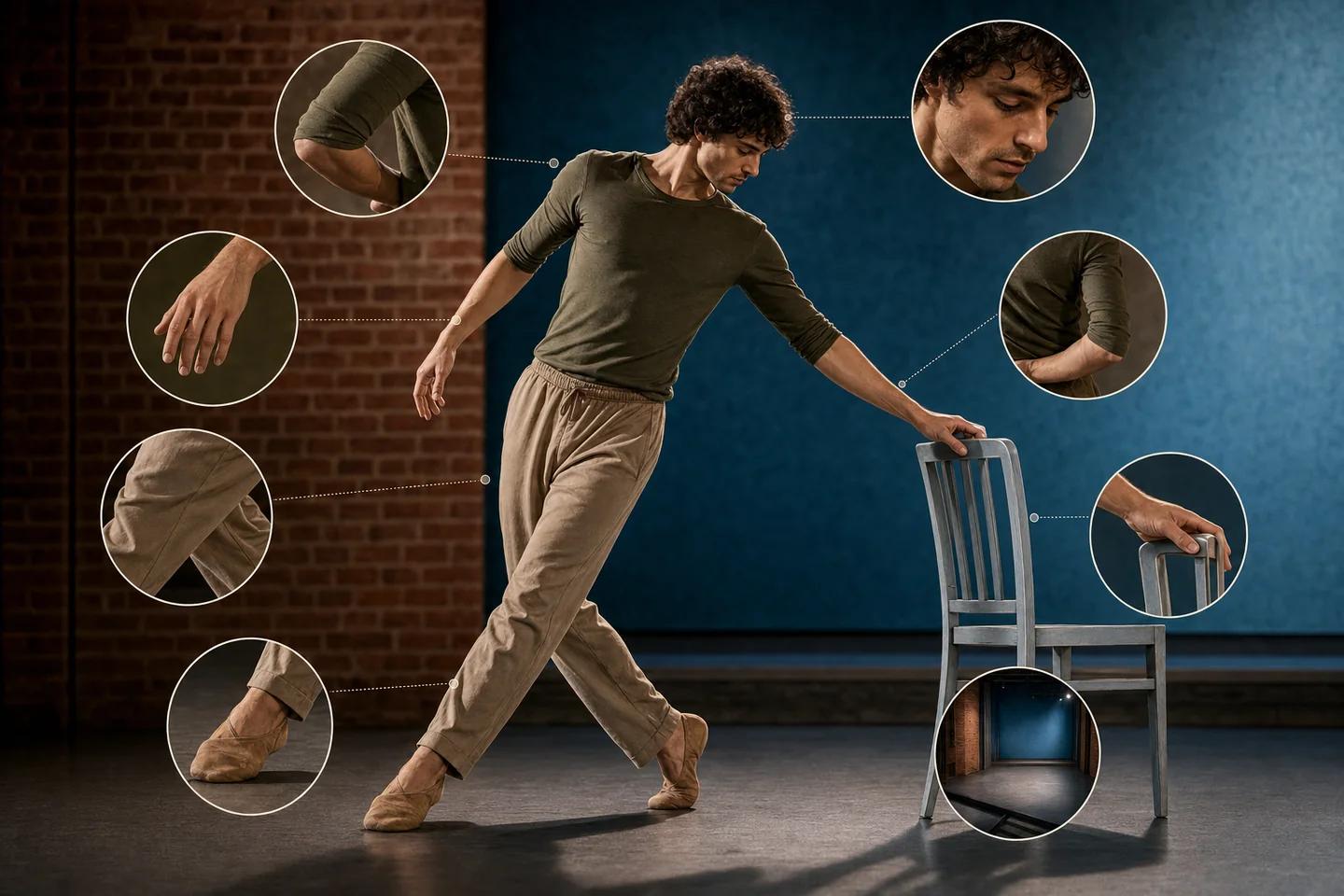

Why does temporal consistency matter in AI-generated video?
Temporal consistency matters because video is judged over time. A viewer, a reviewer or a detector does not see one frame; it sees a person who should keep the same face, a shirt that should keep the same pattern, a room whose furniture should stay put when the camera pans away and back. When a generator fails at that, the clip reads as fake even if every individual frame is photorealistic. When it succeeds, the most intuitive evidence of generation disappears.
The stakes are practical. In identity verification, a selfie video is supposed to show one person continuously; a face that drifts between frames is a strong warning sign. In newsrooms and claims handling, an object that changes shape mid-clip undermines a video's value as evidence. As generators get better at consistency, defenders lose an easy cue and must rely on subtler signals.
What is the difference between short-term and long-term consistency?
Short-term consistency is smoothness between neighbouring frames: no flicker, no boiling texture, no jumps in motion. Long-term consistency is persistence over seconds or minutes: the same identity, the same objects, the same scene after occlusions and camera moves. A model can be excellent at the first and poor at the second.
NVIDIA's Video-to-Video Synthesis paper of August 2018 generated each frame conditioned on the frames just before it, which kept motion smooth. Its follow-up, World-Consistent Video-to-Video Synthesis from July 2020, named the gap directly: methods that look only at a few previous frames keep short-term consistency but fail at long-term consistency. Its fix condensed everything rendered so far into a physically grounded estimate of the current frame, a guidance image, so that a building seen earlier looked the same when the camera returned to it.
How do video generators try to stay consistent?
Three design families dominate. Keyframe pipelines generate distant frames first and fill the gaps with temporal super-resolution or interpolation. Joint space-time models generate the whole clip together; Google's Lumiere, posted in January 2024, used a Space-Time U-Net to produce the entire duration in one pass, and its authors argued that the keyframe approach makes global consistency hard to achieve. Transformer models such as Sora process compressed video as spacetime patches, so attention can link content across the whole sequence.
None of these fully solves persistence. OpenAI's February 2024 Sora report presented object permanence as an emerging behaviour and, in the same document, listed failures in physics and in long, complex actions. Consistency improves with scale and architecture but remains the property most likely to break in long clips.
How is temporal consistency measured?
Older benchmarks folded it into one number. Fréchet Video Distance compares the statistics of real and generated clips, which captures some temporal quality but cannot say what went wrong. VBench, released in November 2023, separates video quality into 16 dimensions, several of them temporal: subject identity inconsistency, temporal flickering and motion smoothness among them, each with its own prompts and checks and validated against human preference. Separating dimensions shows that a model can score well on smoothness and still lose a subject's identity across a shot.
Why temporal detection cues keep expiring
Early deepfake detectors used whatever temporal mistakes generators made. In June 2018, Yuezun Li, Ming-Ching Chang and Siwei Lyu proposed exposing fake face videos by their eye blinking, describing blinking as a physiological signal that synthesized videos did not represent well. Within a short time, newer face-swap tools blinked convincingly, and the cue lost most of its value. The same arc has played out for flicker, jittery face boundaries and identity drift.
The lesson is to treat any single temporal cue as perishable and to test detectors on current generators. The table summarises cues that defenders have relied on and their status.
| Cue | Why it appeared | Status today |
|---|---|---|
| Missing or odd blinking | Training data had few closed-eye frames | Largely fixed in current face-swap and animation tools |
| Frame-to-frame flicker | Frames generated with weak temporal coupling | Much reduced by joint space-time models |
| Identity drift over seconds | No long-range memory of the subject | Reduced, still visible in long or occluded shots |
| Broken object permanence | Objects regenerated after leaving frame | Still common in long clips |
| Physically wrong interactions | Limited model of contact and cause | Still a frequent failure |
What temporal analysis still offers defenders
Sequence evidence remains valuable when it is used as one input among several. Comparing the face across every frame of a verification video can reveal a swap that slips during a head turn. Checking that lip motion matches the audio can expose dubbing. Watching hands, hair and objects through occlusions can show regeneration. Compression is the main caveat: low bitrates create their own temporal artifacts in genuine video, so evidence should be weighed against the file's encoding history.
A practical review records where in the clip the evidence sits, not just whether it exists. A swap that holds for frontal frames and slips for two frames during a turn is a different finding from a texture that shimmers throughout, and the two point to different generation methods. Noting the time codes also lets a second reviewer check the same moments, which makes the conclusion easier to defend in a dispute or an audit.
How Neural Defend analyses video over time
NeuroDetect lets an analyst examine an authorized video in a case with heatmaps and attention views down to individual frames and audio segments, so evidence that appears only at certain moments, such as a face boundary slipping during a turn, is visible rather than averaged away. An LLM-assisted summary links each statement to the evidence, the analyst makes the final call, and the forensic report records observations, uncertainty and model context.
For verification flows, NeuroVerify screens face video and audio in one API call across six signals, including Live Presence Verification and Face Manipulation Detection, and returns one risk score with signal-level evidence. Its latency, under 200 ms at p95 on eligible image requests under defined test conditions, leaves room to check more than one frame per session.
Evidence boundary
Limitations
- Temporal artifacts also arise from compression and frame-rate conversion of genuine video, so they need careful interpretation.
- Generator descriptions here come from each paper's abstract or report and do not compare consistency quantitatively.
- Cue status in the table is a general trend; individual tools and settings vary.
Source record
Sources and references
- arXivVideo-to-Video SynthesisPublished August 20, 2018. Verified August 7, 2026.
- arXivWorld-Consistent Video-to-Video SynthesisPublished July 16, 2020. Verified October 19, 2026.
- arXivLumiere: A Space-Time Diffusion Model for Video GenerationPublished January 23, 2024. Verified October 19, 2026.
- arXivVBench: Comprehensive Benchmark Suite for Video Generative ModelsPublished November 29, 2023. Verified October 19, 2026.
- arXivIn Ictu Oculi: Exposing AI Generated Fake Face Videos by Detecting Eye BlinkingPublished June 7, 2018. Verified October 19, 2026.
- OpenAIVideo Generation Models as World SimulatorsPublished February 15, 2024. Verified August 7, 2026.