
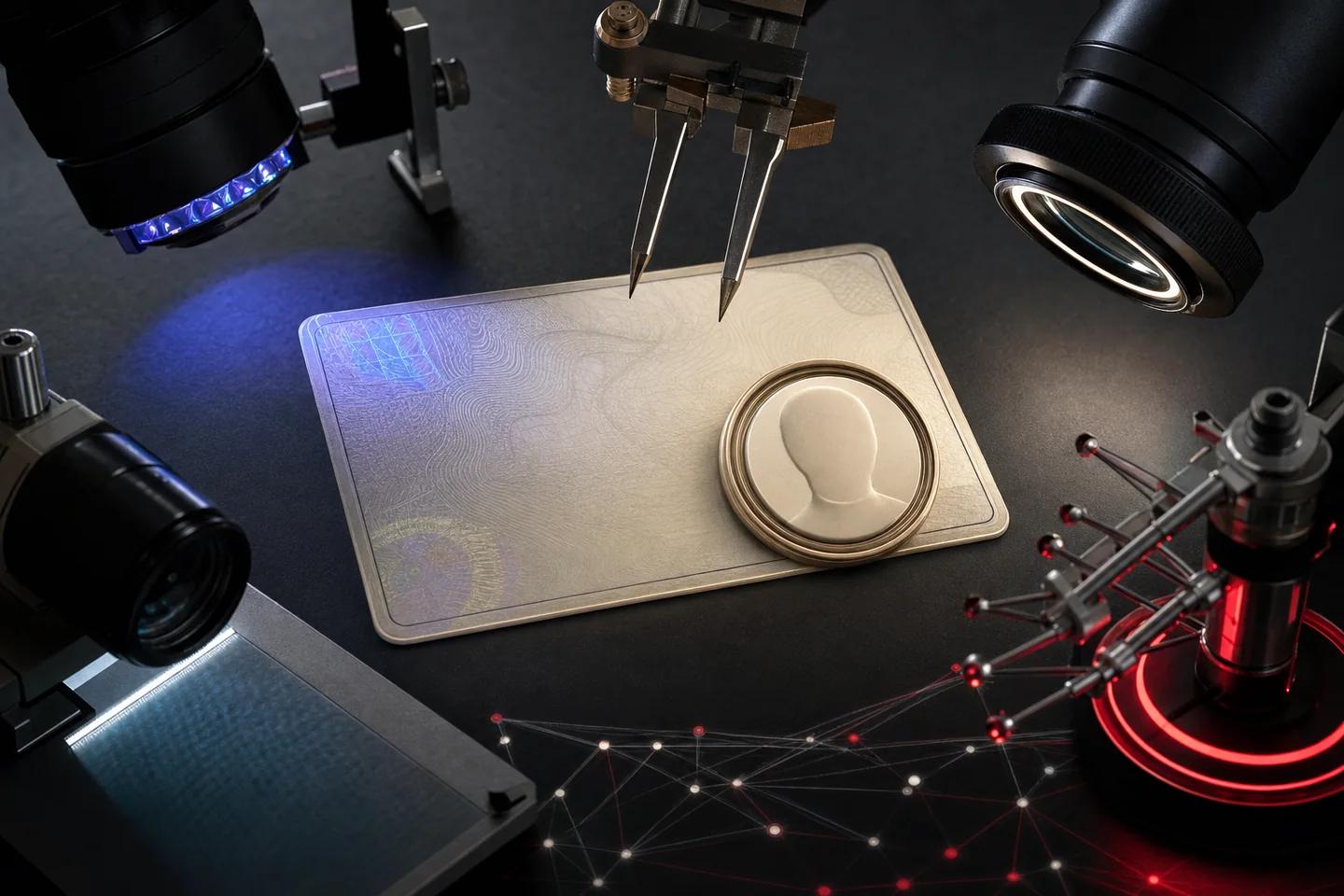
What is document and selfie fraud?
Most remote identity verification asks for two things: a photo of an ID document and a selfie or short video. The system checks that the document looks genuine, that the selfie shows a live person, and that the two faces match. Document and selfie fraud attacks all three at once by supplying a matched pair the attacker created.
The weakness is structural. A face match measures similarity between two images; it says nothing about whether either image is real. If the attacker generates an ID portrait and then generates or swaps a selfie of the same face, the matcher sees two very similar faces and reports a strong match. The checks that actually stop the attack are the ones that test each half independently.
Generative AI changed the economics of the attack. Producing a convincing fake ID once took design skill, templates and printing; producing a matching face meant finding a photo or an accomplice. Now both halves can be generated in minutes, with a new face for every attempt, so the same person can try many identities without ever showing their own face. That volume is why per-application checks need support from linkage and duplicate search.
Can AI-generated fake IDs pass KYC?
Yes, AI-generated fake IDs have passed KYC checks, and there is public reporting to show it. In February 2024, 404 Media reported on OnlyFake, a site claiming to use neural networks to produce ID images for $15 each, and said a reporter used one to get through the identity verification process at the cryptocurrency exchange OKX.
Regulators have seen the same pattern in bank data. FinCEN's alert FIN-2024-Alert004 of 13 November 2024 states that criminals used generative AI to alter or generate images for identification documents such as driver's licences and passport cards and books, either by modifying an authentic source image or creating a synthetic one, and opened accounts that later received proceeds of other fraud. The FBI's December 2024 public service announcement likewise warns of AI-generated fake driver's licences and credentials.
Fake IDs succeed most often where the flow accepts an uploaded image instead of a live capture, checks only visual appearance, and never validates data against an authoritative source or the document's chip. They succeed less often where the physical card must be filmed live and its data cross-checked.
Four ways attackers combine a fake document with a selfie
Attackers choose a combination based on what they have: a stolen identity, a willing accomplice or nothing at all. Each combination defeats a different check, which is why no single control covers them all.
| Document | Selfie | What it defeats | Most effective check |
|---|---|---|---|
| Genuine stolen ID | Face swap or deepfake of the victim | Document authenticity checks | Selfie manipulation analysis, live presence |
| Genuine ID with replaced portrait | Attacker's own real face | Face match and liveness | Document tamper analysis, chip or data validation |
| AI-generated ID | Generated or swapped face matching the portrait | Face match, often weak document checks | Live document capture, data cross-checks, selfie manipulation analysis |
| AI-generated ID for a synthetic identity | Generated face, sometimes a real accomplice | Single-application review | Linkage across applications, data issuance checks |
Controls that stop document and selfie fraud
Test each half on its own evidence, then test whether they belong together. NIST SP 800-63A-4, published in July 2025, gives several anchors: automated document validation must use live capture with document presence checks and compare MRZ or barcode data with the printed fields, and remote proofing must analyse submitted media for manipulation. The checklist below turns that into flow design.
- Capture the document live in the app, across several frames, and reject gallery uploads for identity steps.
- Validate document data against the MRZ, barcode or chip where available, and against authoritative records where your jurisdiction allows.
- Run manipulation and generation analysis on the selfie and liveness video before face matching, so two fakes cannot vouch for each other.
- Check consistency: does the apparent age fit the date of birth, and do multiple documents agree? FinCEN lists both among its red flags.
- Run reverse image search on the ID portrait and selfie when a case is referred.
- Search for the same face across other applications under different names.
Where detection helps and where it does not
For most teams, selfie analysis is the most effective place to add a control. Document vendors already inspect the ID, but a generated or swapped face that matches a fake portrait passes the matcher by design. Manipulation analysis on the selfie breaks the pair: if the face shows generation or swap traces, the match result no longer means anything.
Detection does not verify personal data. A document that is visually genuine but issued to someone else, or a real accomplice's face on a synthetic identity, will pass manipulation checks. Data validation, linkage analysis and account monitoring carry those cases. The page on synthetic identity fraud covers the data side.
How Neural Defend covers the selfie half and supports document review
NeuroVerify checks the selfie, liveness video or audio in one API call across six signals: Visual Safety Screening, Live Presence Verification, Face Manipulation Detection, AI Generative Model Analysis, AI Pixel-Level Manipulation and AI Content Compliance. It returns one unified risk score with signal-level evidence, and eligible image requests complete in under 200 ms p95 under defined test conditions, so it runs before the face match without slowing the flow. NeuroVerify does not analyse ID documents; that stays with your document verification vendor.
For escalated cases, NeuroDetect lets an analyst upload the ID image, selfie and video into one case, view heatmaps down to specific regions and frames, and export a forensic report with uncertainty and model version.
Both build on ARCAS 1B, Neural Defend's own detection model. On the public VendorBench-100 benchmark of 100 adversarial still images, including face swaps and AI photo edits, Neural Defend ranked first of 36 systems with an MCC of 0.876 against 0.646 for the next vendor; one benchmark author also co-authored the ARCAS paper, and the corpus is public.
Evidence boundary
Limitations
- NeuroVerify does not analyse ID documents; document authenticity requires a document verification vendor or NeuroDetect review.
- Manipulation analysis cannot detect a genuine document issued to someone else or a real accomplice's face.
- The OnlyFake case is a single journalistic test at one exchange in 2024 and does not show how often AI IDs pass KYC in general.
- VendorBench-100 covers still images only and shares an author with the ARCAS paper.
Source record
Sources and references
- Financial Crimes Enforcement Network (FinCEN)FIN-2024-Alert004: FinCEN Alert on Fraud Schemes Involving Deepfake Media Targeting Financial InstitutionsPublished November 13, 2024. Verified October 19, 2026.
- 404 MediaInside the Underground Site Where 'Neural Networks' Churn Out Fake IDsPublished February 5, 2024. Verified October 19, 2026.
- FBI Internet Crime Complaint CenterI-120324-PSA: Criminals Use Generative Artificial Intelligence to Facilitate Financial FraudPublished December 3, 2024. Verified October 19, 2026.
- National Institute of Standards and TechnologySP 800-63A-4, Digital Identity Guidelines: Identity Proofing and EnrollmentPublished July 1, 2025. Verified October 19, 2026.
- arXivVendorBench-100: A Unified Cross-Paradigm Benchmark for Deepfake Image DetectionPublished July 29, 2026. Verified October 19, 2026.