
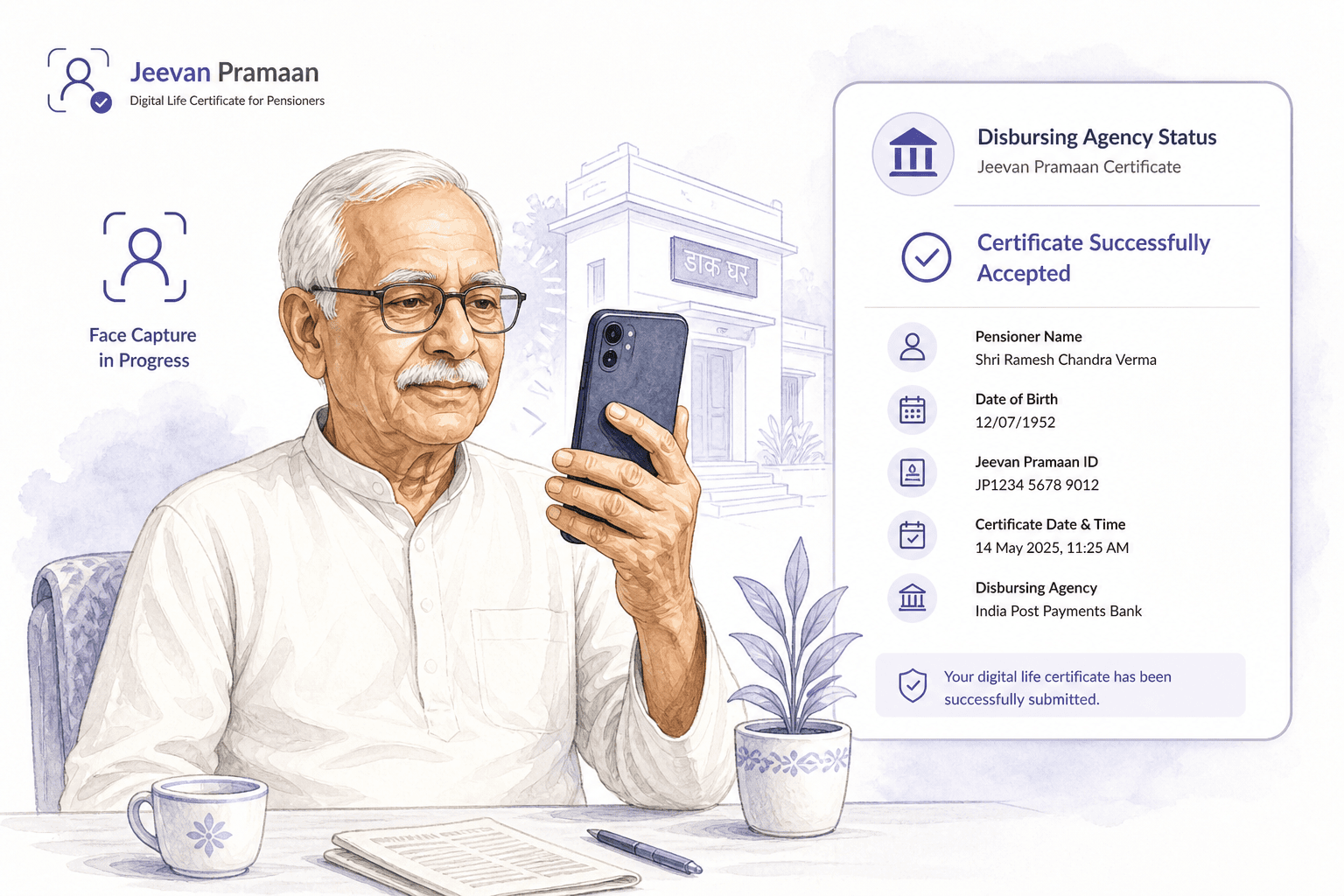
Recipient opens app or visits an agent → Face capture → Match to record → Certificate accepted → Payments continue
The match confirms similarity to the stored record. It does not confirm that the face is a living, real person.
Pensions and benefits / NeuroVerify
Pension funds and benefit agencies increasingly confirm that recipients are alive through a remote face capture. NeuroVerify checks that capture for deepfakes and manipulation beyond liveness, and returns one risk score with signal-level evidence before payments continue.
It runs on the face capture your digital proof-of-life flow already collects, so the recipient takes no extra step and you make one API call.
NeuroVerify does not confirm eligibility, identity records or payment entitlement, and it does not make the payment decision. Your programme rules and disbursing policy keep those decisions.
The gap
Pension and benefit programmes pay recipients for as long as they live. Traditionally, recipients appear in person or submit a certificate each year. Many programmes now accept a remote check: a face capture on a phone, sometimes assisted by a bank, post office or service centre. India's Jeevan Pramaan is one example of this model; the same need exists in many countries.
The remote check creates an opening. If a recipient has died, someone may try to keep the payments flowing. A face-swap, a generated video or an altered photo of the deceased can be used to answer the capture. Recipients who are frail may also be impersonated by a relative or an agent.
Recipient opens app or visits an agent → Face capture → Match to record → Certificate accepted → Payments continue
The match confirms similarity to the stored record. It does not confirm that the face is a living, real person.
Recipients are often older and less familiar with technology, so friction must stay low. Agents or relatives frequently help. Errors cost twice: a false accept pays someone who should not be paid, and a false reject stops a genuine pensioner's income. Evidence that a reviewer can read matters more here than in most flows. See synthetic media controls for government enrollment.
Threats
These are attack patterns, not claims about any specific programme.
Someone presents a generated or altered face to keep a deceased person's pension active.
An agent or relative masks the real person on camera with the recipient's face.
A previous real recording or photo is replayed through the app to satisfy the check.
A fabricated beneficiary with a generated face is added and maintained.
Software feeds a prepared clip into the capture step on a helper's device.
One operator submits many captures using re-rendered faces for multiple recipients.
Where NeuroVerify fits
NeuroVerify sits right after the face capture in your proof-of-life flow and before the certificate is accepted. The recipient, the assisting agent and your records match step all stay as they are.
Face capture → NeuroVerify risk score → Match to record → Certificate accepted, reviewed or held
One added call. The recipient takes the same capture as before.
Six signals run in one request: Visual Safety Screening, Live Presence Verification, Face Manipulation Detection, AI Generative Model Analysis, AI Pixel-Level Manipulation and AI Content Compliance. NeuroVerify analyses face images, video and audio. It does not analyse identity documents.
Government and public-sector programmes that need data kept inside their own boundary can deploy in a private cloud, on-premises or air-gapped. See government and deployment.
Pass the image or video your app or agent device already records.
Receive one score with signal-level evidence in the response.
Send high-risk captures to a human case worker and never cut off a genuine recipient automatically.
Keep the result for audits, appeals and disbursing-agency review.
What you get
Manipulated captures are flagged before a certificate is accepted.
Evidence supports a human review rather than an automatic rejection.
The same call covers phones, agent devices and service-centre captures.
Signal-level results explain why a capture was flagged.
Private cloud, on-premises and air-gapped options for public-sector rules.
Questions
No. Jeevan Pramaan is one example of digital proof of life. NeuroVerify applies to any programme in any country that confirms a recipient is alive with a face capture, whether through an app, an agent device or a service centre.
Treat the score as evidence for a human reviewer, not as an automatic stop. Set a review band in your policy, route high scores to a case worker, and offer an alternative way to prove life, such as an in-person check. The decision always stays with your programme.
Not for this purpose. Live Presence Verification is one of the six signals NeuroVerify runs in a single request, alongside Face Manipulation Detection, AI Generative Model Analysis, AI Pixel-Level Manipulation, Visual Safety Screening and AI Content Compliance. It checks face images, video and audio from proof-of-life captures for deepfakes and manipulation beyond liveness.
If you already run a liveness vendor, keep it during evaluation and compare outcomes on your own media before deciding what to retire. The difference is explained in Deepfake Detection vs Liveness Detection.
It fits the capture step you already run, so the end user sees nothing new. You send the media you already collect to one API call. Native mobile SDKs (Android/Kotlin, iOS/Swift, Flutter), backend SDKs (Python, TypeScript/Node.js, Go, Java) and a REST API are available, and an MCP server covers AI agents.
Two lines to integrate and live in under 24 hours are product claims. Your own timeline depends on how your proof-of-life flow is wired.
NeuroVerify returns in under 200 ms at p95 on eligible image requests under defined test conditions. The methodology is available on request. Video and audio take longer than a single image, so decide with your team which step runs inline and which runs in the background.
You choose the deployment model: managed cloud API, private cloud or customer VPC, secure container, on-premises, or air-gapped. Neural Defend holds ISO/IEC 27001, ISO/IEC 27701, ISO/IEC 42001 and SOC 2 Type II certifications. Your legal team decides consent, retention and residency for the media you send.
Details are on the deployment and product data handling pages. For the privacy angle, see GDPR, Biometrics, and Authenticity Analysis.
Yes, and that is the test that matters. On the public VendorBench-100 benchmark, NeuroVerify ranked first of 36 systems with a detection score (MCC) of 0.876 against 0.646 for the next-best vendor. A benchmark does not reflect your devices, lighting, compression or attack mix, so bring representative samples from your own journey.
Contact us to set up an evaluation.
NeuroVerify returns one unified risk score with signal-level evidence. It does not approve or reject anyone. Your policy sets the thresholds and decides what happens at each level: continue, step up to a manual review, or decline.
The signal-level evidence tells a reviewer why a case scored high, which makes review queues faster and decisions easier to explain later.
Evaluate NeuroVerify
Send face captures from your own programme and review the risk scores and evidence. Contact us to plan an evaluation.