
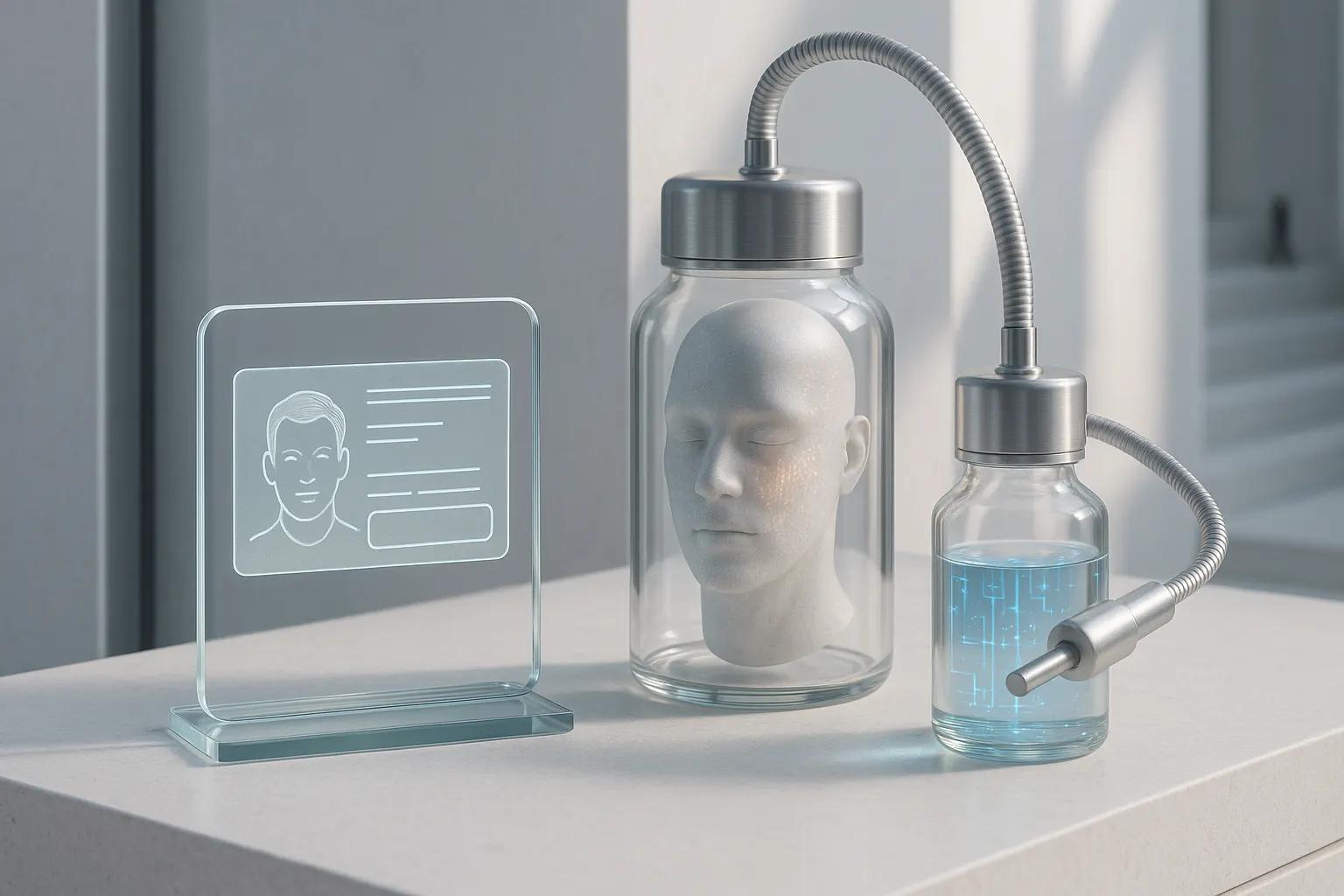
How does deepfake detection complement identity verification?
Identity verification establishes a binding: this person, this document, this claimed identity. Deepfake detection tests whether the biometric evidence used to make that binding is authentic. The two run on the same capture and answer different questions, which is why one cannot stand in for the other.
The difference shows up in how attacks are built. The World Economic Forum's January 2026 report Unmasking Cybercrime describes a deepfake KYC attack as a chain: prepare a stolen, purchased, forged or AI-generated identity document; generate face-swapped media that matches it; use camera injection tools to feed that media into the live biometric check; then rotate emulators, proxies and VPNs so many accounts do not link back to one device or address. A verification stack that only asks whether the face matches the document passes the second step, because the face was made to match.
Each link in that chain has a natural owner in your control set. Seeing the chain this way helps identity teams assign controls instead of expecting one vendor to cover everything.
| Attack stage | What the attacker does | Control that addresses it |
|---|---|---|
| Document misuse or forging | Uses a stolen, bought, forged or AI-generated ID | Document verification and data checks |
| Face swapping and synthetic media | Creates a face or video that matches the ID photo | Deepfake detection on the submitted media |
| Camera feed substitution | Injects synthetic video in place of the live camera | Injection attack detection, device and app integrity |
| Device manipulation | Rotates emulators and virtual environments | Device intelligence and attestation |
| Network layering | Uses residential proxies, mobile proxies or VPNs | Network and velocity risk signals |

What the 2026 WEF study of face-swap tools means for identity teams
The WEF report examined 17 face-swapping tools and eight camera injection tools collected from darknet forums, Telegram channels and social media between 1 July 2024 and 30 April 2025. Genuine real-time face swapping was uncommon: five tools demonstrated it, and three of those offered virtual-camera or equivalent injection paths suitable for live verification flows.
Quality was uneven. Six of the 17 tools preserved nuanced expressions well enough for natural dynamic video, and the report says timing slippage during challenge-response prompts was consistently observed as a failure point. It also notes that its findings rest on the tools' own documentation and websites rather than direct testing.
For identity teams, the takeaway is that challenge-response liveness still filters out most commodity tools, while the small set that works in real time is exactly what organised groups will pay for. Media analysis looks for blending, texture and generation traces in the frames themselves, so it does not depend on the attacker fumbling a prompt. The WEF report's own recommendations for KYC providers include stronger liveness and injection attack detection plus synthetic media forensics.
How does deepfake risk affect digital identity programs across APAC?
Deepfake risk reaches APAC digital identity programs through remote account opening and lending, where a face check is often the main link between a person and an identity card. Regulators in the region have mostly responded with guidance and enforcement action rather than deepfake-specific rules, so identity teams have to translate general fraud and technology risk expectations into concrete controls.
Hong Kong shows the attack pattern. In August 2023, police broke up a syndicate that, according to The Standard, used identity cards stolen from at least eight people to open 54 bank accounts and make up to 90 loan applications to 20 banks and financial institutions. Four loans were granted, involving HK$200,000, and an AI face-swap program got past facial recognition once. In a written Legislative Council reply on 26 June 2024, the Secretary for Security said nine people were arrested and described it as the first detected case involving AI face-swapping, with online loan applications made between September 2022 and July 2023.
Singapore shows the supervisory response. On 18 September 2025 the Monetary Authority of Singapore issued circular MAS/TCRS/2025/06 with an information paper on cyber risks associated with deepfakes, citing a global surge in deepfake-related incidents affecting financial institutions and setting out mitigation measures they could implement.
Programs that span several APAC markets face uneven rules, different national ID schemes and different data residency expectations. A single detection layer that runs the same way in each market, with deployment chosen per market, is simpler to govern than a patchwork. India's eKYC and V-CIP rules have their own guide on deepfake detection for KYC in India.

How to combine verification and detection results in one decision
Run deepfake detection on the same capture your verification vendor receives, in parallel, and combine both outputs in your own orchestration or decision layer. Keeping the decision with you means you can change thresholds, add signals or swap vendors without rebuilding the flow.
Write explicit rules for conflicts. A strong face match with a high manipulation score should hold the application, since that is the signature of a face built from the ID photo. A weak match with a clean authenticity score points to an ordinary mismatch or poor capture. Log every input, score, model version and rule that fired, so an auditor or investigator can reconstruct why a decision was made.
Ask the same questions of every component. NIST SP 800-63A-4 requires providers to test automated image analysis against available attack artifacts and to document false negative rates for relying parties on request. Gartner's February 2024 advice to security and risk leaders was to choose vendors that can show capabilities and a plan going beyond current standards, and that monitor and quantify new attack types.
What integration and latency look like for an identity team
Adding a detection layer is an API integration, not a platform change. NeuroVerify offers mobile SDKs for Android, iOS and Flutter, backend SDKs for Python, TypeScript, Go and Java, a REST API and an MCP server for AI agents. Neural Defend describes it as two lines to integrate and live in under 24 hours. The guide to integrating Neural Defend into an existing KYC stack walks through the wiring and regional notes.
Latency decides whether the check can sit in a live flow. NeuroVerify returns eligible image requests in under 200 ms p95 under defined test conditions. In the VendorBench-100 v2 paper's own still-image test setup, Neural Defend's mean latency was 175 ms, compared with 1.1 s for Sightengine, 1.7 s for Hive and 21.9 s for Reality Defender; the paper cautions that latency is not comparable across tracks.
Deployment follows your residency rules: managed cloud API, private cloud or VPC, secure container, on-premises or air-gapped, scoped during evaluation.
Where NeuroVerify fits in an identity stack, and where it stops
NeuroVerify is the authenticity layer. One call runs six signals on a face image, video or audio clip (Visual Safety Screening, Live Presence Verification, Face Manipulation Detection, AI Generative Model Analysis, AI Pixel-Level Manipulation and AI Content Compliance) and returns a unified risk score with signal-level evidence. The models build on ARCAS 1B, Neural Defend's deepfake detection foundation model.
On the public VendorBench-100 benchmark of 100 adversarial still images, Neural Defend ranked first of 36 systems with an MCC of 0.876, against 0.646 for the next vendor. One VendorBench author also co-authored the ARCAS paper; the corpus and results are public, so teams can rerun them. Neural Defend holds ISO/IEC 27001, ISO/IEC 27701, ISO/IEC 42001 and SOC 2 Type II certifications.
It stops at the media. NeuroVerify does not verify ID documents, check databases, detect emulators or virtual cameras, or make the identity decision. Those stay with your verification vendor, device tooling and policy, and that division is what makes the combination stronger than either part alone.
Evidence boundary
Limitations
- The WEF tool evaluation is based on the tools' published claims, not direct testing, so capability counts may understate or overstate real performance.
- Hong Kong and Singapore examples illustrate the region; APAC rules differ by market and this page is not a regulatory survey.
- VendorBench-100 latency figures come from the paper's own still-image setup and are not comparable across tracks or to video workloads.
- NeuroVerify does not analyse identity documents or device state, so it complements rather than replaces identity verification and injection controls.
Source record
Sources and references
- World Economic ForumUnmasking Cybercrime: Strengthening Digital Identity Verification against DeepfakesPublished January 1, 2026. Verified October 19, 2026.
- The Standard (Hong Kong)Six arrested for defrauding HK$200,000 using deepfake face swap programPublished August 25, 2023. Verified October 19, 2026.
- Hong Kong SAR GovernmentLCQ9: Combating frauds involving deepfake (written reply by the Secretary for Security)Published June 26, 2024. Verified October 19, 2026.
- Monetary Authority of SingaporeCircular MAS/TCRS/2025/06: Cyber Risks Associated with DeepfakesPublished September 18, 2025. Verified October 19, 2026.
- National Institute of Standards and TechnologySP 800-63A-4, Digital Identity Guidelines: Identity Proofing and Enrollment (HTML edition)Published July 1, 2025. Verified October 19, 2026.
- GartnerGartner Predicts 30% of Enterprises Will Consider Identity Verification and Authentication Solutions Unreliable in Isolation Due to AI-Generated Deepfakes by 2026Published February 1, 2024. Verified October 19, 2026.
- arXivVendorBench-100: A Unified Cross-Paradigm Benchmark for Deepfake Image Detection (v2)Published July 29, 2026. Verified October 19, 2026.