
Proposer joins video call → Document shown → Face matched → Policy issued
All checks pass on process, and the face on the call may be synthetic.
Insurance video KYC / NeuroVerify
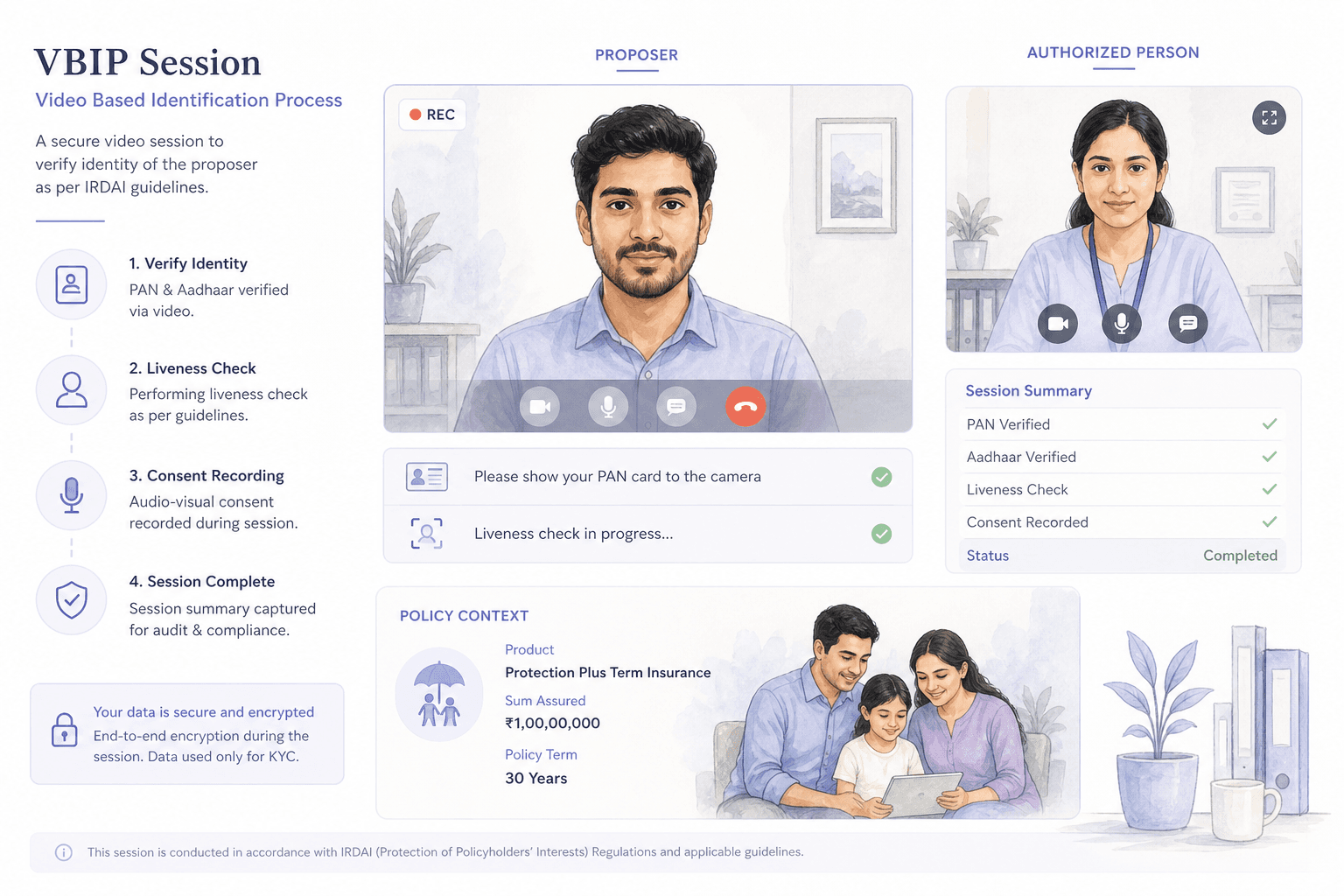
Insurers and brokers verify proposers by video call at policy purchase and when claims or changes arrive. Attackers use synthetic faces and voices to buy, take over or claim against policies, and NeuroVerify checks that media for manipulation beyond liveness. India's VBIP is one regulated example.
It uses the selfie, video or audio your journey already collects, in one API call, with no extra step for the customer.
NeuroVerify does not underwrite, verify identity documents or decide claims; it adds authenticity evidence to your own underwriting and claims policy.
The gap
Insurers have moved policy sales, servicing and claims to digital channels. A video call or selfie often stands in for an in-person meeting. Some regimes formalise this: India's IRDAI allows video-based identification (VBIP) for policyholders, and other markets accept remote identification under their own rules.
The checks around that video are designed for identity and process: a document, a face match, an agent on the line. None is designed to tell whether the face or voice was generated.
Long-tail value. A policy can sit quietly for years and pay out later. Fraud placed at onboarding surfaces at claim time, when the cost is higher and evidence is harder to rebuild.
Many touchpoints. Purchase, nominee or beneficiary change, premium refund and claim each rely on a face, a voice or a short video.
Third-party channels. Brokers, agents and partner apps capture media on devices the insurer does not control.
Proposer joins video call → Document shown → Face matched → Policy issued
All checks pass on process, and the face on the call may be synthetic.
The same weakness affects claims media. See deepfake detection for insurance for the wider picture.
Threats
These are attack techniques, not claims about any insurer. Each uses manipulated faces or voices at a moment where the insurer relies on remote trust.
A generated or swapped face joins the call to buy a policy under a stolen or fabricated identity.
A real-time swap lets an attacker answer agent questions while showing someone else's face.
A cloned voice or swapped face requests a nominee change, address update or surrender on someone else's policy.
A synthetic video or photo is submitted as proof of identity or as part of a claim file.
A virtual camera feeds media into a broker or partner app, so the insurer receives a clean stream with no real capture behind it.
The same manipulated face appears on many proposals under different names, hiding a pattern that single-file review misses.
Regulators in many markets ask insurers to apply risk-based customer due diligence and to understand the technology they rely on for remote onboarding, as in FATF digital identity guidance.
NeuroVerify supports those controls with evidence. It does not make a programme compliant; your policy decides.
Where NeuroVerify fits
NeuroVerify runs after your journey captures a selfie, video or voice sample and before your underwriting, servicing or claims policy acts. One request checks for deepfakes and manipulation beyond liveness.
Proposal → Video call → Document and face match → Policy issued
Process checks pass without any authenticity signal.
Proposal → Video call → NeuroVerify risk score → Document and face match → Policy issued or reviewed
The same journey, with evidence attached to each case.
- Visual Safety Screening - Live Presence Verification - Face Manipulation Detection - AI Generative Model Analysis - AI Pixel-Level Manipulation - AI Content Compliance
The same API can screen selfies and media at servicing and claims touchpoints. See claims, refunds and account recovery and NeuroVerify.
Keep your existing video call, selfie or voice capture in the app, broker portal or call.
Post the media from your backend, mobile SDK or REST API in a single request.
Get one risk score with signal-level evidence you can store on the policy or claim file.
Issue, send to underwriting or fraud review, or step up verification, based on thresholds you define.
What you get
Catching a synthetic proposer at onboarding avoids the larger cost of finding the problem at claim time.
The same API screens faces, video and voice wherever remote trust is used, so teams do not need a different tool per touchpoint.
Media is checked on your backend or via SDK, so a partner-captured selfie can be screened regardless of channel.
Signal-level evidence travels with the file, which helps special investigation units explain why media was flagged.
The score feeds your existing rules. You keep the decision and the thresholds.
Questions
No. VBIP is one regulated example. NeuroVerify checks face images, video and audio from any insurance journey in any country, including purchase, servicing and claims.
NeuroVerify is not meant to sit next to a liveness product as a second vendor. Live Presence Verification is one of the six signals in the same request, alongside Face Manipulation Detection, AI Generative Model Analysis, AI Pixel-Level Manipulation, Visual Safety Screening and AI Content Compliance. It checks proposer selfies, video and audio for deepfakes and manipulation beyond liveness.
Standalone liveness is usually built around physical presentation: a printed photo, a mask, a screen held to a lens. It was not designed to tell you whether the face or voice inside a stream was generated or injected. Many teams keep their existing liveness vendor during evaluation and compare outcomes on their own media before deciding what to retire. See deepfake detection vs liveness detection.
Call it after your journey captures the proposer media and before underwriting or claims policy acts. Send the media you already capture to one REST endpoint, or use a native mobile SDK (Android/Kotlin, iOS/Swift, Flutter) or a backend SDK (Python, TypeScript/Node.js, Go, Java). An MCP server is available for AI agents.
Integration is two lines of code in the common case, and teams can go live in under 24 hours. Your end users see no new step.
NeuroVerify analyses face images, video and audio. It can screen selfies, videos and voice notes attached to a claim. It does not analyse documents, receipts or damage photos of property, so keep your existing checks for those. See insurance claims media evidence review.
Neural Defend analyses the media you send and returns a risk score with signal-level evidence. Consent, retention and residency stay under your policy. Neural Defend holds ISO/IEC 27001, ISO/IEC 27701, ISO/IEC 42001 and SOC 2 Type II certifications.
Read the product data handling page and the trust centre for specifics, and ask us for the details your security review needs.
NeuroVerify returns in under 200 ms p95 on eligible image requests under defined test conditions. The methodology is available on request.
Latency for video and audio depends on length and deployment, so we measure it with you on your own traffic during evaluation.
Yes, and it is the only test that counts. Published benchmarks do not reflect your devices, codecs or compression. Neural Defend ranks first of 36 systems on VendorBench-100 (MCC 0.876 against 0.646 for the next-best vendor), but your proposer and claims media is the better yardstick.
Bring representative genuine and suspected-fake samples and your current decision states, and we will run them through the API with you.
Evaluate NeuroVerify
Run proposer and claims media through NeuroVerify on your own samples. We will show you the scores and signals and help set thresholds for underwriting and fraud review.