
Identity record supplied → Selfie or video capture → Face match → eSIM or SIM issued → Number active or port approved
The capture step is often the only live check before a number is issued or moved.
Telecom onboarding / NeuroVerify
Mobile operators and MVNOs in many countries now activate SIMs, eSIMs and number ports through a remote selfie or video step. NeuroVerify checks that media for deepfakes and manipulation beyond liveness and returns one unified risk score with signal-level evidence.
It runs behind the face-capture step your self-service or assisted activation already uses: no new step for the subscriber, one API call.
NeuroVerify does not verify identity documents or national registry records and does not authorise activations; it adds authenticity evidence for your own policy.
The gap
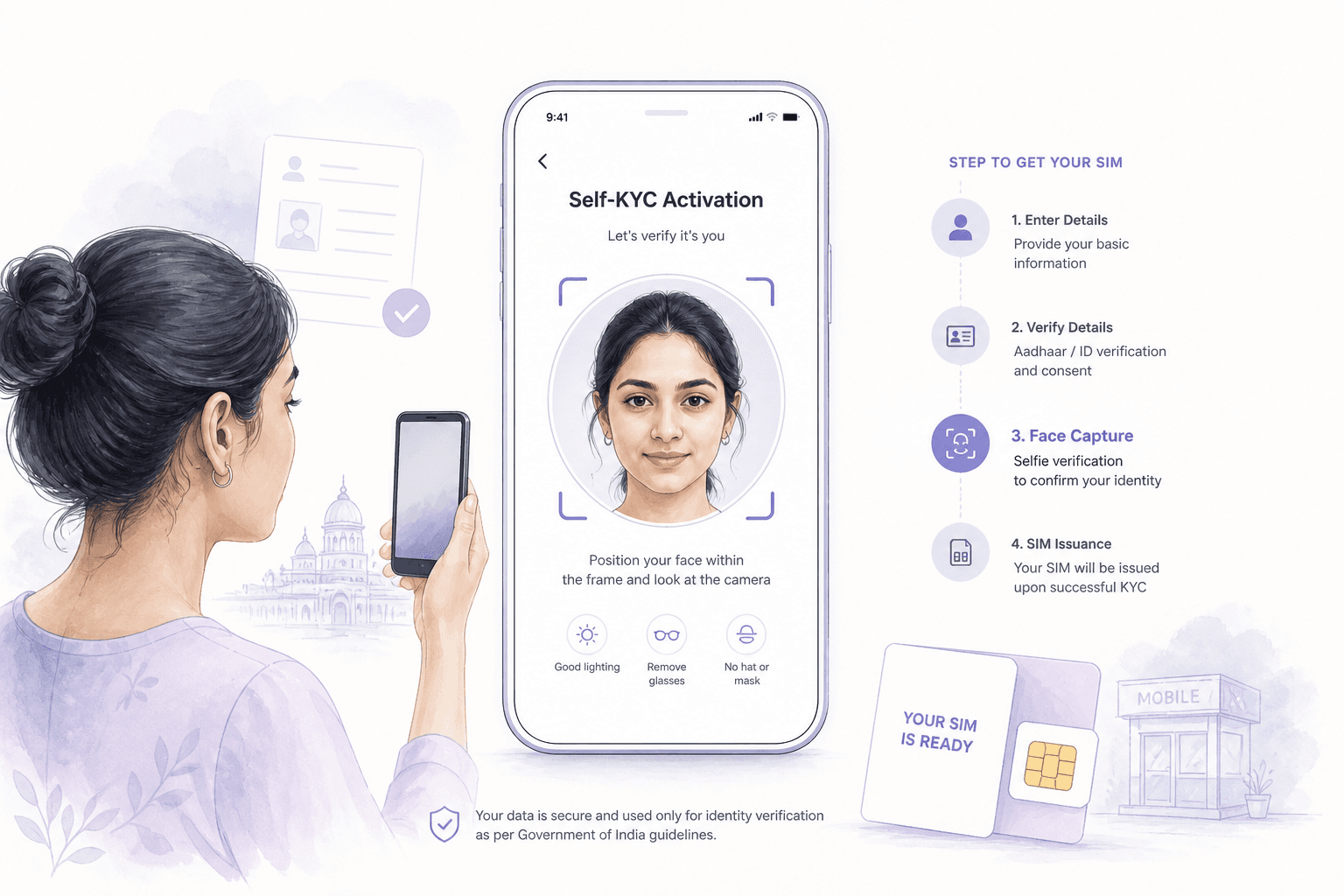
A mobile number now anchors bank logins, messaging accounts, one-time passcodes and account recovery. That makes the process of getting or moving a number a high-value target. Operators in many markets have moved SIM activation, eSIM provisioning, number porting and re-verification online, using a selfie or video step to link a subscriber to an identity record.
Identity record supplied → Selfie or video capture → Face match → eSIM or SIM issued → Number active or port approved
The capture step is often the only live check before a number is issued or moved.
Registry or document checks confirm an identity record exists. Face match confirms two images look alike. Liveness confirms a prompt was satisfied. None of those tells you whether the face was generated, swapped or injected.
Bulk activation makes this worse. A network that needs many numbers, for relay, scam calling or mule accounts, can try each identity many times with low-cost tools.
Ported and re-issued numbers matter for a different reason. A successful port or SIM swap can let an attacker receive one-time passcodes for the victim's accounts, so the cost of one bad activation goes beyond the telecom operator.
Threats
These are techniques, not claims about any operator. Each defeats a remote subscriber check.
Many numbers are activated under borrowed or synthetic identities, then used for scams, relay and account takeover.
A generated or swapped face is built from a stolen identity record and submitted as the live capture.
A prepared video is presented as the device camera in a web or app flow, so the operator receives a clean stream.
A printed photo or screen is held up to the camera to pass basic liveness.
Manipulated face evidence is used to authorise the move of a victim's number to a new operator or SIM.
A remote eSIM request is approved with the wrong person's face, which can transfer access to a number instantly.
Repeated use of one face across many activations is also a signal worth reviewing.
Where NeuroVerify fits
NeuroVerify sits behind the selfie or video capture in your activation, porting and re-verification flows. You send the media you already collect. It returns one unified risk score with evidence from six signals, and your policy decides whether to issue, step up or hold.
It checks face, video and audio evidence. It does not analyse ID documents. Operators can also send voice samples where a call-based step is part of the journey.
Pass the media from your existing capture step to the API with an SDK or REST.
Get one score with signal-level evidence in a single response.
Issue, step up to an assisted channel, hold a port for review or decline, by product and risk.
Store the output for fraud, compliance and dispute teams.
What you get
Add a check for generated and swapped faces to remote SIM and eSIM issuance.
Add authenticity evidence to port requests that affect other accounts.
Signal-level output helps spot repeated faces and templated attacks.
The capture the subscriber already completes is the input.
Run in the cloud, in your VPC, on-premises or air-gapped.
Questions
It sits behind the selfie or face-capture step you already run. You send the image, video or audio you already collect to one API call, and the response comes back with a unified risk score and signal-level evidence. The end user sees no new step.
Integration uses native mobile SDKs (Android/Kotlin, iOS/Swift, Flutter), backend SDKs (Python, TypeScript/Node.js, Go, Java) or the REST API. Two lines to integrate and live in under 24 hours are product claims; your own environment and review process set the real timeline.
Liveness asks whether a live person appears to be in front of the camera. It was designed around printed photos, screen replays and masks. It does not ask how the media was produced, so a face swap, a fully synthetic face or an injected stream can satisfy it.
NeuroVerify checks for deepfakes and manipulation beyond liveness. Keep your liveness vendor and add the authenticity evidence next to it. See deepfake detection vs liveness detection.
One unified risk score, plus evidence from six signals: Visual Safety Screening, Live Presence Verification, Face Manipulation Detection, AI Generative Model Analysis, AI Pixel-Level Manipulation and AI Content Compliance.
Your policy decides what happens next: approve, step up, route to manual review or decline. NeuroVerify does not approve or reject the subscriber or the number.
Latency is under 200 ms p95 on eligible image requests under defined test conditions. The methodology is available on request, so you can compare it with your own traffic.
On the public VendorBench-100 benchmark, NeuroVerify ranked first of 36 systems, with a detection score (MCC) of 0.876 against 0.646 for the next-best vendor.
Deployment options are a managed cloud API, private cloud or customer VPC, a secure container, on-premises, and air-gapped. Pick the one that matches your data residency and security requirements.
The platform holds ISO/IEC 27001, ISO/IEC 27701, ISO/IEC 42001 and SOC 2 Type II certifications. For handling details, see product data handling and the trust centre.
Yes. Send a representative sample of activation, port and re-verification captures across channels and device types and compare the scores with your own labels. Include genuine captures from low-end handsets and poor lighting so you can see how thresholds behave on real users, not just on attacks.
Contact the team to set up an evaluation. See also how to evaluate a detection API.
Yes, wherever the journey captures a face image or video. Assisted channels can add risk because staff handle the device, so many operators score every channel the same way and compare results by channel.
Evaluate NeuroVerify
Send NeuroVerify a sample of your SIM, eSIM and porting selfies and compare the scores with the checks you run today.