
Registration with photo → Pre-exam check-in selfie → Proctored session video → Face match at each stage → Result and certificate
Each stage depends on the face being real. If it is not, every match still reports the registered candidate.
Online exams and assessments / NeuroVerify
Exam bodies, universities, certification programs and hiring platforms rely on a face check to confirm the right candidate sits the test. NeuroVerify checks registration selfies and proctoring video for deepfakes, swaps and replays, and returns one risk score with evidence.
It fits the selfie or proctoring check-in your platform already runs: no new step for the candidate, one API call.
NeuroVerify does not verify ID documents, monitor screens or detect cheating behaviour. It adds authenticity evidence about the face and video; your exam integrity policy decides.
The gap
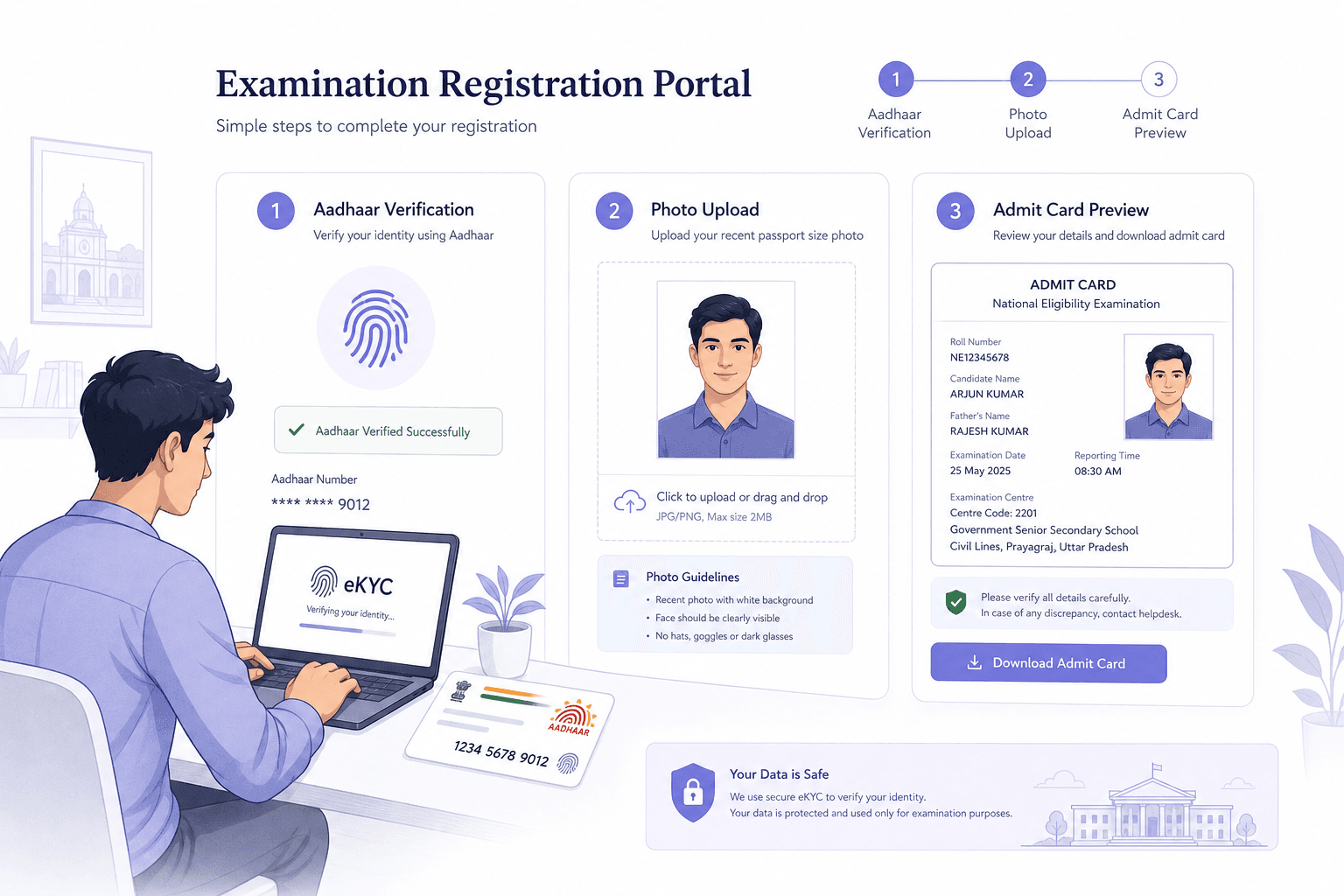
Exam platforms verify candidates at registration, check in again before the test and may record video during it. Face matching ties each of those moments back to the registered identity.
That chain only works if the media is genuine. A proxy test-taker can present a swapped face, a pre-recorded video or a generated selfie. Face match passes because it compares faces, and basic liveness may miss generated or injected streams.
Registration with photo → Pre-exam check-in selfie → Proctored session video → Face match at each stage → Result and certificate
Each stage depends on the face being real. If it is not, every match still reports the registered candidate.
Results, certificates and hiring decisions rest on the claim that the named person did the work. Impersonation undermines that claim for the candidate, the institution and everyone who relies on the credential.
For hiring platforms, the same issue shows up in remote assessments. See Deepfake Controls for Remote Hiring.
Threats
These are attack techniques seen in remote assessment, not claims about any specific exam body.
Someone registers with a generated or swapped face built from the real candidate photo, so the proxy can later sit the exam as them.
A different person presents a face swap or injected video at check-in, then sits the test while the registered face is shown.
A photo or video of the real candidate is shown on a second screen to the webcam. Simple checks may accept it as live.
A real-time swap runs through the video feed during the session, so the proctor and the matcher see the registered candidate.
At test centres with camera check-in, candidates sell their slot and a substitute uses manipulated media to pass.
One manipulated face appears across multiple registrations, sessions or institutions, each reviewed alone.
Where NeuroVerify fits
NeuroVerify sits behind each face capture in your exam platform. Run it at registration, at pre-exam check-in and on sampled frames from proctoring video, then use the result in your integrity rules.
Registration → Check-in selfie → NeuroVerify at each capture → Face match → Proctored session with sampled frames → Risk score and integrity policy
The same call runs at each stage. Your proctoring and exam delivery tools stay as they are.
NeuroVerify checks the face image, video or audio for deepfakes and manipulation beyond liveness. All six signals run together and resolve into one risk score:
- Visual Safety Screening - Live Presence Verification - Face Manipulation Detection - AI Generative Model Analysis - AI Pixel-Level Manipulation - AI Content Compliance
The response carries the unified score plus signal-level evidence. Your own policy makes the final decision.
Your proctoring tools and reviewers, your ID document checks, your exam rules and appeal process, your consent and retention rules, and the decision on every candidate.
Pass the image or frames your platform already captures at registration, check-in or during the session.
Use the REST API or an SDK from your assessment platform.
Store the score and signal evidence in the candidate record.
Continue, flag for proctor review or hold results under your own integrity rules.
What you get
Swapped, generated and replayed faces are flagged before they undermine a result.
Signal-level output gives reviewers and appeals panels a clear basis.
Reviewers look at flagged sessions instead of watching everything.
Institutions and employers can rely more on results from remote exams.
The check runs on selfies and video you already collect.
Questions
Liveness answers whether a live person appears to be in front of the camera. It was built for presentation attacks such as a printed photo, a mask or a screen held to the lens. It was not built to tell whether the stream reaching your server came from a camera at all, or whether the face inside it was generated or swapped.
NeuroVerify runs inside the selfie or video step you already have. Live Presence Verification is one of its six signals, and the other five look for face manipulation, generative-model traces, pixel-level edits and unsafe content in the same request. For exams, that includes video from proctoring sessions, not only a single selfie. You can keep your current liveness vendor during an evaluation and compare outcomes on your own media. See deepfake detection vs liveness detection.
No. NeuroVerify checks face images, video and audio for deepfakes and manipulation. It does not monitor screens, browsers or behaviour. Keep your proctoring tools for that.
At registration, at pre-exam check-in and on sampled frames during the session. Running it at each stage makes it harder for a substitute to pass by switching in late.
NeuroVerify offers native mobile SDKs (Android/Kotlin, iOS/Swift, Flutter), backend SDKs (Python, TypeScript/Node.js, Go, Java) and a REST API. Integration is two lines of code, and teams can be live in under 24 hours.
Native mobile SDKs suit apps for candidates, and backend SDKs suit assessment platforms. Teams can be live in under 24 hours.
NeuroVerify analyses the face images, video or audio you send and returns a risk score with evidence. Candidates may be minors or in strict privacy regimes, so keep consent, retention and residency under your policy. See GDPR, biometrics and authenticity analysis. Consent, retention and residency stay under your policy. See product data handling for how media is treated.
Deployment options include the managed cloud API, private cloud or customer VPC, a secure container, on-premises and air-gapped environments. Neural Defend holds ISO/IEC 27001, ISO/IEC 27701, ISO/IEC 42001 and SOC 2 Type II certifications, shown on the trust page.
NeuroVerify targets under 200 ms at p95 on eligible image requests under defined test conditions. The test methodology is available on request, so you can check it against your own media sizes and network path.
It is one API call on media you already capture, so it adds a single request rather than a new user step. Peak exam windows create bursts, so test throughput as well as latency.
NeuroVerify returns one unified risk score and signal-level evidence. It does not approve or reject anyone. Your policy sets the thresholds and decides what each band does.
Mid-band results usually go to a human proctor for a quick review rather than automatic disqualification.
Yes, and that is the test that matters. Public results help: NeuroVerify ranked first of 36 systems on VendorBench-100, with a detection score of MCC 0.876 against 0.646 for the next-best vendor. But your capture devices, compression and attack mix decide real performance.
Use authorized samples from registration, check-in and proctoring video, across the devices and lighting your candidates use. Compare scores and evidence against your current decisions. For a vendor shortlist, see the top 5 deepfake detection APIs.
Evaluate NeuroVerify
Bring authorized media from your own journey. NeuroVerify returns a risk score with signal-level evidence, so you can compare it with your current checks before changing anything.