
Where deepfake detection fits in bank customer onboarding
A remote onboarding flow answers several separate questions, and deepfake detection answers only one of them: is the face in this selfie or video a real, unaltered person in front of a camera? It runs at capture, before the face is compared with the ID photo, because a face match between two fakes proves nothing.
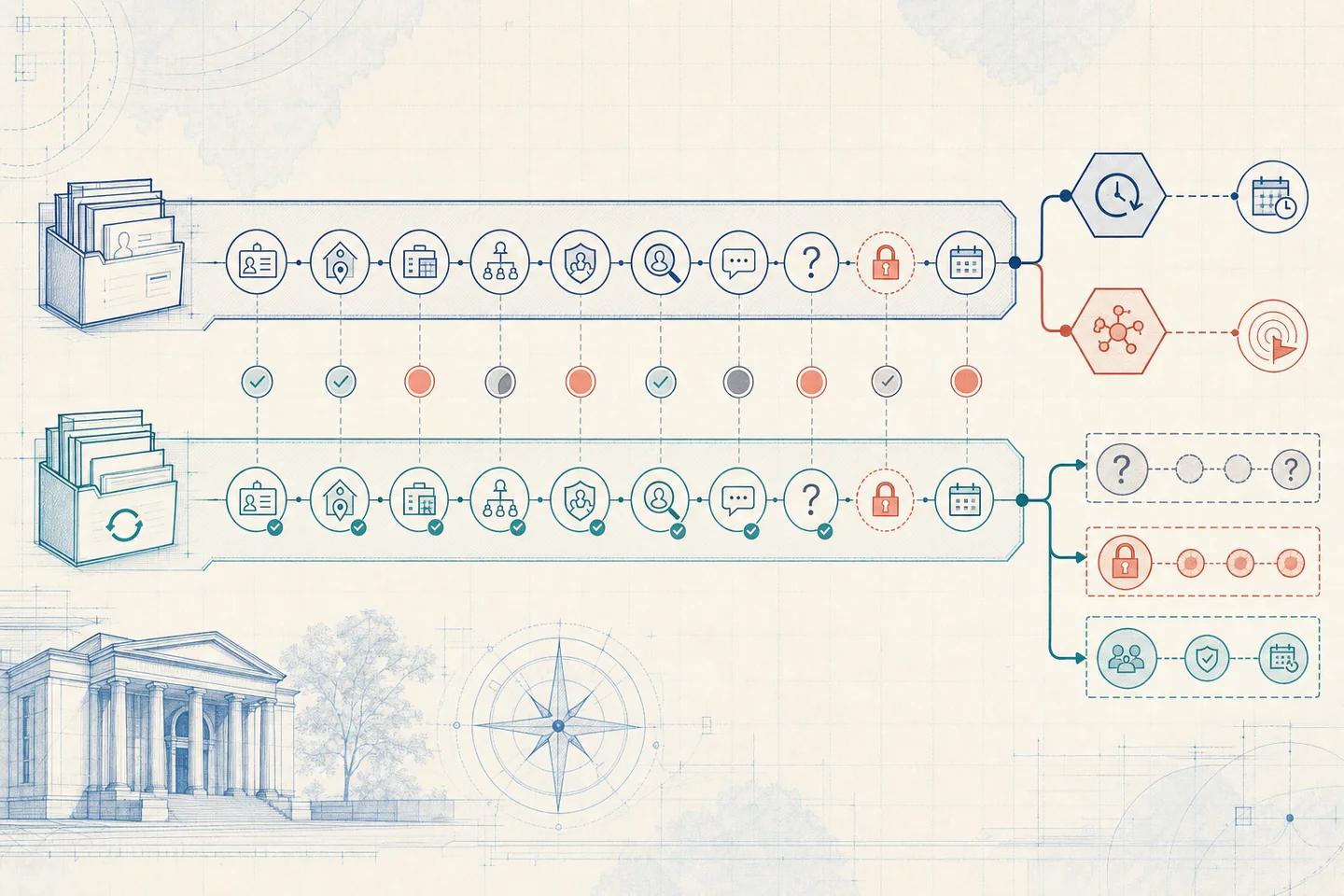
The table shows a typical sequence. Keep each check's result as its own field in the application record, so a reviewer can see which one raised the concern and an auditor can confirm none was skipped.
| Step | Question answered | Typical owner |
|---|---|---|
| 1. Consent and data capture | Do we have the applicant's details and permission to process biometrics? | Onboarding product |
| 2. Document validation | Is the ID genuine, unaltered and consistent with the entered data? | Document verification vendor |
| 3. Selfie and video capture with deepfake analysis | Is this a live, unmanipulated face on a genuine capture path? | Fraud and identity team |
| 4. Face comparison | Does the live face match the ID photo? | Identity verification vendor |
| 5. Sanctions, PEP and adverse media screening | Is the person someone we cannot onboard? | Financial crime compliance |
| 6. Duplicate and synthetic identity checks | Has this face, device or data appeared under another name? | Fraud analytics |
| 7. Decision routing | Approve, step up, review or decline? | Policy engine and reviewers |
What FinCEN has seen at account opening
FinCEN's alert FIN-2024-Alert004 says suspicious activity reports describing deepfake media rose from 2023 into 2024, and that criminals used generative AI to alter or create images for driver's licences, passport cards and passports. Some combined generated images with stolen or fake personal data to build synthetic identities. Accounts opened this way received and laundered proceeds from scams, check fraud, credit card fraud, authorised push payment fraud, loan fraud and unemployment fraud.
The alert also describes how fraudsters behave in a live check. They may claim repeated technical glitches, ask to switch communication method, or use third-party webcam plugins that display previously generated video instead of a live feed. Most of FinCEN's red flags can be tested during onboarding:
- The photo shows visual tells of alteration or does not fit the date of birth.
- Several identity documents are inconsistent with each other.
- A third-party webcam plugin is used, or the applicant tries to change channel citing glitches.
- The applicant declines multifactor authentication.
- A reverse image search matches the photo to a gallery of AI-generated faces.
- Commercial or open-source deepfake detection software flags the photo or video.
- Geographic or device data does not match the identity documents.
Configuring the deepfake check: step by step
The steps below assume a mobile or web capture flow that already runs document verification and face matching. They add a deepfake signal without changing the vendor that handles documents.
Steps 3 and 4 matter most for operations. A three-band design keeps honest applicants moving while giving reviewers a manageable queue, and storing the model version lets you explain any decision later.
- Capture the selfie and liveness video in your app using the NeuroVerify Android, iOS or Flutter SDK, or send captured media from your backend through the Python, TypeScript, Go or Java SDK.
- Send each capture to NeuroVerify and store the unified risk score, the six signal-level results and the request timestamp in the application record.
- Set three bands: clear (continue to face match), uncertain (ask for one fresh capture), and high risk (hold and send to review). Calibrate the cut-offs on your own genuine and attack samples.
- Record the model version and policy version with every decision so later reviews compare like with like.
- Cap retries per device and identity, since repeated attempts with small changes are a probing pattern.
- Feed high-risk results to your duplicate-identity check, so the same synthetic face is caught if it returns under another name.
How reviewers should handle a flagged application
A reviewer receives the application with every check's result, not just the deepfake score. Their job is to decide whether the evidence together supports opening the account, and to record why.
Start with the signal-level evidence: which of the six signals raised the score, such as Face Manipulation Detection or AI Generative Model Analysis. Then compare against the other checks. A manipulation flag combined with a document inconsistency, a mismatched device location and a request to switch channels is a strong pattern. A flag on a single low-quality capture from an otherwise consistent applicant may justify a fresh capture or an assisted route instead.
Do not tell the applicant which signal fired; that teaches attackers what to fix. If the case is suspicious, FinCEN asks US institutions to reference the alert in suspicious activity reports with the key term FIN-2024-DEEPFAKEFRAUD. The page on the FinCEN deepfake fraud alert covers the filing details.
Regulatory anchors for remote onboarding controls
Three references shape most remote onboarding designs. NIST SP 800-63A-4, published in July 2025, requires remote proofing services to implement presentation attack detection tested to ISO/IEC 30107-3:2023 with an impostor attack presentation accept rate below 0.07, to analyse submitted media for manipulation, and to raise confidence that media came from a genuine sensor.
In the EU, the European Banking Authority's Guidelines on the use of remote customer onboarding solutions (EBA/GL/2022/15) have applied since 2 October 2023 to credit and financial institutions in scope of the Anti-Money Laundering Directive. The FATF Guidance on Digital Identity asks regulated entities to understand the assurance level of any digital identity system they rely on for customer due diligence.
None of these names a product, and none says a deepfake check alone satisfies customer due diligence. They describe outcomes, and the bank decides which controls deliver them.
Why NeuroVerify suits the onboarding capture step
NeuroVerify was built for exactly this step. One request runs six signals: Visual Safety Screening, Live Presence Verification, Face Manipulation Detection, AI Generative Model Analysis, AI Pixel-Level Manipulation and AI Content Compliance. It returns one unified risk score with signal-level evidence, and eligible image requests complete in under 200 ms p95 under defined test conditions, so applicants do not wait.
The models build on ARCAS 1B, Neural Defend's own detection model. On the public VendorBench-100 benchmark of 100 adversarial still images, including face swaps, Neural Defend ranked first of 36 systems with an MCC of 0.876 against 0.646 for the next vendor. One VendorBench author also co-authored the ARCAS paper, and the benchmark does not test video or injection; the corpus is public for anyone to rerun.
Banks can deploy NeuroVerify as a managed cloud API, in a private cloud or VPC, on premises or air-gapped, and Neural Defend holds ISO/IEC 27001, ISO/IEC 27701, ISO/IEC 42001 and SOC 2 Type II certifications. NeuroVerify does not analyse ID documents and does not decide whether to open an account; it supplies evidence to your existing policy.
Evidence boundary
Limitations
- A deepfake score does not prove identity, eligibility or intent; customer due diligence and screening remain separate obligations.
- NeuroVerify does not analyse ID documents, so generated or altered IDs must be caught by document verification.
- Cut-offs must be calibrated on each bank's own applicant population; thresholds from one bank do not transfer.
- VendorBench-100 measures still images only and shares an author with the ARCAS paper.
Source record
Sources and references
- Financial Crimes Enforcement Network (FinCEN)FIN-2024-Alert004: FinCEN Alert on Fraud Schemes Involving Deepfake Media Targeting Financial InstitutionsPublished November 13, 2024. Verified October 19, 2026.
- National Institute of Standards and TechnologySP 800-63A-4, Digital Identity Guidelines: Identity Proofing and EnrollmentPublished July 1, 2025. Verified October 19, 2026.
- European Banking AuthorityGuidelines on the use of remote customer onboarding solutions (EBA/GL/2022/15)Published November 22, 2022. Verified October 19, 2026.
- Financial Action Task ForceGuidance on Digital IdentityPublished March 6, 2020. Verified August 7, 2026.
- FBI Internet Crime Complaint CenterI-120324-PSA: Criminals Use Generative Artificial Intelligence to Facilitate Financial FraudPublished December 3, 2024. Verified October 19, 2026.
- arXivVendorBench-100: A Unified Cross-Paradigm Benchmark for Deepfake Image DetectionPublished July 29, 2026. Verified October 19, 2026.