How did StyleGAN change synthetic face generation?
StyleGAN, posted by Tero Karras, Samuli Laine and Timo Aila of NVIDIA in December 2018 and published at CVPR 2019, changed how a generator receives its instructions. Earlier GANs fed a random code straight into the network. StyleGAN first passed that code through a mapping network into an intermediate space, then injected the result as a style at every resolution of the image. Coarse layers shaped pose and face structure; finer layers shaped skin texture, hair strands and colour.
The authors report that the design learned, without labels, to separate high-level attributes such as pose and identity from stochastic detail such as freckles and hair, and that it allowed intuitive control at each scale. It also improved standard quality metrics, interpolated more smoothly between faces, and came with a new, highly varied face dataset. For the first time, an unconditional generator produced portraits most viewers could not tell from photographs, and gave users handles to adjust them.
Why do StyleGAN faces fool people so reliably?
Because, by 2020, the obvious defects were gone and what remained was subtle. A 2022 study in PNAS by Sophie Nightingale and Hany Farid tested StyleGAN2 faces on people directly. Across 315 participants, accuracy at telling real from synthetic faces was 48.2%, roughly chance. A second group of 219 people who received training and feedback reached 59.0%. A third group rated synthetic faces as slightly more trustworthy than real ones, 4.82 against 4.48 on a seven-point scale.
Those numbers explain why generated profile photos became a staple of fake accounts. The FBI's December 2024 public service announcement lists realistic profile photos and fake identification images among the ways criminals use generative AI. A face that no human reviewer can reject on sight shifts the work to procedure, provenance and machine detection.
How did StyleGAN2 and StyleGAN3 remove the tell-tale artifacts?
StyleGAN2, posted in December 2019, set out to find and fix the characteristic artifacts of the first version. The team redesigned the generator's normalization, revisited progressive growing and added a path length regularizer. That regularizer made the generator easier to invert, and the authors note that this lets a generated image be traced back to the network that produced it, an early form of model attribution.
StyleGAN3, published as Alias-Free GAN in June 2021, addressed a quieter problem: fine detail that appeared glued to image coordinates rather than moving with the face. The authors traced it to aliasing in the generator and rebuilt the signal processing so the network became equivariant to translation and rotation, which they suggest suits video and animation. Each release removed a cue that someone could have used to spot its predecessor.
| Version | Date | Main change | Effect on detection cues |
|---|---|---|---|
| StyleGAN | Dec 2018 (CVPR 2019) | Mapping network and per-scale styles | Characteristic artifacts later documented by its successor |
| StyleGAN2 | Dec 2019 (CVPR 2020) | New normalization, path length regularization | Removed those artifacts; easier inversion enabled attribution |
| StyleGAN3 | Jun 2021 (NeurIPS 2021) | Alias-free signal processing | Reduced coordinate-locked texture, a cue visible in animation |
Is a StyleGAN face a deepfake of a real person?
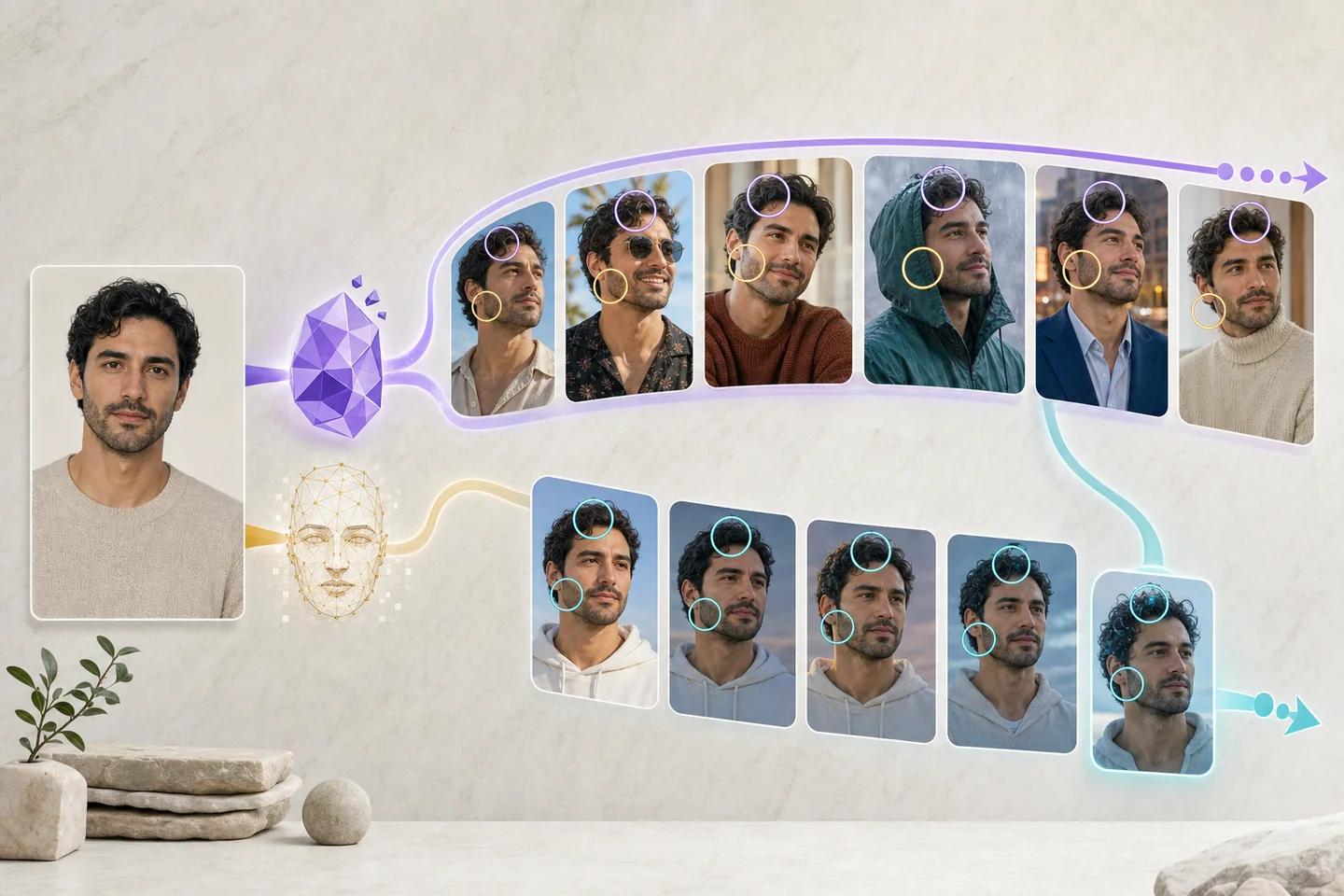
Usually not. Unconditional StyleGAN output depicts a plausible stranger who may not exist. Turning it into an impersonation of a chosen person needs another step, such as inverting a real photo into the generator's latent space, fine-tuning on that person, or conditioning on a reference image. Inversion has its own limits: details outside what the generator learned can be lost or altered.
That distinction matters for defence. A synthetic stranger is a synthetic persona risk: fake profiles, fake reviewers, fake job applicants. An edited or swapped real face is an impersonation risk aimed at a specific identity. The first calls for generated-image detection; the second also needs comparison with the claimed person and controls such as face matching against enrolled data.
What StyleGAN teaches about detecting generated faces
The main lesson is that artifacts have a half-life. Researchers found real, physical cues in GAN faces; Shu Hu, Yuezun Li and Siwei Lyu showed in 2020 that the reflections in the two eyes are often inconsistent in GAN-generated faces, because the generator has no model of physics. Cues like that are useful while they last, but a newer architecture or a different generator family can remove them. A rule validated on one StyleGAN checkpoint says little about StyleGAN3, a diffusion model or a compressed screenshot of either.
Practical detection therefore leans on models trained across many generators and tested on held-out ones, combined with context. Cropping can remove hair and background cues, compression can erase texture statistics, and repeated editing can mix generated and captured pixels. A careful report states whether the evidence supports generation in general, a specific model family, or neither.
For onboarding teams the practical test is simple to state: mix generated faces from several model families, including recent diffusion output, with genuine selfies from your own users, and measure both the catch rate and the false positive rate at the threshold you plan to run. A detector that only knows StyleGAN will look excellent on StyleGAN and disappoint everywhere else.
How Neural Defend detects generated faces today
NeuroVerify checks a face image or video in one API call across six signals, two of which target this history directly: AI Generative Model Analysis looks for traces of image generators, and AI Pixel-Level Manipulation looks for edited regions. It returns one risk score with signal-level evidence in under 200 ms at p95 on eligible image requests under defined test conditions, so onboarding and profile flows can screen every upload. For investigations into fake profiles or fabricated evidence, NeuroDetect shows heatmaps over the regions behind a finding and exports a forensic report with model context.
The ARCAS 1B model behind both products reports pooled accuracy of 99.99% on GenImage, 99.92% on WildFake and 99.09% on AIGIBench in the ARCAS paper. On the public VendorBench-100 benchmark of 100 adversarial still images, Neural Defend ranked first of 36 systems by MCC (0.876); one author also co-authored the ARCAS paper, and the results are public.
Evidence boundary
Limitations
- Human-accuracy figures come from one PNAS study of StyleGAN2 faces under controlled viewing and may differ for other generators or contexts.
- Artifact-based cues described here can be absent from newer models or removed by compression and editing.
- VendorBench-100 covers 100 still images and one author overlaps with the ARCAS 1B paper; it does not measure video, audio or injection attacks.
Source record
Sources and references
- arXivA Style-Based Generator Architecture for Generative Adversarial NetworksPublished December 12, 2018. Verified October 19, 2026.
- arXivAnalyzing and Improving the Image Quality of StyleGANPublished December 3, 2019. Verified October 19, 2026.
- arXivAlias-Free Generative Adversarial NetworksPublished June 23, 2021. Verified October 19, 2026.
- Proceedings of the National Academy of SciencesAI-synthesized faces are indistinguishable from real faces and more trustworthyPublished February 14, 2022. Verified October 19, 2026.
- arXivExposing GAN-generated Faces Using Inconsistent Corneal Specular HighlightsPublished September 24, 2020. Verified October 19, 2026.
- FBI Internet Crime Complaint CenterCriminals Use Generative Artificial Intelligence to Facilitate Financial Fraud (I-120324-PSA)Published December 3, 2024. Verified October 19, 2026.
- arXivBenchmarking Neural Defend ARCAS 1B: A Foundational Multimodal Deepfake Detection ModelPublished September 21, 2026. Verified October 19, 2026.
- arXivVendorBench-100: A Unified Cross-Paradigm Benchmark for Deepfake Image Detection (v2)Published July 29, 2026. Verified October 19, 2026.