
Why Recorded Media Can No Longer Be Taken at Face Value
Photos, video and audio have long been treated as strong evidence. Europol's Innovation Lab made the point directly in its 2022 report Facing reality? Law enforcement and the challenge of deepfakes: in court, audio-visual material is usually trusted as an authentic account of events, whether it came from a suspect's phone, social media or a shop's CCTV. The report argued that with deepfakes, investigators will need to vet digital evidence for authenticity and keep a consistent, transparent chain of custody showing nobody could have altered it.
The same report describes a child custody dispute in which a parent manipulated an audio recording to make the other parent sound threatening. It was not a full deepfake, but it shows the pattern investigators now face: fabricated media offered as proof, and genuine media dismissed as fake by whoever it harms.
Criminals are also using synthetic media against the public in law enforcement's name. The FBI's public service announcement of 3 December 2024 says criminals generate fraudulent identification documents, including fake law enforcement credentials, and create videos for real-time video chats posing as company executives, law enforcement or other authority figures. Evidence intake units will see this media arrive as complaints, tips and exhibits.
Intake Steps Before Any Analysis
Every later finding depends on what happens at intake. NIST IR 8387, Digital Evidence Preservation: Considerations for Evidence Handlers (September 2022), notes that digital files are very easy to change, which is why chain of custody needs documentation of the original source of each file and how it was created or obtained. It also notes that a verified exact copy of a digital file is identical to the original, which lets analysts work on copies without degrading evidence.
A defensible intake sequence for media that may be synthetic:
- Acquire the earliest available version: the device original, the platform export or the file as first received, not a screenshot or screen recording.
- Compute and record a cryptographic hash at acquisition, with who acquired it, when, from where and with what tool.
- Capture surrounding context: account identifiers, URLs, upload times, message threads, device details and any provenance data such as Content Credentials.
- Store the original read-only and create verified working copies for every examination.
- Log each analysis against a working copy, including tool, model version and settings, so another examiner can reproduce it.

What a Deepfake Evidence Review for Law Enforcement Examines
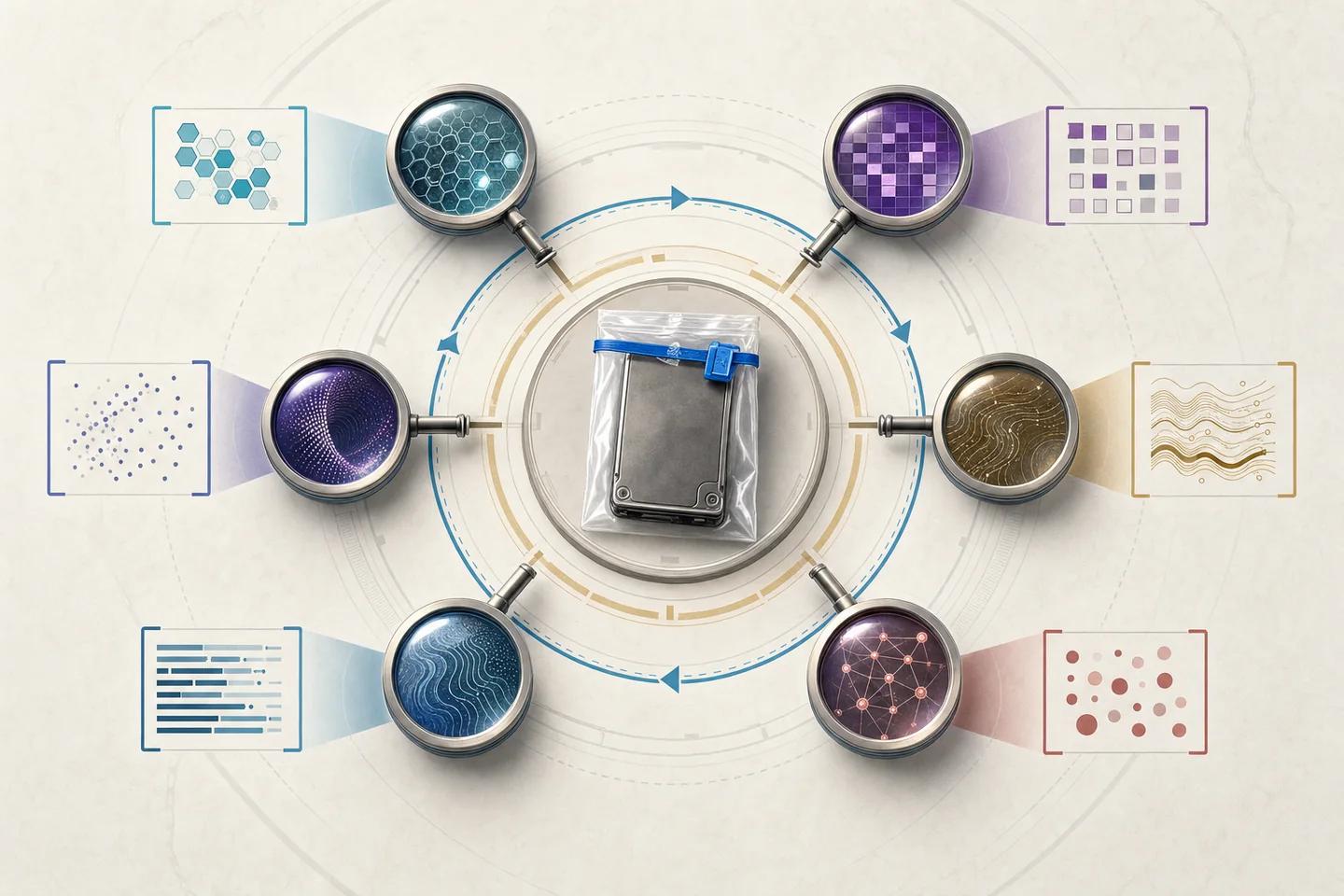
Forensic review asks more than whether a file is fake. It asks what was done to it, where in the file, and how confident the examiner can be. Different evidence types answer different parts of that question, and a sound report draws on several.
| Evidence type | What it can show | What it cannot show |
|---|---|---|
| Model-based manipulation analysis | Regions, frames or audio segments with signs of generation, face swapping or editing | Who made the file, or that an unflagged file is authentic |
| Metadata and container structure | Encoding history, editing software traces, re-saves | Content truth; metadata is easily stripped or forged |
| Provenance data (for example C2PA Content Credentials) | Signed capture or edit history where present | Anything about files that carry no credentials, which is most of them |
| Source and account evidence | Who posted or sent the file, when and from where | Whether the content itself was altered |
| Corroboration | Agreement or conflict with witnesses, other recordings, location data | Technical manipulation inside the file |
Running the Examination in NeuroDetect
NeuroDetect is Neural Defend's forensic media workspace. An examiner uploads an authorized image, audio file, video or document into a case. Each analysis keeps its model and version context, which answers the first question a defence expert will ask. Detailed views show the original alongside explainability heatmaps and attention views, down to specific regions, video frames and audio segments, so the examiner can describe where signs of manipulation appear instead of citing only a score.
An LLM-assisted summary drafts plain-language findings linked to the underlying evidence; the examiner reviews it and makes the final call. The case exports as a forensic report covering observations, uncertainty, provenance, model context and analyst notes, plus structured results for case management systems. Agencies that cannot send evidence to a public cloud can scope private cloud, on-premises or air-gapped deployment during evaluation, and Neural Defend holds ISO/IEC 27001, ISO/IEC 27701, ISO/IEC 42001 and SOC 2 Type II certifications.
Neural Defend's detection research is public. Its ARCAS 1B foundation model paper reports pooled accuracy of 99.99 percent on GenImage and 97.65 percent on OpenFake, and Neural Defend ranked first of 36 systems on the public VendorBench-100 still-image benchmark. Benchmarks describe performance on their own data; an examiner still has to report on the specific file in front of them.
Reporting Findings That Hold Up
Write the report for someone who will try to take it apart. State what was examined (with the hash), what was found, where, and with what confidence. Use graded language such as consistent with manipulation, no indications found, or inconclusive, and explain what drives each grade. Record the tool and model version, and keep working copies so the analysis can be rerun.
Keep detection findings separate from conclusions about people. A report can say a voice segment shows signs of synthesis; it should not say who synthesized it unless other evidence establishes that. When a defendant claims genuine evidence is a deepfake, the same discipline applies in reverse: corroboration and custody records carry as much weight as the absence of manipulation signals.
Where Detection Helps Investigators and Where It Does Not
Detection helps triage large volumes of seized or submitted media, points examiners to the frames or segments worth close inspection, and gives a documented technical basis for a finding. It is weakest on files that have been compressed, re-recorded or screen-captured many times, because each pass removes signal. NIST AI 100-4 (November 2024) notes that detection methods carry nonzero false positive and false negative rates.
Detection also cannot catch a genuine recording placed in a false context, such as old footage presented as new. That requires source and corroboration work. Treat every detector output as an examiner's tool, never as a standalone conclusion presented to a court.
Evidence boundary
Limitations
- Detection performance drops on media that has been heavily compressed, re-recorded or screen-captured.
- A finding of no manipulation does not establish authenticity, and detection cannot catch genuine media used in a false context.
- NeuroDetect analyses media; it does not identify who created a file, and the examiner makes the final determination.
- Rules on expert evidence and machine-generated evidence vary by jurisdiction and are under active review; this page is not legal advice.
Source record
Sources and references
- Europol Innovation LabFacing reality? Law enforcement and the challenge of deepfakesVerified October 19, 2026.
- National Institute of Standards and TechnologyNIST IR 8387, Digital Evidence Preservation: Considerations for Evidence HandlersPublished September 8, 2022. Verified October 19, 2026.
- FBI Internet Crime Complaint CenterCriminals Use Generative Artificial Intelligence to Facilitate Financial Fraud (PSA I-120324)Published December 3, 2024. Verified October 19, 2026.
- National Institute of Standards and TechnologyNIST AI 100-4, Reducing Risks Posed by Synthetic ContentPublished November 20, 2024. Verified October 19, 2026.
- arXivBenchmarking Neural Defend ARCAS 1B: A Foundational Multimodal Deepfake Detection ModelPublished September 21, 2026. Verified October 19, 2026.