
End user joins session → Liveness prompt → Face match → Tenant reviewer decides
The platform reports a pass. It has no authenticity signal to report.
Video KYC platforms / NeuroVerify
If you build a video KYC or identity verification platform, your customers now expect protection against face swaps and injected feeds. NeuroVerify gives you one API for deepfake and manipulation detection beyond liveness, with a unified risk score and signal-level evidence per session.
It plugs into the capture and liveness step your platform already runs, across tenants, with no new step for end users.
NeuroVerify does not replace your platform, document verification or reviewer workflow; it adds authenticity evidence your tenants can act on under their own policy.
The gap
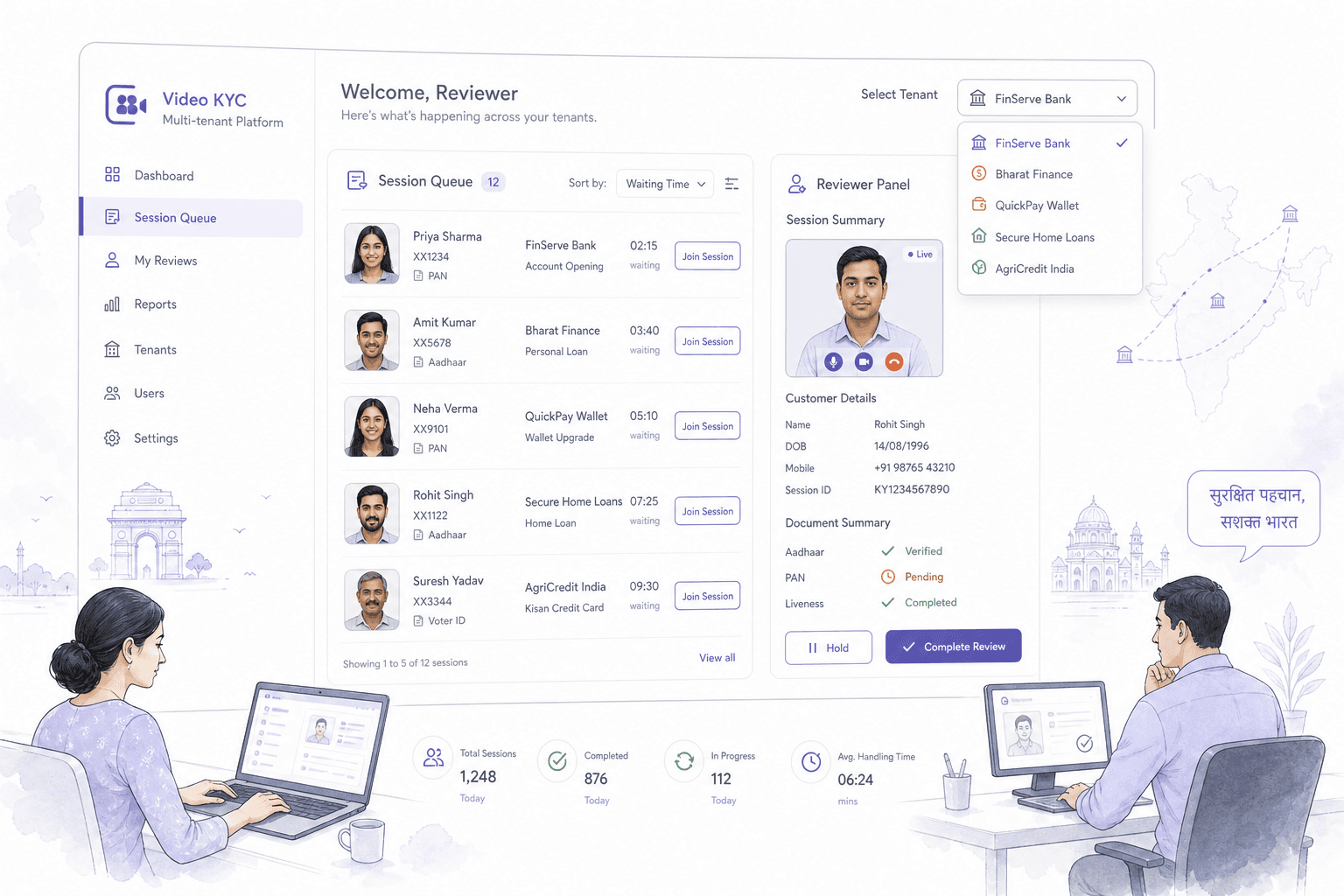
Video KYC and identity verification platforms sit between regulated businesses and their end customers. Banks, fintechs, brokers and insurers rely on your sessions, liveness checks and face match to onboard people they never meet.
When a deepfake gets through, the tenant takes the loss and your platform takes the blame. Buyers now ask about injection attacks, face swaps and synthetic media in every security review.
A moving target. Generative tools improve monthly. A detector trained last year may miss this year's tools, so it needs continuous research and fresh data.
Several attack paths. Swapped faces, generated stills, injected feeds and cloned audio each need different signals.
Multi-tenant demands. Different tenants need different thresholds, residency rules and audit trails, so one fixed model and one fixed policy do not fit.
Latency and scale. Checks must run inside a session budget across many concurrent sessions.
End user joins session → Liveness prompt → Face match → Tenant reviewer decides
The platform reports a pass. It has no authenticity signal to report.
Read build versus buy for synthetic media detection for the trade-offs.
Threats
These are attack techniques, not claims about any platform or tenant. Each hits the capture layer your product controls.
A swapped face is driven by a real person, passing prompts and agent questions during a live call.
The camera input is replaced at the device or driver layer, so your platform receives a clean synthetic stream.
The capture SDK is hooked or run in an emulator to feed prepared media into the session.
AI-generated or retouched face images arrive through the API in standard formats and pass format checks.
Matching synthetic audio makes the session feel consistent to a reviewer.
The same synthetic face or technique is tried against many tenants. A consistent score across tenants exposes the pattern.
Your tenants operate under many regimes, including FATF digital identity guidance, eIDAS and national rules. See FATF digital identity guidance and eIDAS and EUDI wallet identity proofing.
NeuroVerify supports your tenants' controls with evidence. It does not make a tenant compliant.
Where NeuroVerify fits
NeuroVerify sits inside your pipeline after media capture and before the result is returned to the tenant. One request checks the selfie, video or audio for deepfakes and manipulation beyond liveness.
Capture → Liveness → Face match → Result to tenant
No media-authenticity signal in the result.
Capture → Liveness → NeuroVerify risk score → Face match → Result to tenant with score and signals
A new field in your result, with no change to the end-user flow.
- Visual Safety Screening - Live Presence Verification - Face Manipulation Detection - AI Generative Model Analysis - AI Pixel-Level Manipulation - AI Content Compliance
Native mobile SDKs (Android/Kotlin, iOS/Swift, Flutter), backend SDKs (Python, TypeScript/Node.js, Go, Java), a REST API and an MCP server cover most stacks. Managed cloud, private cloud or VPC, container, on-premises and air-gapped deployment let you match each tenant's requirements. See NeuroVerify and technology.
Leave the session, liveness and face-match steps as they are for every tenant.
Send the selfie, video or audio from your backend or SDK in a single request.
Add the unified risk score and signal-level evidence to your result payload and reviewer console.
Expose thresholds per tenant so they can continue, review or step up under their own rules.
What you get
Answer injection, face-swap and synthetic-media questions in security reviews with a measurable control.
You get top performance on the public VendorBench-100 benchmark (ranked first of 36, MCC 0.876 vs 0.646) without building models.
Add one call per session. Many teams go live in under 24 hours.
Signal-level evidence helps tenant reviewers understand flags without extra tooling.
Per-tenant thresholds and deployment options, including VPC, on-premises and air-gapped, fit different residency rules.
Questions
NeuroVerify is not meant to sit next to a liveness product as a second vendor. Live Presence Verification is one of the six signals in the same request, alongside Face Manipulation Detection, AI Generative Model Analysis, AI Pixel-Level Manipulation, Visual Safety Screening and AI Content Compliance. It checks selfies, video and audio for deepfakes and manipulation beyond liveness.
Standalone liveness is usually built around physical presentation: a printed photo, a mask, a screen held to a lens. It was not designed to tell you whether the face or voice inside a stream was generated or injected. Many teams keep their existing liveness vendor during evaluation and compare outcomes on their own media before deciding what to retire. See deepfake detection vs liveness detection.
Call it inside your pipeline after media capture and before you return the result to the tenant. Send the media you already capture to one REST endpoint, or use a native mobile SDK (Android/Kotlin, iOS/Swift, Flutter) or a backend SDK (Python, TypeScript/Node.js, Go, Java). An MCP server is available for AI agents.
Integration is two lines of code in the common case, and teams can go live in under 24 hours. Your end users see no new step.
Commercial arrangements for platforms are agreed with Neural Defend. Contact us through the contact page to discuss how you want to package it for tenants.
NeuroVerify returns a score and signal-level evidence. Your platform can expose thresholds and actions per tenant, so each customer decides what to continue, review or block.
Neural Defend analyses the media you send and returns a risk score with signal-level evidence. Consent, retention and residency stay under your policy. Neural Defend holds ISO/IEC 27001, ISO/IEC 27701, ISO/IEC 42001 and SOC 2 Type II certifications.
Read the product data handling page and the trust centre for specifics, and ask us for the details your security review needs.
NeuroVerify returns in under 200 ms p95 on eligible image requests under defined test conditions. The methodology is available on request.
Latency for video and audio depends on length and deployment, so we measure it with you on your own traffic during evaluation.
Yes, and it is the only test that counts. Published benchmarks do not reflect your devices, codecs or compression. Neural Defend ranks first of 36 systems on VendorBench-100 (MCC 0.876 against 0.646 for the next-best vendor), but your own platform traffic is the better yardstick.
Bring representative genuine and suspected-fake samples and your current decision states, and we will run them through the API with you.
Evaluate NeuroVerify
Run representative session media through NeuroVerify and see the scores and signals your tenants would receive. We will help you plan the integration.