
Official verifies customer → Questions in randomised order → Face matched to ID → Session recorded and stored
The record is complete, and the face in it may still be synthetic.
Regulated video identification / NeuroVerify
Many regulators allow remote customer identification over recorded, agent-led video sessions. India's V-CIP is one example. Attackers target those sessions with face swaps and injected feeds, and NeuroVerify gives compliance teams authenticity evidence for each one.
NeuroVerify takes the selfie, video or audio your session already records, in one API call, with no new step for the customer or the official.
NeuroVerify does not conduct the session, validate identity documents or approve the application; it adds media-authenticity evidence to your existing controls.
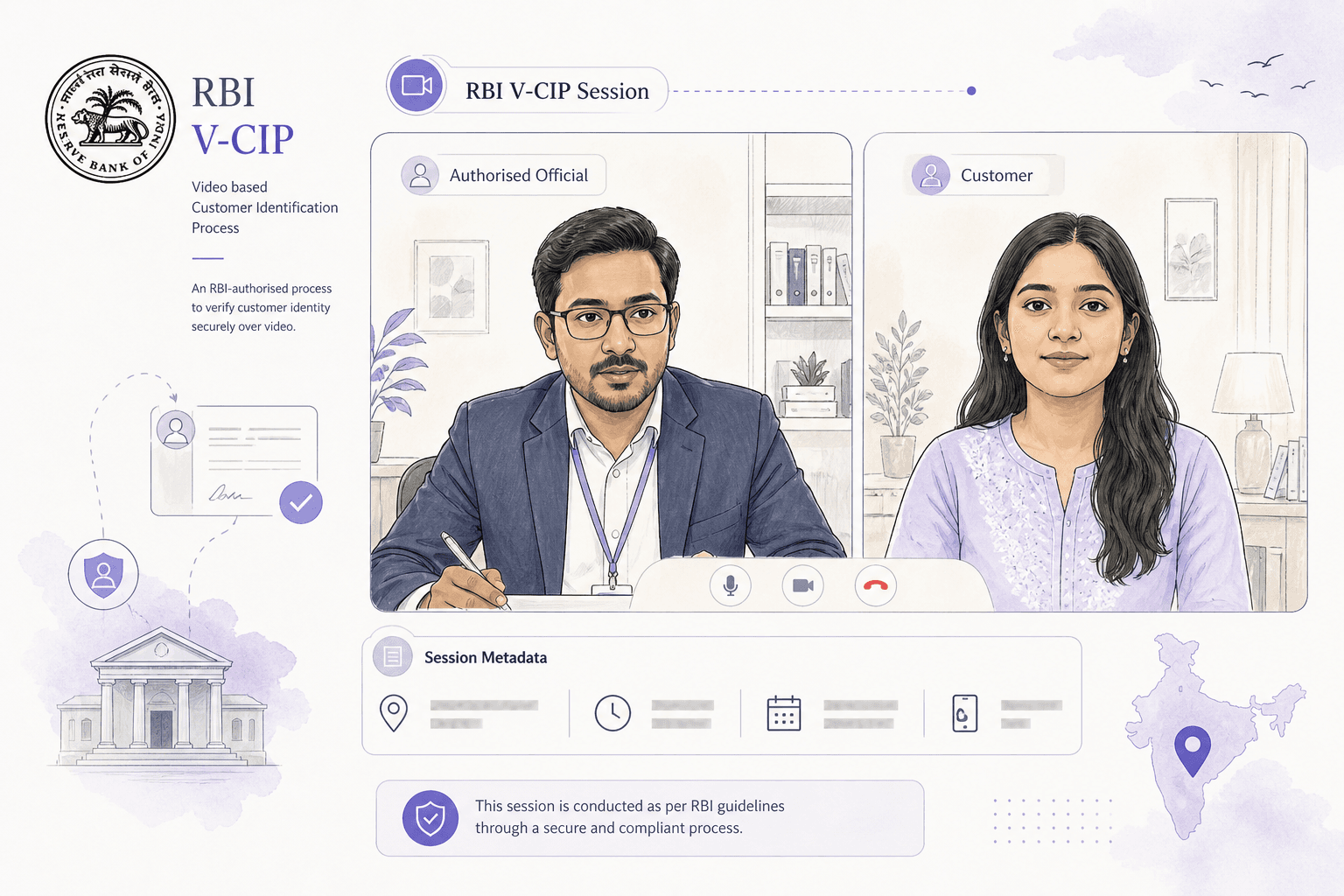
The gap
Regulated video identification programmes usually set strict process rules: a trained official, a live call, randomised questions, timestamps and location capture, recording and retention. India's V-CIP framework for regulated financial entities is a well-known example, and similar remote video identification regimes exist elsewhere.
Those rules control the process. They say less about whether the faces and voices in the recording are real, and whether the video reached the platform from a camera at all.
Official oversight relies on a person spotting artefacts in a compressed stream, live, at volume.
Liveness and spoof checks are typically built around physical presentation attacks. Injected streams and real-time swaps can slip past them. India's V-CIP rules, for example, call for liveness and spoof detection; see RBI KYC, V-CIP, liveness and spoof detection.
Face match compares two faces without testing how either was made.
Metadata and recordings are evidence of the process, not of authenticity.
Official verifies customer → Questions in randomised order → Face matched to ID → Session recorded and stored
The record is complete, and the face in it may still be synthetic.
Threats
These are attack techniques, not claims about any institution. Each aims to leave a clean, auditable record around manipulated media.
A synthetic face tracks a real person's movement. Randomised questions and head turns get answered correctly, so the session looks like genuine interaction.
The feed is replaced below the camera layer. The platform records a well-formed stream with no lens behind it.
Where a flow accepts recorded or uploaded video, a pre-built clip can be tuned to the likely prompts.
A generated face is paired with a genuine identity document, with the aim of binding a stolen identity to a fabricated face.
Voice synthesis supplies answers in the victim's or a fabricated voice, reassuring an official who focuses on the face.
The same manipulated face shows up under different names. Reviewing one case at a time hides the pattern.
Regulators increasingly expect firms to understand and manage deepfake risk in remote onboarding. FinCEN's alert on deepfake fraud, for example, is summarised in FinCEN deepfake fraud alert.
NeuroVerify supports your controls by supplying evidence. It does not make your programme compliant, and your policy decides outcomes.
Where NeuroVerify fits
NeuroVerify runs after your platform captures session media and before your policy decides. It checks face images, video and audio for deepfakes and manipulation beyond liveness, in one request.
Official-led session → Face match → Review and approval → Recorded for audit
The audit trail shows process, not authenticity.
Official-led session → NeuroVerify risk score → Face match → Review and approval → Recorded with score and signals
Each file now carries authenticity evidence a reviewer can inspect.
- Visual Safety Screening - Live Presence Verification - Face Manipulation Detection - AI Generative Model Analysis - AI Pixel-Level Manipulation - AI Content Compliance
The score and signal-level evidence can be stored against the case. Deployment options include a managed cloud API, private cloud, secure container, on-premises and air-gapped, which helps where recordings must stay in-country. Learn more about deployment and NeuroVerify.
The official, questions, recording and consent steps stay exactly as your programme defines them.
Submit the selfie, video clip or audio to NeuroVerify from your platform backend or via SDK.
Save the risk score and signal-level evidence with the case record for audit and later review.
Continue, send to exception review, or require a repeat session, using your own thresholds.
What you get
Signal-level evidence shows why a session was flagged, so exception handling and later audits do not rely on memory.
Face manipulation, generative and pixel-level signals test how the media was produced, which presentation-based liveness does not.
Officials and customers see the same flow. Nothing is added to call time or to the script.
Private cloud, container, on-premises and air-gapped options suit regimes that keep recordings in-country.
Ranked first of 36 systems on VendorBench-100 (MCC 0.876 vs 0.646 for the next-best vendor), and testable on your own media.
Questions
No. India's V-CIP is one example of a regulated video identification regime. NeuroVerify works on the selfie, video and audio from any recorded video KYC or video identification flow, in any country.
NeuroVerify is not meant to sit next to a liveness product as a second vendor. Live Presence Verification is one of the six signals in the same request, alongside Face Manipulation Detection, AI Generative Model Analysis, AI Pixel-Level Manipulation, Visual Safety Screening and AI Content Compliance. It checks session video, selfies and audio for deepfakes and manipulation beyond liveness.
Standalone liveness is usually built around physical presentation: a printed photo, a mask, a screen held to a lens. It was not designed to tell you whether the face or voice inside a stream was generated or injected. Many teams keep their existing liveness vendor during evaluation and compare outcomes on their own media before deciding what to retire. See deepfake detection vs liveness detection.
Call it after the session media is captured and before the official or your system makes the decision. Send the media you already capture to one REST endpoint, or use a native mobile SDK (Android/Kotlin, iOS/Swift, Flutter) or a backend SDK (Python, TypeScript/Node.js, Go, Java). An MCP server is available for AI agents.
Integration is two lines of code in the common case, and teams can go live in under 24 hours. Your end users see no new step.
Neural Defend analyses the media you send and returns a risk score with signal-level evidence. Consent, retention and residency stay under your policy. Neural Defend holds ISO/IEC 27001, ISO/IEC 27701, ISO/IEC 42001 and SOC 2 Type II certifications.
Read the product data handling page and the trust centre for specifics, and ask us for the details your security review needs.
NeuroVerify returns in under 200 ms p95 on eligible image requests under defined test conditions. The methodology is available on request.
Latency for video and audio depends on length and deployment, so we measure it with you on your own traffic during evaluation.
Options include a managed cloud API, private cloud or your own VPC, a secure container, on-premises, and air-gapped environments. The right choice usually follows your data-residency and security-review requirements. See deployment options.
Yes, and it is the only test that counts. Published benchmarks do not reflect your devices, codecs or compression. Neural Defend ranks first of 36 systems on VendorBench-100 (MCC 0.876 against 0.646 for the next-best vendor), but your recorded sessions is the better yardstick.
Bring representative genuine and suspected-fake samples and your current decision states, and we will run them through the API with you.
Evaluate NeuroVerify
Run recorded sessions, genuine and suspected fakes, through NeuroVerify and see the score and signals for each. We will help you set thresholds for your own exception process.