
Sign-up and phone → Identity and licence upload → Selfie and liveness → Face match → Instant tier active → Full checks complete later
The selfie is often the only human-proof step in the instant tier.
Delivery and quick commerce / NeuroVerify
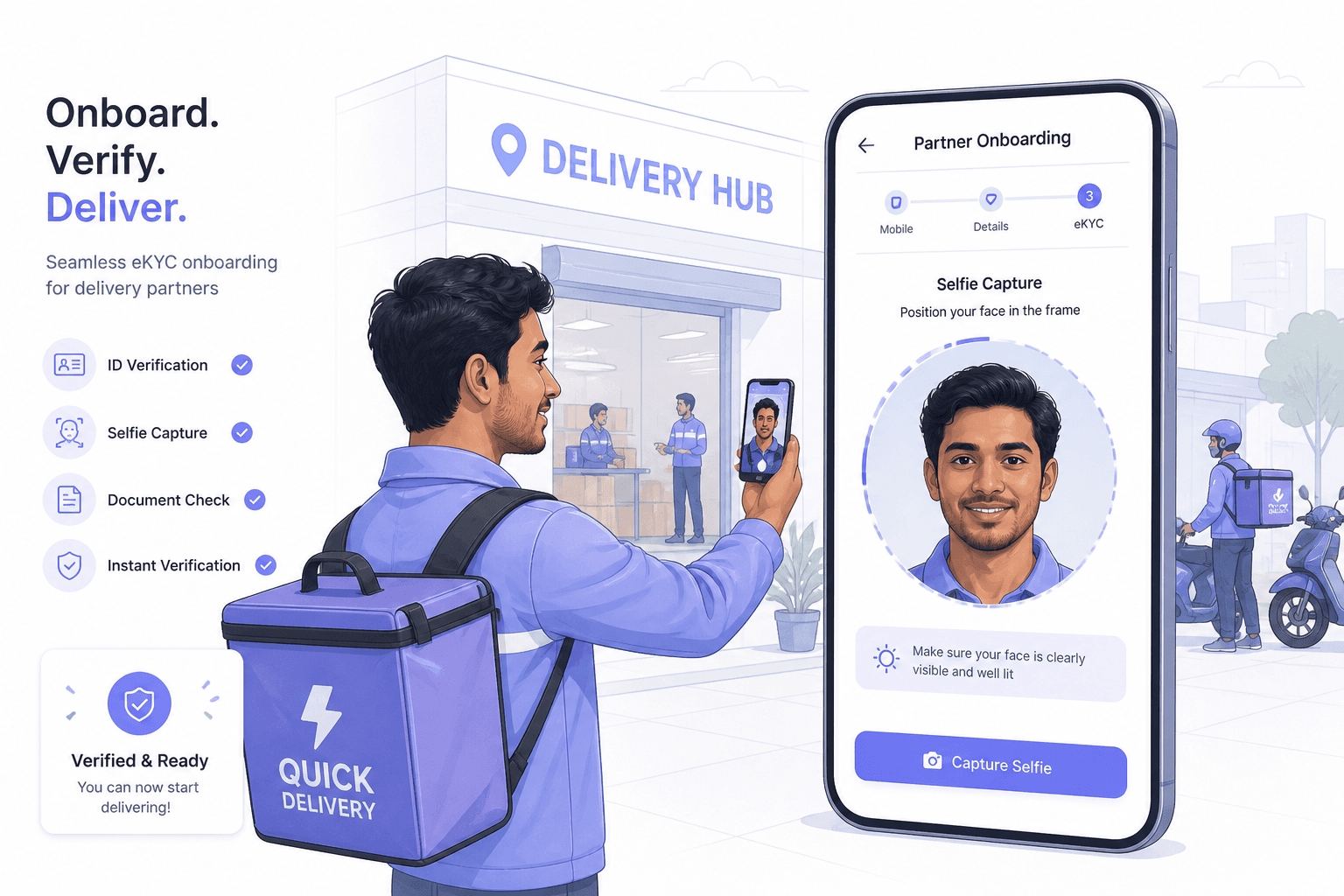
Delivery and quick-commerce platforms need verified couriers and store partners on the road within hours, and the selfie is often the only live check in that window. NeuroVerify checks it for deepfakes and manipulation beyond liveness and returns one unified risk score with evidence.
It runs behind the selfie step already in your partner onboarding and re-verification: no new step for the partner, one API call.
NeuroVerify does not run background checks, validate licences or vehicle papers, or decide who gets activated; it adds authenticity evidence for your own policy.
The gap
Delivery and quick-commerce platforms compete on how fast they can put a rider or picker to work. Some activate partners the same day. Others take a day or two. Background and document checks run slower than the selfie, so the platform often relies on a fast first tier: identity record, selfie, liveness, face match, then partial activation.
Sign-up and phone → Identity and licence upload → Selfie and liveness → Face match → Instant tier active → Full checks complete later
The selfie is often the only human-proof step in the instant tier.
A verified courier handles customer addresses, cash on delivery, high-value orders and restricted goods. The person on the road must be the person who was onboarded. If the account is shared, resold or opened with a substituted face, the platform loses the trust link with customers and with regulators.
The existing checks do not test whether the selfie is authentic. Face match confirms resemblance. Liveness confirms a presentation check passed. Neither asks whether the face is generated, swapped or injected, and hub-assisted onboarding can add risk of its own.
Re-verification adds a second exposure. Platforms ask partners to repeat a selfie at intervals or after suspicious activity, which gives an attacker more chances to try a prepared face.
Threats
These are techniques, not claims about any platform. Each defeats a fast selfie step.
An account goes live on the instant tier and runs orders before document or background checks catch a mismatch.
A printed or on-screen face is shown at the speed the app expects, targeting prompts that were tuned for convenience.
A free face-swap app on an inexpensive phone presents the account owner's face to the camera.
Prepared images or videos are reused for several candidates where onboarding is assisted.
A face blocked on one platform returns under another name, or on a competitor, with a new account.
A prepared stream replaces the camera feed beneath the app layer so the SDK receives a clean-looking video.
The risk is highest where speed targets are tight and staff or agents assist the capture.
Where NeuroVerify fits
NeuroVerify sits behind the selfie capture in your onboarding and re-verification flows. You send the image or video you already collect. It returns one unified risk score with evidence from six signals in a single call, and your policy decides whether to activate, hold or review.
Latency is under 200 ms p95 on eligible image requests under defined test conditions, so it fits a same-day activation target. The checks apply to face and video evidence, not to licences or vehicle papers.
Pass the image or video from your capture step to the API through the mobile SDK or backend.
Get one score with signal-level evidence, in time for the instant-tier decision.
Activate, ask for a fresh capture, hold for manual review or decline, by city, role and order value.
Send the selfie again at periodic or triggered re-checks and compare the evidence over time.
What you get
Add authenticity evidence to the fast tier without slowing it down.
Catch substituted faces at sign-up and at re-verification.
A verified person is more likely to be the person at the door.
Signal-level output highlights unusual onboarding batches.
Android, iOS and Flutter SDKs match the apps partners already use.
Questions
It sits behind the selfie or face-capture step you already run. You send the image, video or audio you already collect to one API call, and the response comes back with a unified risk score and signal-level evidence. The end user sees no new step.
Integration uses native mobile SDKs (Android/Kotlin, iOS/Swift, Flutter), backend SDKs (Python, TypeScript/Node.js, Go, Java) or the REST API. Two lines to integrate and live in under 24 hours are product claims; your own environment and review process set the real timeline.
Liveness asks whether a live person appears to be in front of the camera. It was designed around printed photos, screen replays and masks. It does not ask how the media was produced, so a face swap, a fully synthetic face or an injected stream can satisfy it.
NeuroVerify checks for deepfakes and manipulation beyond liveness. Keep your liveness vendor and add the authenticity evidence next to it. See deepfake detection vs liveness detection.
One unified risk score, plus evidence from six signals: Visual Safety Screening, Live Presence Verification, Face Manipulation Detection, AI Generative Model Analysis, AI Pixel-Level Manipulation and AI Content Compliance.
Your policy decides what happens next: approve, step up, route to manual review or decline. NeuroVerify does not approve or reject the partner or the account.
Latency is under 200 ms p95 on eligible image requests under defined test conditions. The methodology is available on request, so you can compare it with your own traffic.
On the public VendorBench-100 benchmark, NeuroVerify ranked first of 36 systems, with a detection score (MCC) of 0.876 against 0.646 for the next-best vendor.
Deployment options are a managed cloud API, private cloud or customer VPC, a secure container, on-premises, and air-gapped. Pick the one that matches your data residency and security requirements.
The platform holds ISO/IEC 27001, ISO/IEC 27701, ISO/IEC 42001 and SOC 2 Type II certifications. For handling details, see product data handling and the trust centre.
Yes. Send a representative sample of partner selfies from direct sign-ups and from assisted hubs, across cities and device types and compare the scores with your own labels. Include genuine captures from low-end handsets and poor lighting so you can see how thresholds behave on real users, not just on attacks.
Contact the team to set up an evaluation. See also how to evaluate a detection API.
Latency is under 200 ms p95 on eligible image requests under defined test conditions. Your own network, region and capture quality will also affect end-to-end time, which a trial on your traffic will show.
Evaluate NeuroVerify
Send NeuroVerify a sample of partner onboarding selfies, including hub-assisted ones, and compare the results with your current checks.