
Business details and registry check → Owner and signatory capture → Selfie or video session → Face match → Credit and fraud rules → Funds released
Business checks can pass in full. The only live-human evidence is the selfie or video.
Small business lending / NeuroVerify
Small business loans need a real person to act for a real company. NeuroVerify checks the selfie or video of the owner, director or signatory for deepfakes, swaps and injected video, and returns one risk score with evidence.
It fits the selfie or video step your business onboarding already runs: no new step for the applicant, one API call.
NeuroVerify does not run business registry checks, verify company documents or decide credit. It adds authenticity evidence about the person on camera; your policy decides.
The gap
Know-your-business checks confirm that a company exists, who owns it and whether its registrations and tax details line up. Then someone has to act for that company: apply, sign, accept terms and receive funds.
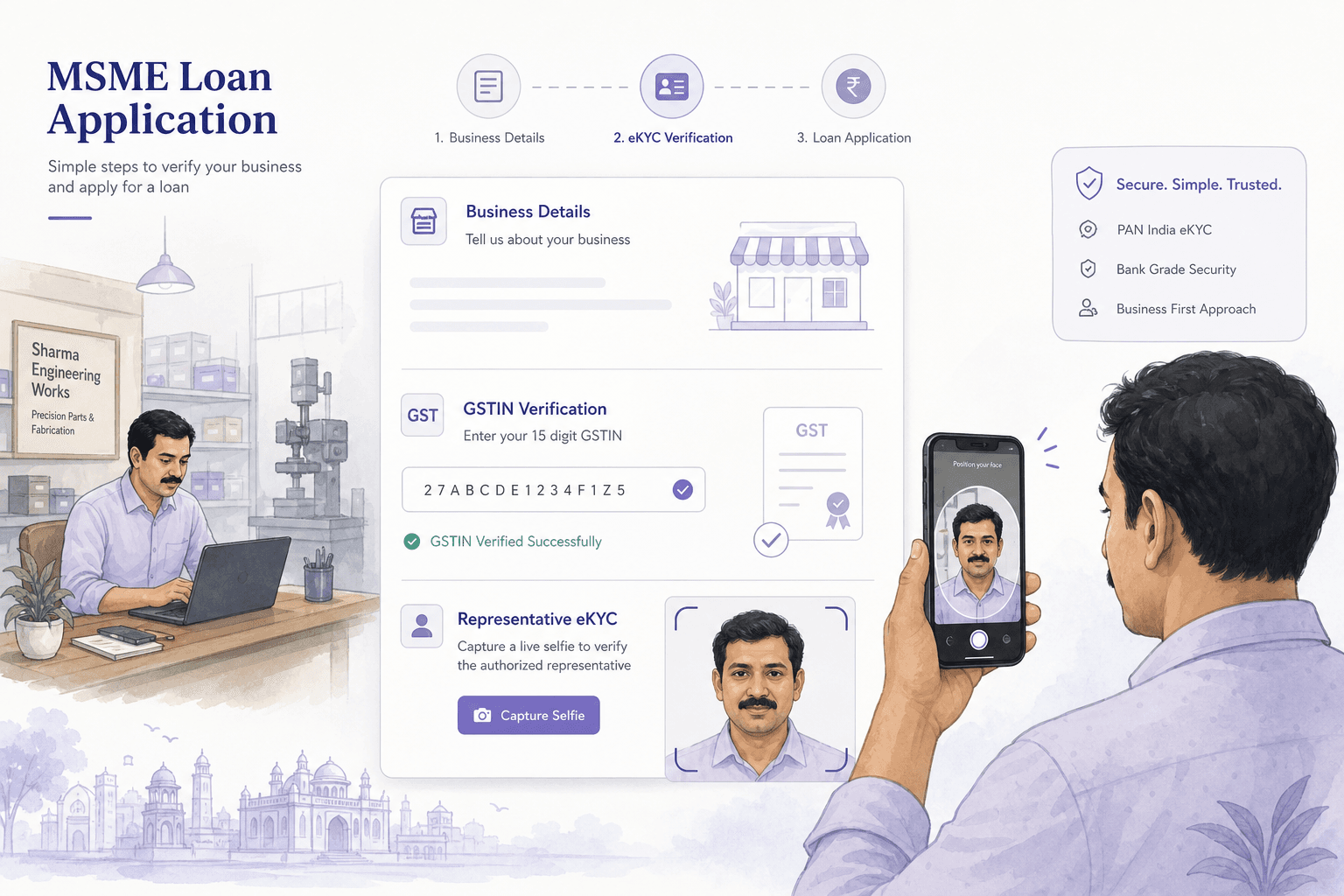
That person is verified with a selfie or a video session, the same way an individual customer would be. The company record can be perfect while the human at the camera is not the registered owner or authorised signatory, or is not a real person at all.
Business details and registry check → Owner and signatory capture → Selfie or video session → Face match → Credit and fraud rules → Funds released
Business checks can pass in full. The only live-human evidence is the selfie or video.
Applications are often assisted by agents or third parties, owners are busy and sign remotely, and several people may be involved in one deal. That makes it easy for a different person to step in front of the camera. Generated faces and swapped video make it harder to spot.
See KYB Authorized Representative Verification for how representative checks fit the wider workflow.
Threats
These are attack techniques, not claims about any specific lender or business.
A person who is not the owner submits a generated or swapped selfie that matches the owner photo on file. The business record is genuine.
A live face swap shows the authorised signatory on screen while someone else answers prompts and agrees terms.
The real controller stays hidden behind a nominee. A manipulated selfie hides the fact that the person on camera is not the owner.
A fabricated individual with a generated face is attached to a real registered business and passes records checks.
An intermediary completes the representative step with pre-prepared or manipulated media to close deals faster.
A prepared clip or a virtual camera feed replaces a live session. Prompts are scripted around it. See virtual camera injection attacks.
Background: synthetic identity fraud and Business Lending Representative Review.
Where NeuroVerify fits
NeuroVerify sits between media capture of the owner or signatory and your face match and credit logic. Your registry, ownership and document checks stay where they are.
Business details and registry check → Owner and signatory capture → Selfie or video capture → NeuroVerify → Face match → Risk score and credit policy
One call is added per representative. Business verification is unchanged.
NeuroVerify checks the face image, video or audio for deepfakes and manipulation beyond liveness. All six signals run together and resolve into one risk score:
- Visual Safety Screening - Live Presence Verification - Face Manipulation Detection - AI Generative Model Analysis - AI Pixel-Level Manipulation - AI Content Compliance
The response carries the unified score plus signal-level evidence. Your own policy makes the final decision.
Your business registry and ownership checks, your document verification, your credit and fraud rules, your agent and partner oversight, your consent and retention rules, and the decision on every application.
Pass the image or frames captured for each owner, director or signatory.
Use the REST API or an SDK from your loan platform or orchestration layer.
Store the score and signal evidence on the business application.
Continue, send to relationship or fraud review, or decline under your own rules.
What you get
Manipulated or substituted representative media is flagged before funds move.
Business checks confirm the company; NeuroVerify checks the person acting for it.
Each owner or director gets a score and signal evidence on the application file.
Clean results continue without extra steps, which matters for time-poor business customers.
Agent and partner submissions get the same check as direct ones.
Questions
Liveness answers whether a live person appears to be in front of the camera. It was built for presentation attacks such as a printed photo, a mask or a screen held to the lens. It was not built to tell whether the stream reaching your server came from a camera at all, or whether the face inside it was generated or swapped.
NeuroVerify runs inside the selfie or video step you already have. Live Presence Verification is one of its six signals, and the other five look for face manipulation, generative-model traces, pixel-level edits and unsafe content in the same request. For business lending, that includes video sessions with signatories. You can keep your current liveness vendor during an evaluation and compare outcomes on your own media. See deepfake detection vs liveness detection.
No. NeuroVerify analyses face images, video and audio only. Registry, ownership and document checks stay with your KYB tools.
That is your policy decision. Most teams run it on each person who acts for the business or controls the account, since each one is a separate point where media can be manipulated.
NeuroVerify offers native mobile SDKs (Android/Kotlin, iOS/Swift, Flutter), backend SDKs (Python, TypeScript/Node.js, Go, Java) and a REST API. Integration is two lines of code, and teams can be live in under 24 hours.
The call can sit in your LOS or workflow engine for each representative capture. See integrating into an existing KYC stack.
NeuroVerify analyses the face images, video or audio you send and returns a risk score with evidence. NeuroVerify processes the face and video media you send, not company records. Consent, retention and residency stay under your policy. See product data handling for how media is treated.
Deployment options include the managed cloud API, private cloud or customer VPC, a secure container, on-premises and air-gapped environments. Neural Defend holds ISO/IEC 27001, ISO/IEC 27701, ISO/IEC 42001 and SOC 2 Type II certifications, shown on the trust page.
NeuroVerify targets under 200 ms at p95 on eligible image requests under defined test conditions. The test methodology is available on request, so you can check it against your own media sizes and network path.
It is one API call on media you already capture, so it adds a single request rather than a new user step. Check latency in the same environment your relationship managers and agents use.
NeuroVerify returns one unified risk score and signal-level evidence. It does not approve or reject anyone. Your policy sets the thresholds and decides what each band does.
Mid-band results often go to a relationship manager or a quick live re-check, which keeps good customers moving.
Yes, and that is the test that matters. Public results help: NeuroVerify ranked first of 36 systems on VendorBench-100, with a detection score of MCC 0.876 against 0.646 for the next-best vendor. But your capture devices, compression and attack mix decide real performance.
Use authorized samples from direct and assisted business applications. Compare scores and evidence against your current decisions. For a vendor shortlist, see the top 5 deepfake detection APIs.
Evaluate NeuroVerify
Bring authorized media from your own journey. NeuroVerify returns a risk score with signal-level evidence, so you can compare it with your current checks before changing anything.