
Application → Identity record check → Selfie or video KYC → Face match → Credit decision → Disbursal
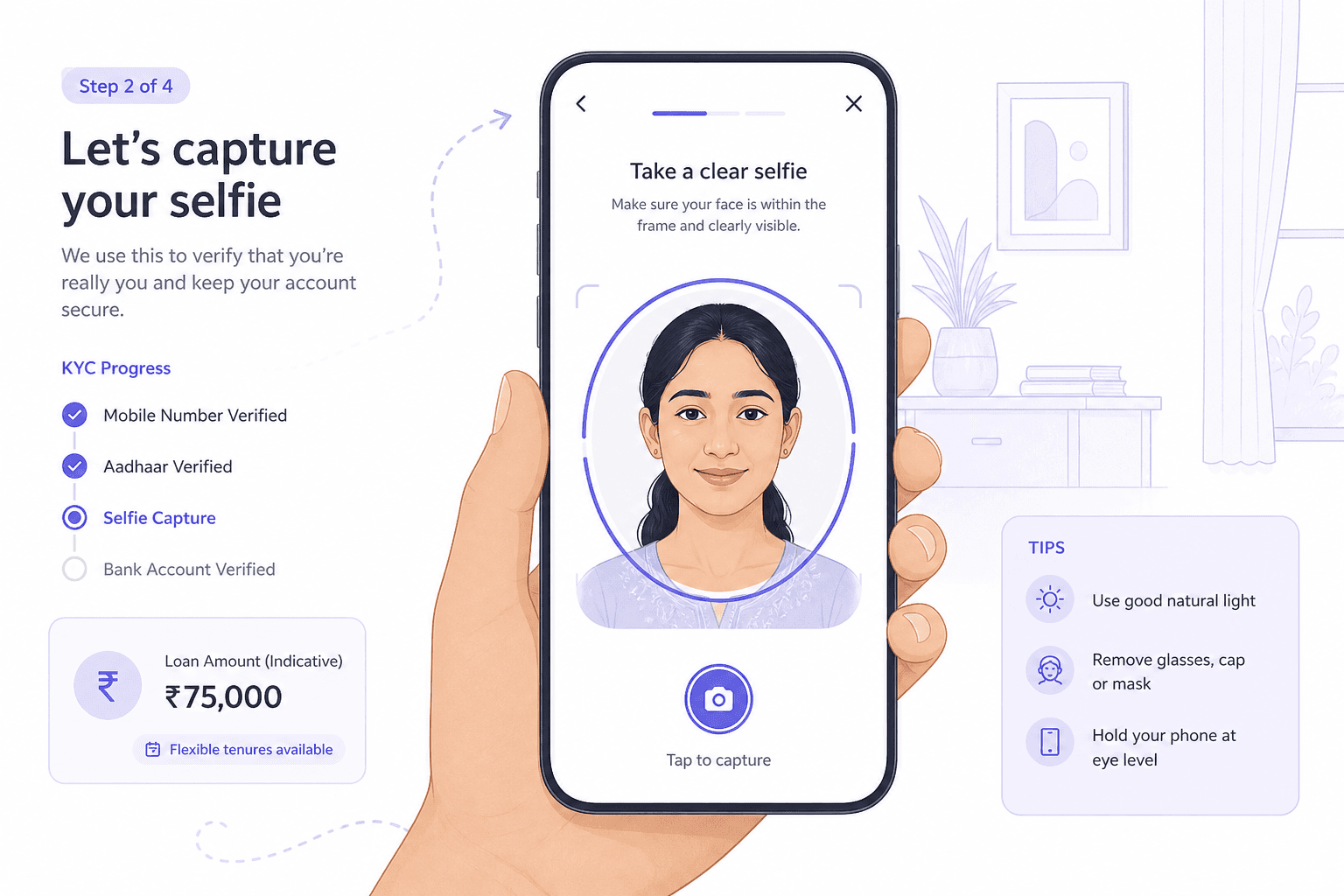
The selfie step is where a manipulated face enters. Nothing after it asks whether the media is authentic.
Digital lending / NeuroVerify
Banks, fintech lenders and non-bank finance companies onboard borrowers through a selfie or video step. NeuroVerify checks that media for deepfakes, face swaps and injected video, and returns one risk score with evidence before money moves.
It runs on the selfie or liveness step your lending journey already has: no new step for the borrower, one API call.
NeuroVerify does not verify documents, assess creditworthiness or approve loans. It adds authenticity evidence; your credit and fraud policy decides.
The gap
Digital lenders verify a lot: identity records, bank statements, bureau data, device signals and a selfie matched to the identity photo. Instant decisions depend on this stack working with no human in the loop.
That stack confirms that data is consistent. It does not confirm that the person on camera is real and present. A fabricated borrower assembled from real records, or a real borrower impersonated with a face swap, can satisfy every one of those checks.
Application → Identity record check → Selfie or video KYC → Face match → Credit decision → Disbursal
The selfie step is where a manipulated face enters. Nothing after it asks whether the media is authentic.
Face match compares two images. If both come from the same fake, they match. Liveness catches physical spoofs, but generated faces and injected video streams do not present anything physical. Once a loan is disbursed, recovery is costly and the borrower is hard to find.
Where regulated video KYC is used, a swapped face can also hold up through a live session. See Deepfake Detection for Digital Lending for the wider picture.
Threats
These are attack techniques, not claims about any specific lender.
Real identifiers are combined into a new persona with a generated face. Records resolve cleanly, and the selfie matches because the same fake face is on the supporting image.
A real person with no intent to repay, or a stand-in for someone else, completes onboarding. A face swap can put the true controller behind the borrower on camera.
Fully automated journeys depend on one image. An AI-generated or swapped selfie arrives in the same format as a genuine one.
The attacker runs a live swap during a regulated video session. Prompted head turns and answers are performed by a real person behind a different face.
The camera feed is replaced at driver or app level, so the lender receives a clean stream that never came from a lens.
The same manipulated face is reused with different names, products or lenders. Reviewed one file at a time, each looks fine.
Background: synthetic identity fraud and digital injection attacks.
Regulated video identification exists in several regions, including India under RBI KYC rules. See RBI KYC, V-CIP, Liveness, and Spoof Detection as one example.
Where NeuroVerify fits
NeuroVerify sits between media capture and your face match and credit logic. It checks the selfie or video you already collect and leaves your decisioning stack untouched.
Application → Identity record check → Selfie or video capture → NeuroVerify → Face match → Risk score and credit policy
One call is added. Your KYC provider and credit engine keep their roles.
NeuroVerify checks the face image, video or audio for deepfakes and manipulation beyond liveness. All six signals run together and resolve into one risk score:
- Visual Safety Screening - Live Presence Verification - Face Manipulation Detection - AI Generative Model Analysis - AI Pixel-Level Manipulation - AI Content Compliance
The response carries the unified score plus signal-level evidence. Your own policy makes the final decision.
Your KYC and bureau vendors, your credit and fraud rules, your collections strategy, your consent and retention rules, and the decision on every applicant. See Digital Consumer Lending Origination Review.
Pass the image or frames your app already captures at onboarding.
Use the REST API or a mobile or backend SDK in your orchestration layer.
Get one score and signal-level evidence for the loan file.
Approve, step up to manual review or decline under your own thresholds.
What you get
Synthetic and impersonated borrowers are flagged before disbursal, when action is still cheap.
Fully automated journeys gain an authenticity signal without adding a user step.
Signal-level output shows why a file was flagged, which speeds fraud review.
Only high-risk results need a human look; clean results continue straight through.
Mobile and backend SDKs mean teams can go live in under 24 hours.
Questions
Liveness answers whether a live person appears to be in front of the camera. It was built for presentation attacks such as a printed photo, a mask or a screen held to the lens. It was not built to tell whether the stream reaching your server came from a camera at all, or whether the face inside it was generated or swapped.
NeuroVerify runs inside the selfie or video step you already have. Live Presence Verification is one of its six signals, and the other five look for face manipulation, generative-model traces, pixel-level edits and unsafe content in the same request. That includes video KYC, where a live swap can pass prompted checks. You can keep your current liveness vendor during an evaluation and compare outcomes on your own media. See deepfake detection vs liveness detection.
No. NeuroVerify adds authenticity evidence next to your KYC and credit stack. Your provider keeps identity checks and your engine keeps the decision.
After selfie or video capture and before face match and credit decisioning. Authenticity evidence is then available to every later rule.
NeuroVerify offers native mobile SDKs (Android/Kotlin, iOS/Swift, Flutter), backend SDKs (Python, TypeScript/Node.js, Go, Java) and a REST API. Integration is two lines of code, and teams can be live in under 24 hours.
Lenders with several channels, such as app, web and partner platforms, can call the same API from each. See integrating into an existing KYC stack.
NeuroVerify analyses the face images, video or audio you send and returns a risk score with evidence. NeuroVerify does not check identity documents or credit data. Consent, retention and residency stay under your policy. See product data handling for how media is treated.
Deployment options include the managed cloud API, private cloud or customer VPC, a secure container, on-premises and air-gapped environments. Neural Defend holds ISO/IEC 27001, ISO/IEC 27701, ISO/IEC 42001 and SOC 2 Type II certifications, shown on the trust page.
NeuroVerify targets under 200 ms at p95 on eligible image requests under defined test conditions. The test methodology is available on request, so you can check it against your own media sizes and network path.
It is one API call on media you already capture, so it adds a single request rather than a new user step. For instant approvals, measure total round-trip time from your own region during evaluation.
NeuroVerify returns one unified risk score and signal-level evidence. It does not approve or reject anyone. Your policy sets the thresholds and decides what each band does.
Many lenders send mid-band results to a lightweight step-up check instead of declining, which protects good borrowers.
Yes, and that is the test that matters. Public results help: NeuroVerify ranked first of 36 systems on VendorBench-100, with a detection score of MCC 0.876 against 0.646 for the next-best vendor. But your capture devices, compression and attack mix decide real performance.
Use authorized samples from app, web and video KYC paths, including your hardest edge cases. Compare scores and evidence against your current decisions. For a vendor shortlist, see the top 5 deepfake detection APIs.
Evaluate NeuroVerify
Bring authorized media from your own journey. NeuroVerify returns a risk score with signal-level evidence, so you can compare it with your current checks before changing anything.