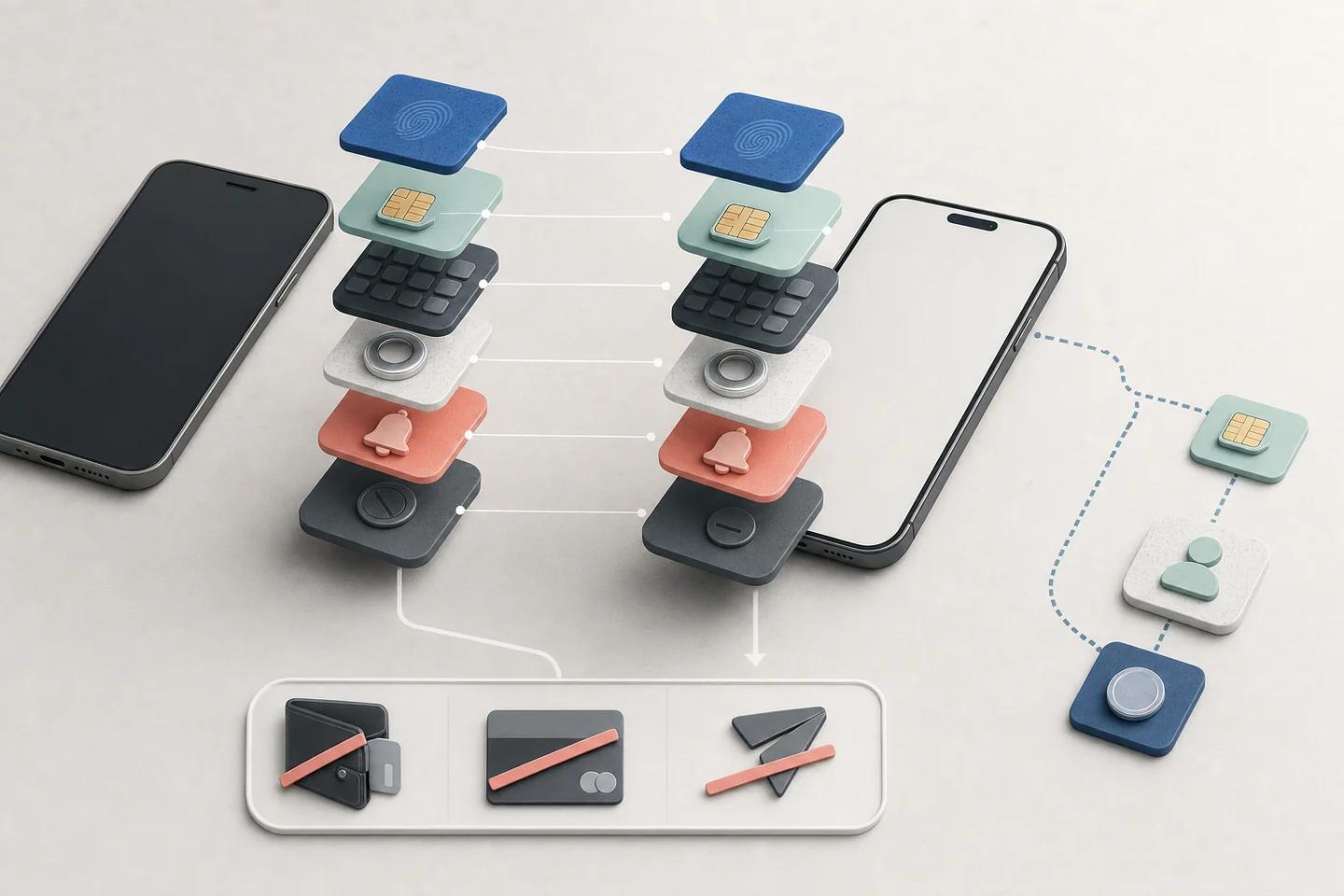
What Does a Device Rebind Actually Hand Over?
Most mobile banking apps bind a cryptographic key, a device identifier or a push-approval channel to one handset at enrolment. From then on, that handset approves logins, confirms payments and receives transaction alerts. Rebinding moves all of that to a new phone. If the new phone belongs to an attacker, every later in-app approval comes from them, and the real customer stops seeing alerts.
That is why the rebind is a favourite takeover step. An attacker who has phished a password still cannot move money while push approval sits on the victim's phone. Getting the bank to bind a new device removes the obstacle in one request, and the request usually looks routine because customers replace phones all the time.
How Attackers Get a Bank to Trust Their Phone
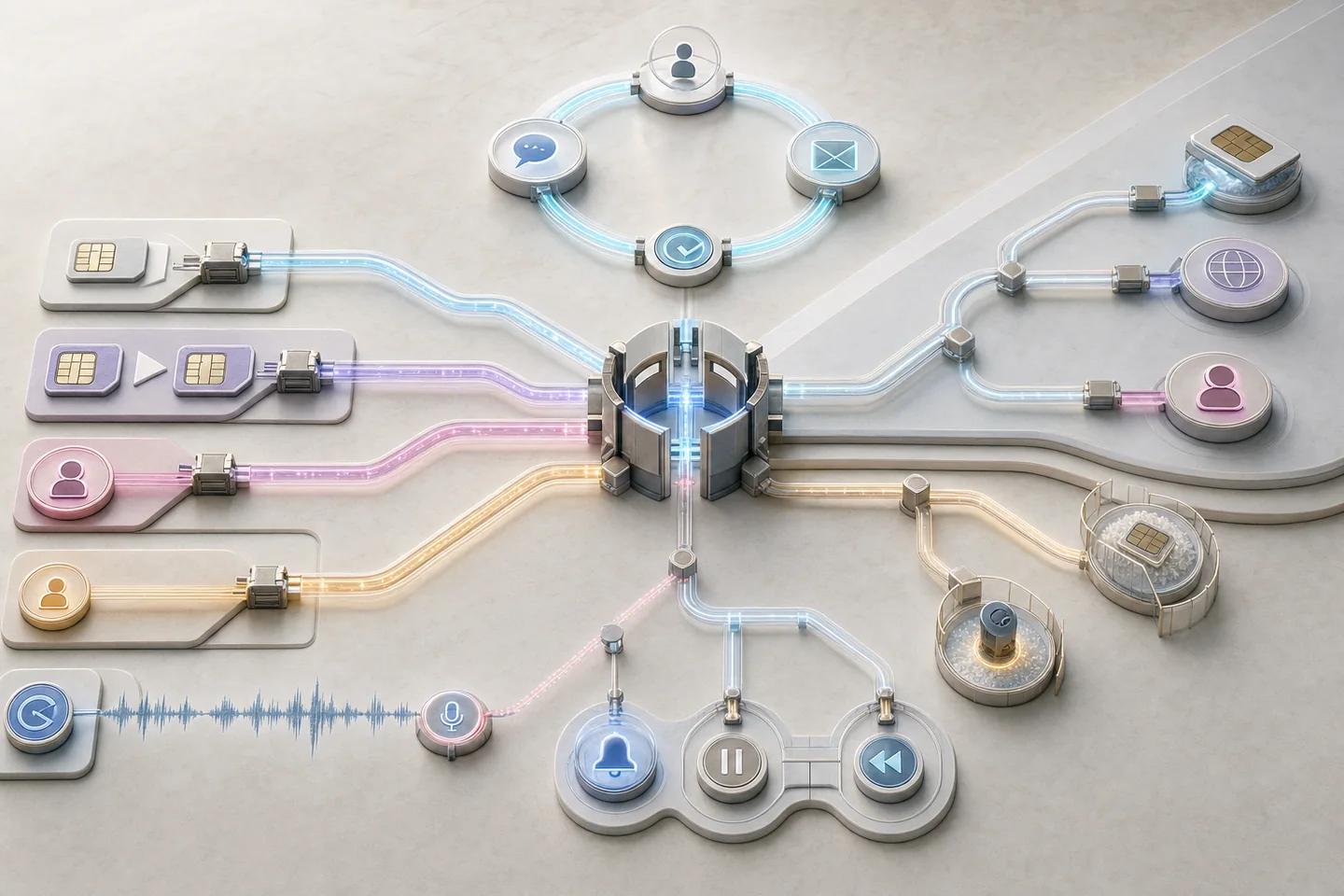
The common route runs through the phone number. A SIM swap or port-out moves the victim's number to the attacker's SIM, after which SMS codes sent for the rebind land on the attacker's handset. The FCC's order FCC 23-95, published in the Federal Register on 8 December 2023 and effective from 8 January 2024 for most provisions, responded to this by requiring US wireless carriers to use secure authentication before a SIM change and to notify customers immediately, before the change or port-out takes effect.
When SMS is not enough, attackers move to the fallback. Many banks fall back to a selfie or video check when the customer says the old phone was lost. FinCEN's November 2024 alert FIN-2024-Alert004 describes attackers using third-party webcam plugins to show pre-generated video during live verification, and the FBI's December 2024 PSA I-120324 describes AI-generated audio used to get into bank accounts. A rebinding selfie taken on a phone the attacker controls is exactly where a virtual camera or face swap would be fed in.
Help desks are the third route. A caller who claims a broken phone and has the victim's personal data can ask an agent to reset device binding over the phone.
Mobile Banking Device Rebinding Security Controls, Step by Step
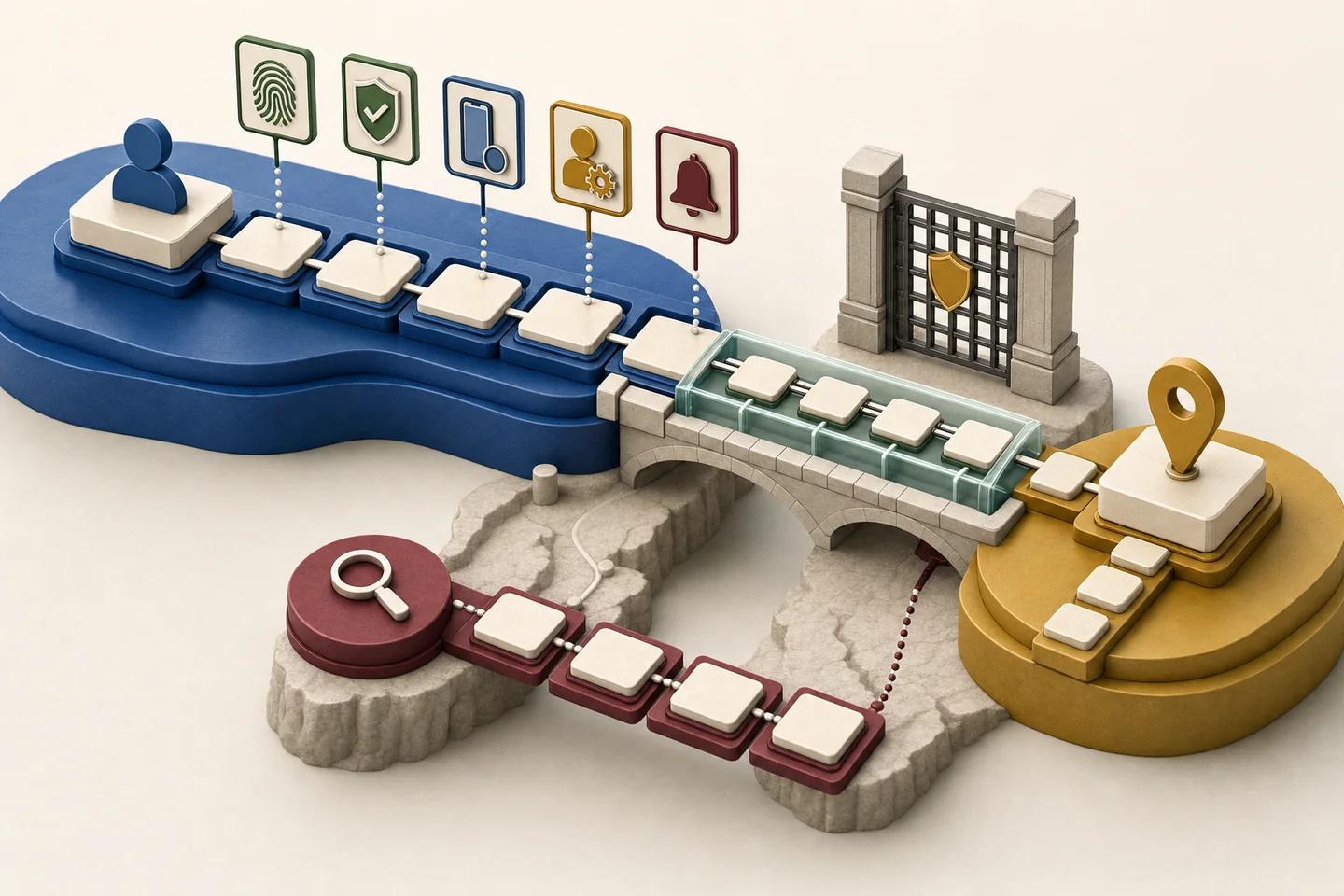
Pick the strongest path the customer can still complete, and make the weaker paths progressively slower and more limited.
Delay matters as much as verification. A legitimate customer replacing a phone rarely needs to add a new payee in the first hour; an attacker almost always does. A 24 to 72 hour restriction on new payees and limit increases after a fallback rebind costs genuine customers little and removes most of the attacker's payoff. Pick the window by product risk and local rules.
- Query recent SIM change and port-out signals for the registered number where your market offers them.
- Check device integrity on the new handset (rooting, emulators, hooking frameworks) before binding any key.
- Notify the old device and the registered email that a new device is being added, with a way to stop it.
- Invalidate the old device's keys once the new binding is confirmed.
| Situation | Preferred path | Extra checks | After binding |
|---|---|---|---|
| Old device available | Approve the new device from the old app or by scanning a code shown on the old screen | Device integrity check on the new handset | Normal limits; alert on both devices |
| Old device lost, number unchanged | Second registered authenticator or passkey | Check for SIM change or port-out in recent days | Short payee and limit hold |
| Old device lost, no other factor | Selfie or video re-verification in your SDK | Deepfake and virtual camera screening; compare with onboarding portrait | Longer hold; confirm through an established channel |
| Recent SIM swap or number port | Do not rely on SMS | Branch, video review or other strong fallback | Treat as high risk until confirmed |
Why Does the Rebinding Selfie Need Deepfake Screening?
Because at rebinding the attacker usually holds the device doing the capture. On a compromised or emulated phone, the camera feed can be replaced by a virtual camera playing a face swap built from the victim's photos, and a basic liveness prompt such as blinking or turning the head can be answered by real-time face reenactment. Liveness checks were designed for masks and printed photos held in front of a genuine camera; injected streams bypass the camera entirely.
Screening should therefore look at the pixels and at the capture context. Signals of face manipulation, generative-model artefacts and pixel-level edits catch synthetic faces; capture inside your own SDK, with device integrity checks, makes injection harder. Neither replaces the comparison with the onboarding portrait, which confirms the face belongs to the account holder.
Where Neural Defend NeuroVerify Fits
NeuroVerify runs on the fallback selfie or short video. One API call returns a unified risk score with evidence from six signals, including Live Presence Verification, Face Manipulation Detection, AI Generative Model Analysis and AI Pixel-Level Manipulation. On eligible image requests the p95 response time is under 200 ms under defined test conditions, so the check does not stall the rebind screen.
The Android, iOS and Flutter SDKs capture inside the banking app, and backend SDKs for Python, TypeScript, Go and Java let the server call the API directly. Integration is two lines, and banks that need to keep biometric data in their own environment can run it in a private cloud, on-premises or air-gapped. Neural Defend holds ISO/IEC 27001, ISO/IEC 27701, ISO/IEC 42001 and SOC 2 Type II.
The detector draws on ARCAS 1B, whose arXiv paper reports pooled accuracy of 99.82% on AIGC-Detect and 97.74% on Community Forensics. Your rebinding policy still decides: NeuroVerify reports what it sees in the media and leaves the binding decision to rules that also weigh SIM signals, device integrity and account history.
What to Record, and What Detection Will Miss
Keep the binding history for each account: old and new device identifiers, the path used, SIM and port-out signals at the time, notifications sent, the selfie risk score and model version, the agent or rule that approved the bind, and every payee or limit change in the following days. When a customer disputes a payment from a new device, that record shows whether the bind was the failure point.
Detection will miss social engineering in which the real customer is talked into approving a new device from their old phone, or reads a one-time code to a caller. Customer-facing wording on approval screens (for example, stating plainly that the bank will never ask them to approve a device for someone else) and alerts on both handsets do more against that pattern than any media check.
Evidence boundary
Limitations
- Deepfake screening cannot stop a genuine customer who is persuaded to approve a new device or read out a code.
- SIM change and port-out signals are not available from every carrier or market.
- Performance claims for NeuroVerify on video and injected streams should be measured in a pilot on your own devices; public still-image benchmarks do not cover them.
- This page is operational guidance and not legal advice on authentication rules in any jurisdiction.
Source record
Sources and references
- National Institute of Standards and TechnologySP 800-63B-4, Authentication and Authenticator ManagementPublished July 31, 2025. Verified October 19, 2026.
- Federal RegisterProtecting Consumers From SIM-Swap and Port-Out Fraud (FCC 23-95)Published December 8, 2023. Verified October 19, 2026.
- Financial Crimes Enforcement NetworkFinCEN Alert on Fraud Schemes Involving Deepfake Media Targeting Financial Institutions (FIN-2024-Alert004)Published November 13, 2024. Verified October 19, 2026.
- FBI Internet Crime Complaint CenterCriminals Use Generative Artificial Intelligence to Facilitate Financial Fraud (PSA I-120324)Published December 3, 2024. Verified October 19, 2026.
- Reserve Bank of IndiaMaster Directions on Cyber Resilience and Digital Payment Security Controls for non-bank Payment System OperatorsPublished July 30, 2024. Verified October 19, 2026.
- arXivBenchmarking Neural Defend ARCAS 1B: A Foundational Multimodal Deepfake Detection ModelPublished September 21, 2026. Verified October 19, 2026.