How zero-shot voice cloning works from short reference audio
Zero-shot voice cloning produces speech in the voice of someone the model never saw during training. The system listens to a short reference clip, compresses the speaker's vocal identity into a numerical representation, and then generates new sentences conditioned on that representation. No retraining or fine-tuning happens for the new speaker, which is what "zero-shot" means.
Older cloning methods needed hours of studio recordings of the target and a training run per voice. Zero-shot systems moved the expensive learning upfront: the model learns what voices in general sound like from thousands of speakers, so at use time it only has to place one more voice inside a space it already understands.
The three-stage design that made it practical
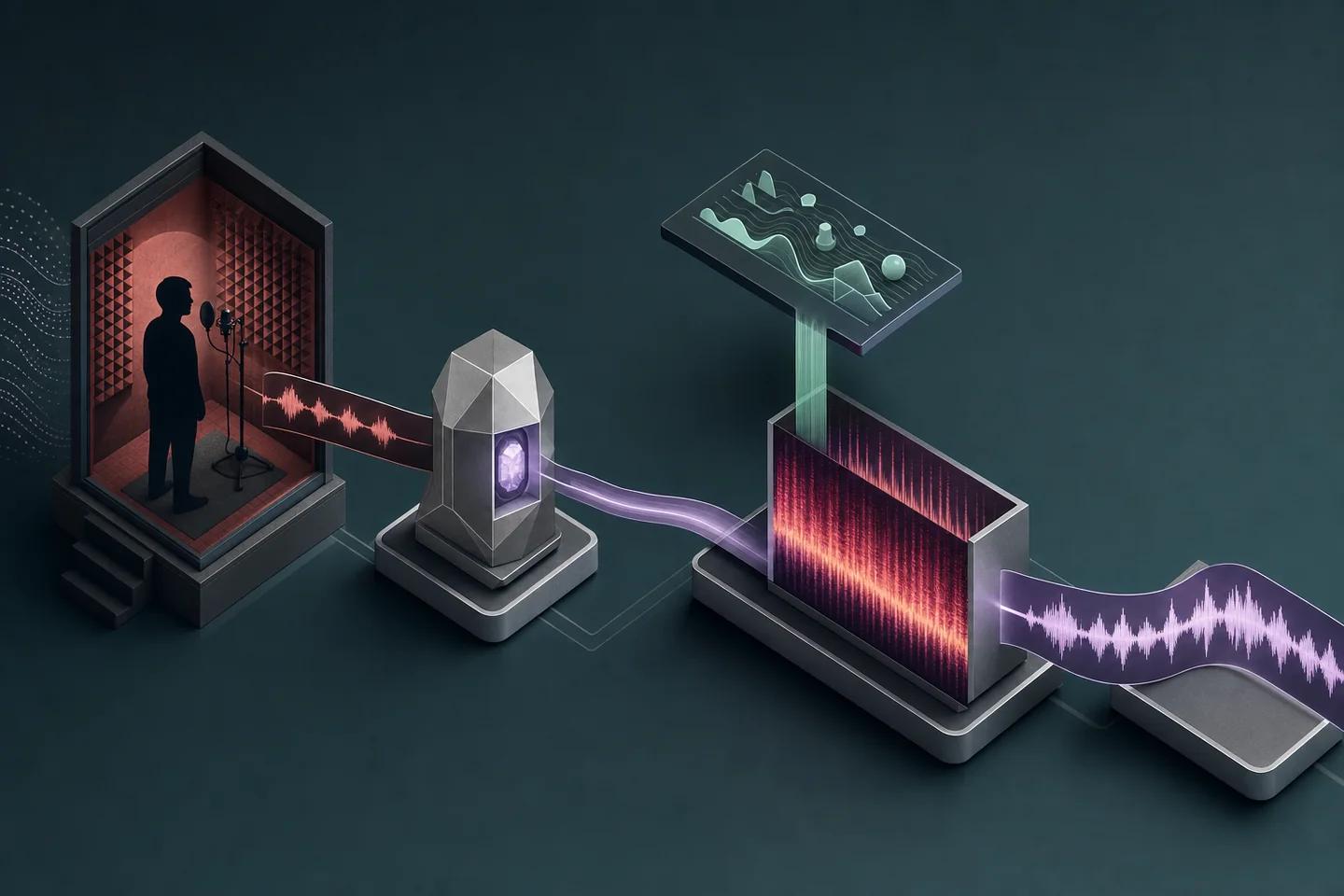
Google researchers set out the template in June 2018 in "Transfer Learning from Speaker Verification to Multispeaker Text-To-Speech Synthesis" (often called SV2TTS). It joins three separately trained parts.
The speaker encoder was first trained for speaker verification, the task of telling whether two clips come from the same person. Because it learned to separate thousands of speakers, its output embedding captures timbre, pitch range and accent while ignoring the words spoken. The paper's point was that seconds of reference speech are enough to produce a usable embedding.
A Tacotron 2 style network then turns text into a mel spectrogram, conditioned on that embedding. A WaveNet vocoder converts the spectrogram into a waveform. Each stage could be trained and improved on its own, so later systems swapped in better synthesisers and faster vocoders without changing the overall design.
| System | Date | Key idea | Reference audio stated |
|---|---|---|---|
| SV2TTS (Google) | June 2018 | Speaker-verification encoder conditions a Tacotron 2 synthesiser and WaveNet vocoder | "Seconds" of reference speech |
| VALL-E (Microsoft) | January 2023 | Treats speech as discrete audio-codec tokens and predicts them with a language model trained on 60,000 hours of English | 3-second enrolled recording |
Why codec language models raised the bar in 2023
In January 2023 Microsoft researchers published VALL-E, which reframed speech synthesis as language modelling. A neural audio codec turns speech into sequences of discrete tokens. The model reads the text plus the tokens of a 3-second enrolled recording, then predicts the codec tokens that should follow, and the codec decoder turns them back into audio.
Scale did much of the work. VALL-E was pre-trained on 60,000 hours of English speech, hundreds of times more than earlier TTS corpora. Because the prompt is treated as a continuation, the model copies more than timbre: it carries over the room acoustics and the speaking style of the reference clip. A clip lifted from a phone video comes back sounding like a phone video, which makes the output more believable on a call.
What short-sample cloning changed for fraud
Short reference requirements removed the main barrier to impersonation. A few seconds of voicemail greeting, a conference talk or a social video is now enough raw material. Starling Bank's September 2024 survey of UK adults found 28% said they had been targeted by an AI voice cloning scam in the previous year, and 46% had never heard of this kind of scam.
Law enforcement says the same. The FBI's December 2024 public service announcement warned that criminals create short audio clips imitating a relative in crisis to demand money or a ransom, and use cloned voices to get into bank accounts. Its advice includes agreeing a secret word with family and calling back on a number you look up yourself.
Where short-sample clones still fall short
A 3-second prompt carries timbre and recording conditions well, but it carries little about how a person argues, hesitates or reacts. Clones built from short clips tend to have steady, even pacing, limited emotional range and uncertain handling of names, numbers and words the speaker uses unusually. They also struggle with spontaneous interruption, which is why scripted scam calls push urgency and discourage questions.
Attackers work around these gaps rather than solving them. They keep calls short, add background noise such as a siren or a crowded room, hand the call to a second "official" with their own voice, or switch to a speech-to-speech converter that lets a human drive the conversation in real time. The FBI's May 2025 warning about cloned voices of senior US officials noted that clones can sound nearly identical to the real person, so listeners should look for call lag or mismatched voice patterns but should not rely on tone alone.
Can zero-shot clones be detected?
Yes, often, but not by ear. Zero-shot clones leave statistical traces in phase, fine spectral structure and the codec or vocoder used to produce them. Anti-spoofing research tracks these traces through the ASVspoof challenges; the 2024 edition, ASVspoof 5, added crowdsourced recordings from many more speakers and, for the first time, adversarial attacks designed to fool detectors.
Detection gets harder when the clone is played through a phone line, because narrowband codecs and packet loss strip out some of the evidence. Every new generator family also needs fresh training data on the detection side. That is why detection should be one signal in a call-handling policy, alongside callback rules and limits on what an agent can change during a single call.
Neural Defend's NeuroCall, currently in Beta, is built for this setting: it analyses call audio for synthetic speech and returns a risk signal for your policy to act on. For uploaded clips that need a reviewed, explainable result, NeuroDetect shows audio-segment level evidence and produces a forensic report.
Evidence boundary
Limitations
- The reference-audio figures here come from research papers and a bank's consumer warning; commercial cloning tools vary and are not documented consistently.
- Detection performance on zero-shot clones drops on narrowband phone audio and on generator families absent from training data.
- NeuroCall is in Beta, and no public benchmark result for it is cited on this page.
Source record
Sources and references
- arXivTransfer Learning from Speaker Verification to Multispeaker Text-To-Speech SynthesisPublished June 12, 2018. Verified October 19, 2026.
- arXivNeural Codec Language Models are Zero-Shot Text to Speech Synthesizers (VALL-E)Published January 5, 2023. Verified October 19, 2026.
- Starling BankStarling Bank launches Safe Phrases campaignPublished September 18, 2024. Verified October 19, 2026.
- FBI Internet Crime Complaint CenterCriminals Use Generative Artificial Intelligence to Facilitate Financial Fraud (I-120324-PSA)Published December 3, 2024. Verified October 19, 2026.
- arXivASVspoof 5: Crowdsourced Speech Data, Deepfakes, and Adversarial Attacks at ScalePublished August 16, 2024. Verified October 19, 2026.
- Federal Trade CommissionScammers use AI to enhance their family emergency schemesPublished March 20, 2023. Verified October 19, 2026.
- FBI Internet Crime Complaint CenterSenior US Officials Impersonated in Malicious Messaging Campaign (I-051525-PSA)Published May 15, 2025. Verified October 19, 2026.